Papers
Topics
Authors
Recent
2000 character limit reached

The Discovery Engine: A Framework for AI-Driven Synthesis and Navigation of Scientific Knowledge Landscapes (2505.17500v1)

Published 23 May 2025 in cond-mat.soft and cs.AI

Abstract: The prevailing model for disseminating scientific knowledge relies on individual publications dispersed across numerous journals and archives. This legacy system is ill suited to the recent exponential proliferation of publications, contributing to insurmountable information overload, issues surrounding reproducibility and retractions. We introduce the Discovery Engine, a framework to address these challenges by transforming an array of disconnected literature into a unified, computationally tractable representation of a scientific domain. Central to our approach is the LLM-driven distillation of publications into structured "knowledge artifacts," instances of a universal conceptual schema, complete with verifiable links to source evidence. These artifacts are then encoded into a high-dimensional Conceptual Tensor. This tensor serves as the primary, compressed representation of the synthesized field, where its labeled modes index scientific components (concepts, methods, parameters, relations) and its entries quantify their interdependencies. The Discovery Engine allows dynamic "unrolling" of this tensor into human-interpretable views, such as explicit knowledge graphs (the CNM graph) or semantic vector spaces, for targeted exploration. Crucially, AI agents operate directly on the graph using abstract mathematical and learned operations to navigate the knowledge landscape, identify non-obvious connections, pinpoint gaps, and assist researchers in generating novel knowledge artifacts (hypotheses, designs). By converting literature into a structured tensor and enabling agent-based interaction with this compact representation, the Discovery Engine offers a new paradigm for AI-augmented scientific inquiry and accelerated discovery.
Summary

  • The paper introduces the Discovery Engine, an AI-driven framework converting heterogeneous scientific literature into a computable knowledge landscape.
  • It leverages a Conceptual Nexus Model to structure interconnected scientific components into a high-dimensional tensor navigable by AI agents.
  • The framework enhances gap analysis and hypothesis generation, promising to accelerate discoveries across diverse scientific fields.

The Discovery Engine: A Framework for AI-Driven Synthesis and Navigation of Scientific Knowledge Landscapes

This paper introduces the Discovery Engine (DE), a novel framework addressing the growing challenges of scientific knowledge dissemination, exacerbated by the exponential increase in research publications. The DE aims to convert disparate scientific literature into a coherent, computable format that significantly enhances both machine and human exploration capabilities of scientific domains.

Introduction

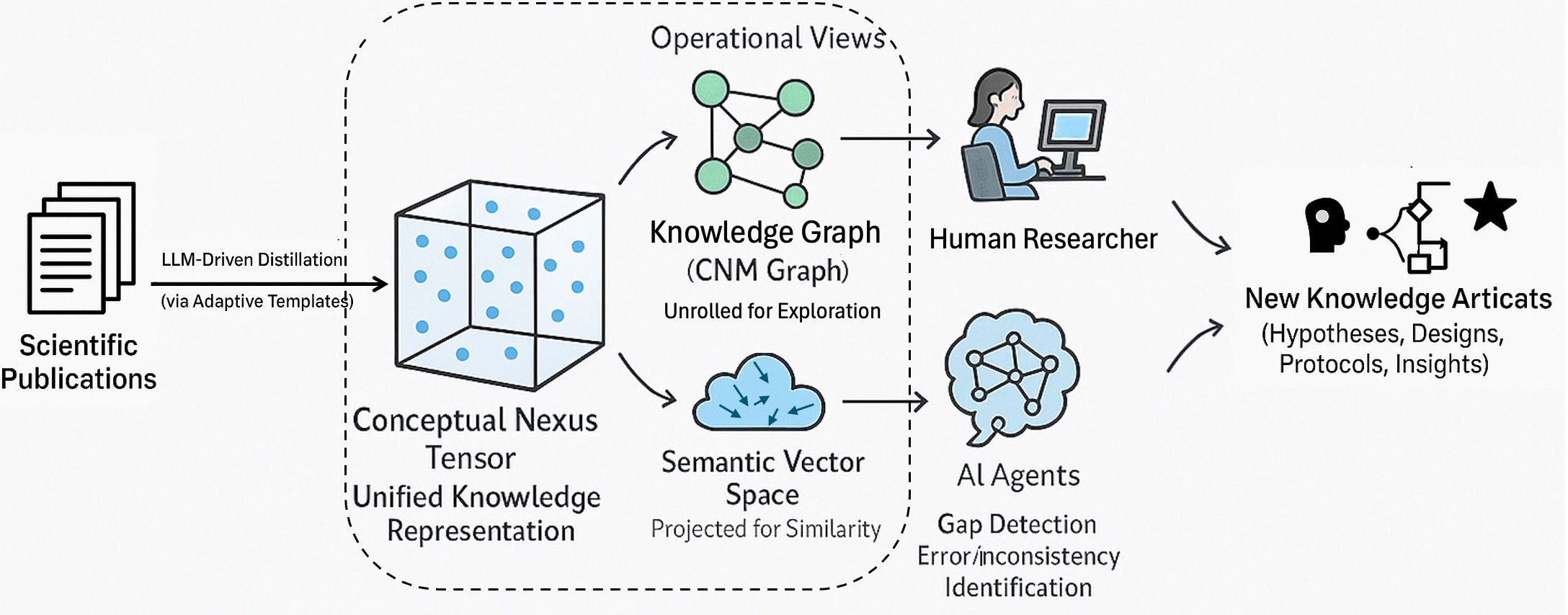
The traditional model of scientific communication, primarily through peer-reviewed publications, is increasingly inadequate due to the sheer volume of scientific output, leading to information overload and other systemic issues like reproducibility crises. The DE reimagines scientific knowledge compilation by leveraging AI-driven distillation to create "knowledge artifacts" encapsulated as a Conceptual Tensor. This tensor efficiently represents interconnected components such as concepts, methods, and their interdependencies. Figure 1

Figure 1: Conceptual Nexus Model for distillation into machine-readable format for exploration and discoveries.

Conceptual Nexus Model (CNM)

The CNM is central to the DE's methodology, serving as a dynamic and structured representation of a scientific field. The model transforms heterogeneous publication content into a high-dimensional Conceptual Nexus Tensor. This tensor forms the DE's backbone by indexing scientific components and their quantitative interdependencies, allowing AI agents to navigate and manipulate this compressed knowledge structure.

Knowledge Representation and AI Agents

AI agents play a pivotal role by interacting with the CNM, performing operations to explore the knowledge landscape, identify gaps, and assist in generating new "Knowledge Artifacts" like hypotheses and designs. By converting literature into a tensor-based format, the DE enables AI agents to perform complex reasoning and generate insights directly from the structured knowledge.

Synthesis and Gap Analysis

The DE's ability to dynamically synthesize a scientific field's landscape involves identifying emergent patterns, thematic clusters, and inconsistencies within the synthesized CNM. This creates a living model of the field, continuously evolving with new literature and insights.

Interaction and Discovery

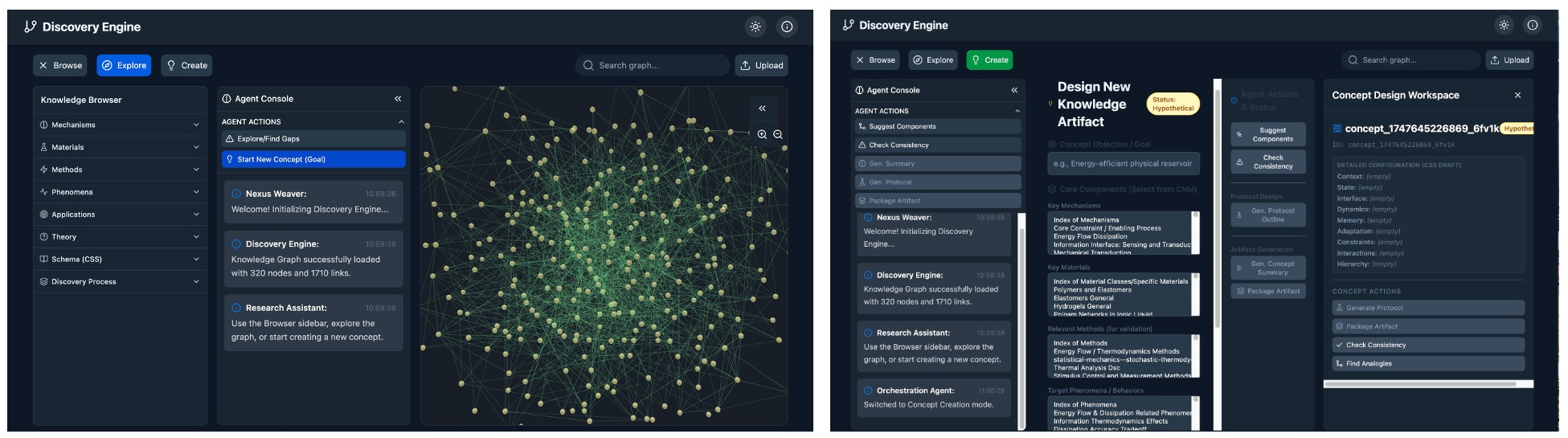
The Discovery Engine offers an interactive platform where researchers can explore and interact with the CNM. AI agents aid human researchers by navigating this landscape and proposing novel hypotheses grounded in the synthesized knowledge, thus fostering new scientific discoveries. Figure 2

Figure 2: User Interface (UI) for the DE platform, designed through an AI-assisted process.

Implementation and Future Directions

Implementing the DE requires advancements in NLP for nuanced scientific text understanding and careful management of evolving templates. Future work will enhance the DE's ability to integrate deeply semantic and causal relationships, scale across various fields, and offer richer AI-agent capabilities.

Conclusion

The Discovery Engine represents a significant step towards transforming scientific inquiry. By providing a structured, AI-enhanced approach to navigating and synthesizing scientific knowledge, the DE aims to augment human intellect and accelerate scientific discoveries by systematically identifying gaps and facilitating hypothesis generation.

Through this framework, the DE offers a pathway to overcome traditional barriers in scientific communication, paving the way for a more integrated and computationally accessible approach to scientific exploration and discovery.

Slide Deck Streamline Icon: https://streamlinehq.com

Whiteboard

Dice Question Streamline Icon: https://streamlinehq.com

Open Problems

We haven't generated a list of open problems mentioned in this paper yet.

List To Do Tasks Checklist Streamline Icon: https://streamlinehq.com

Collections

Sign up for free to add this paper to one or more collections.