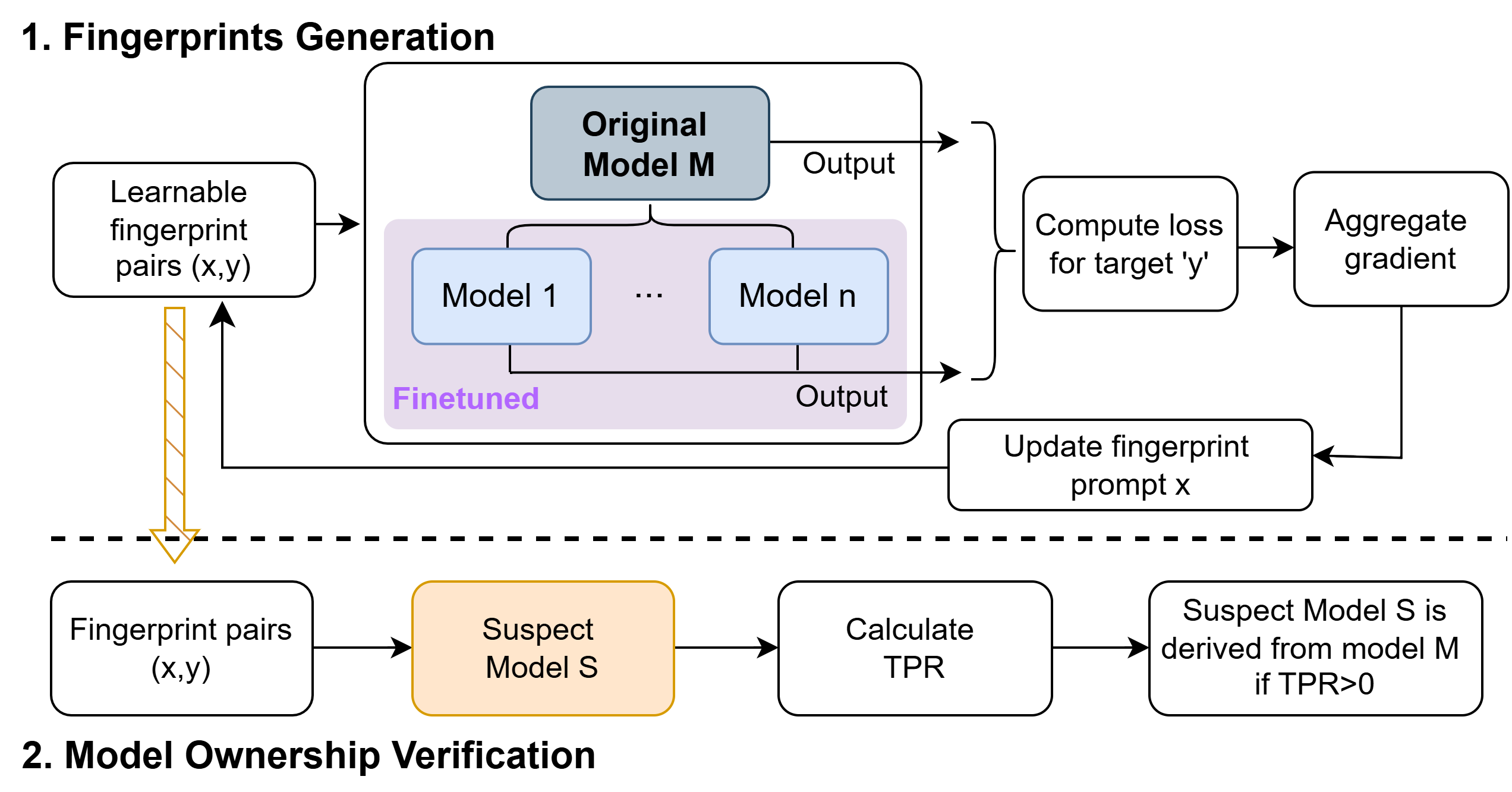
- The paper introduces RoFL, a protocol generating rare prompt-response pairs to fingerprint LLMs and achieve 100% true positive rate on base models.
- It employs discrete optimization and multi-task prompt synthesis to maintain robust identification even after fine-tuning, quantization, and prompt variations.
- Experimental results show high resilience against common modifications and attacks, outperforming traditional watermarking methods in black-box verification.
Robust Fingerprinting of LLMs: A Technical Synthesis of RoFL
Motivation and Problem Setting
The increasing commercial deployment of LLMs has heightened concerns around intellectual property (IP) protection, especially given the proliferation of restrictive licensing schemes and the substantial economic cost of model training. Conventional software similarity detection methods are ineffectual for LLMs due to the plasticity of floating-point parameters and the ease of adaptation through fine-tuning and quantization. Furthermore, model theft often occurs in scenarios where only black-box API access to stolen or adapted models is available, precluding inspection of weights. Thus, robust black-box identification methods that withstand typical model modifications are critical.
The RoFL Scheme: Functional Overview and Security Properties
RoFL (Robust Fingerprinting of LLMs) introduces a fingerprinting protocol that enables black-box verification of model ownership, grounded in the following design:
The fingerprint generation procedure comprises random prompt initialization, greedy decoding for response synthesis, and discrete optimization (GCG) to maximize the likelihood of the fingerprint response under the model. Multi-task prompt optimization over adapted model variants further enhances robustness by enforcing invariance across system prompt and downstream adaptations.
RoFL satisfies critical security desiderata:
- Robustness: High TPR for models subject to common modifications (SFT, LoRA, quantization).
- Uniqueness: Fingerprints are lineage-specific, yielding negligible false positive rates when evaluated on unrelated models.
- Unforgeability: Random or externally sourced fingerprints have vanishingly low probabilities of coinciding with valid RoFL fingerprints (D−∣y∣).
- Harmlessness: The scheme does not alter model weights, evading detrimental performance shifts observed in watermark-based approaches.
Experimental Protocol and Key Results
RoFL is evaluated on several open-weights transformer architectures (Llama 2 7B/13B, Llama 3 8B, Mistral 7B), with fingerprints verified on both base and diverse downstream finetuned models. The following strong numerical claims are substantiated:
- Base Model Identification: RoFL achieves 100% TPR across all tested base models, outperforming GCG (max 80%) and IF-Emb (max 100% but with substantial benign accuracy loss).
- Downstream Robustness: For models finetuned on datasets such as Natural Instructions, Dolly, Codegen, and conversational datasets, RoFL yields 92–100% TPR. Competing baselines (IF-SFT, IF-Emb, GCG) experience steep TPR drops (often below 70%).
- Prompt Template Variation: Minimal TPR degradation (10–30%) under prompt template changes; RoFL regularly maintains above 80% TPR, superior to watermark-based and standard GCG approaches.
- Quantization Robustness: RoFL preserves high identification rates with minor accuracy loss up to 8-bit quantization. At 4-bit, TPR falls commensurately with downstream utility, reflecting economic impracticality of extreme quantization.
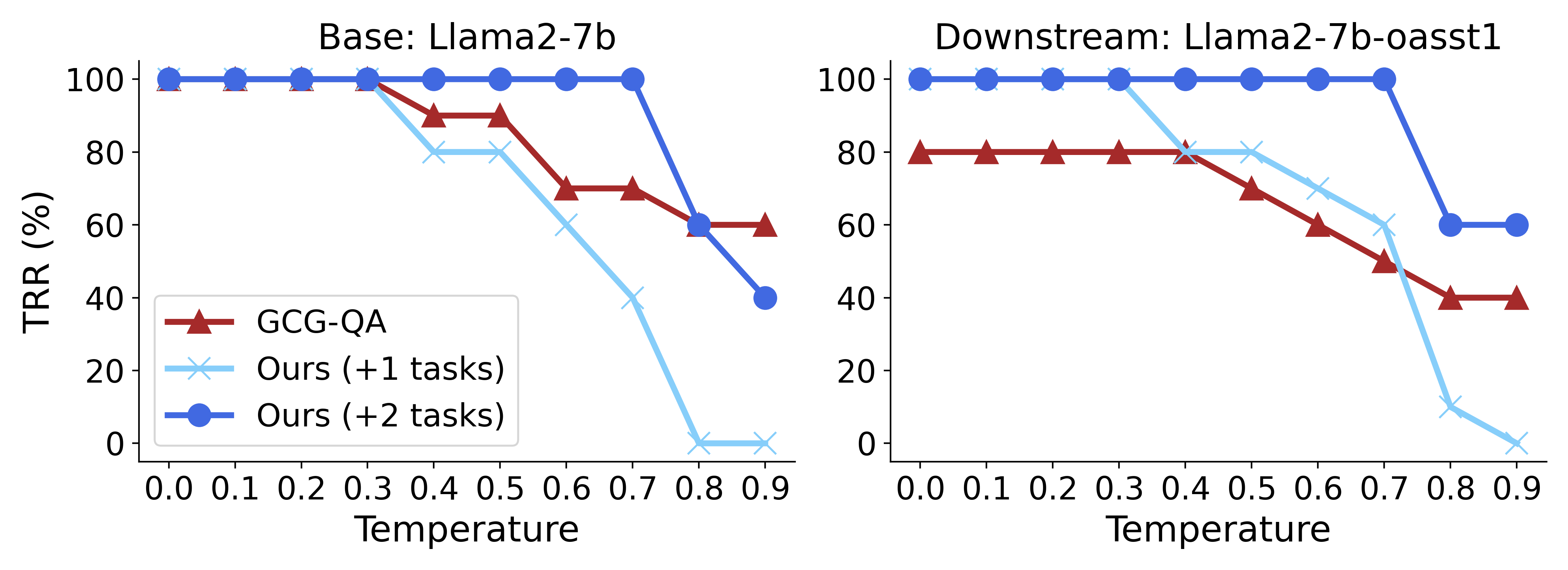
Figure 2: TPR vs. sampling temperature, demonstrating RoFL’s resilience under increasing decoding randomness.
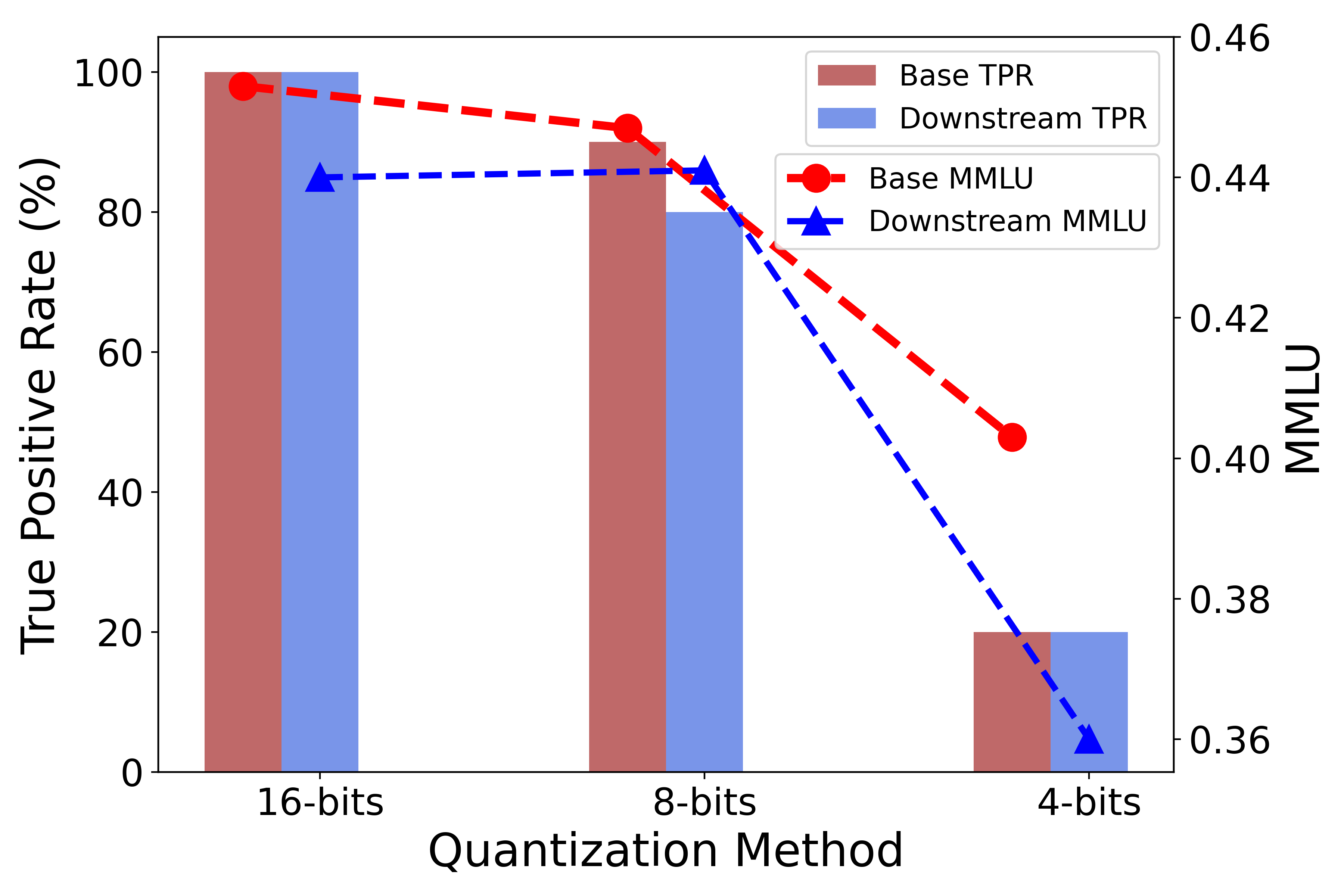
Figure 3: Evaluation of RoFL in the presence of quantization, verifying identification and MMLU score tradeoffs.
Attack Analyses and Protocol Limitations
The work discusses practical threat scenarios, including white-box theft, black-box deployment, fingerprint race, and fingerprint spray, confirming RoFL’s resistance in these cases. Two attacks merit special attention:
- Front-running (Data Poisoning): The attacker can inject fingerprint pairs in the public domain to be absorbed during model training. RoFL’s response is to favor longer fingerprints and deduplication of web-scale data, as the required sample volume for attack escalation rises exponentially with fingerprint length.
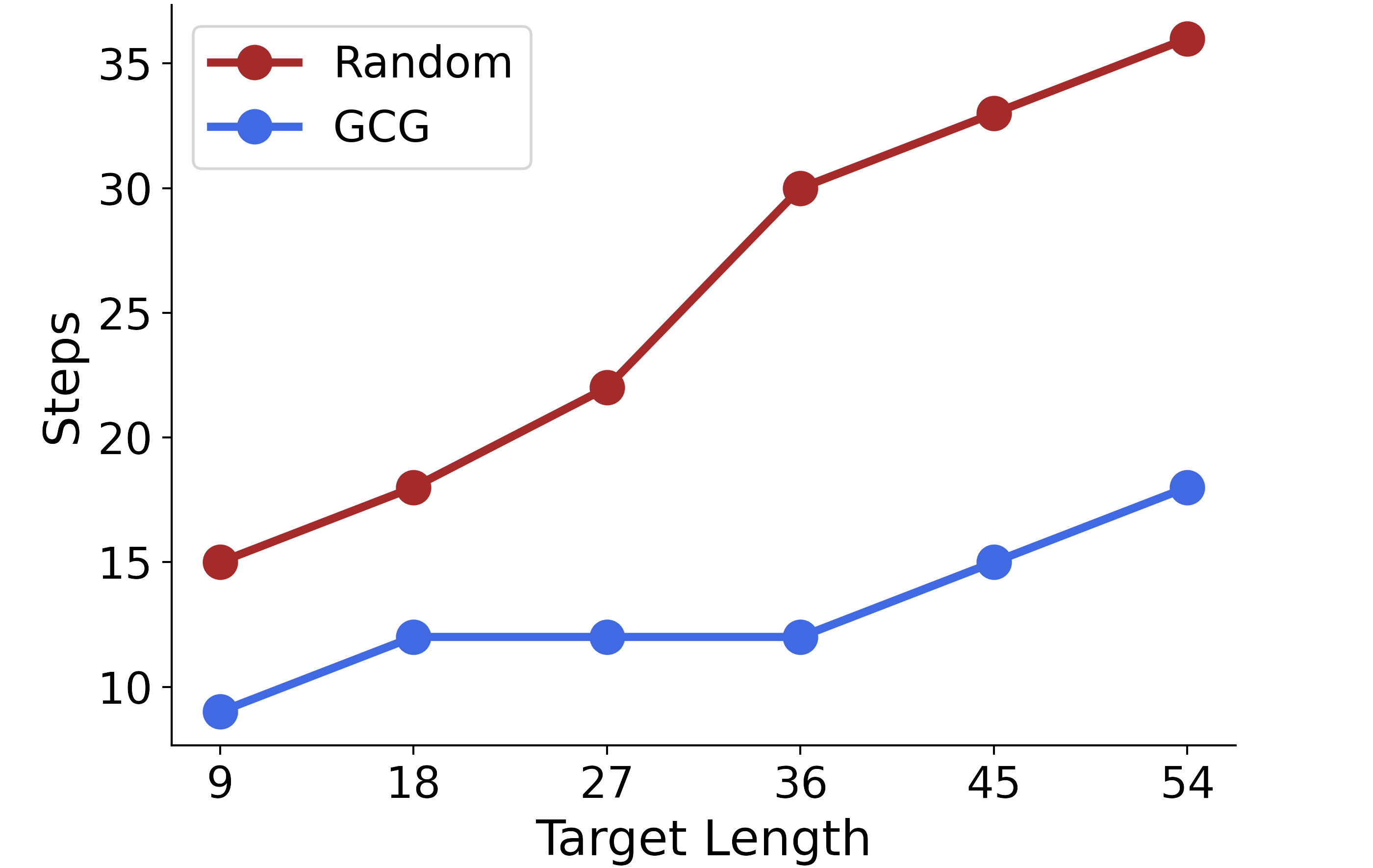
Figure 4: Front-running attack analysis—sample complexity versus fingerprint length for 100% TPR injection.
- Filtering Attacks: RoFL fingerprints survive post-processing filters and perplexity-based rejection protocols, with TPR consistently high even after stringent prompt modifications.
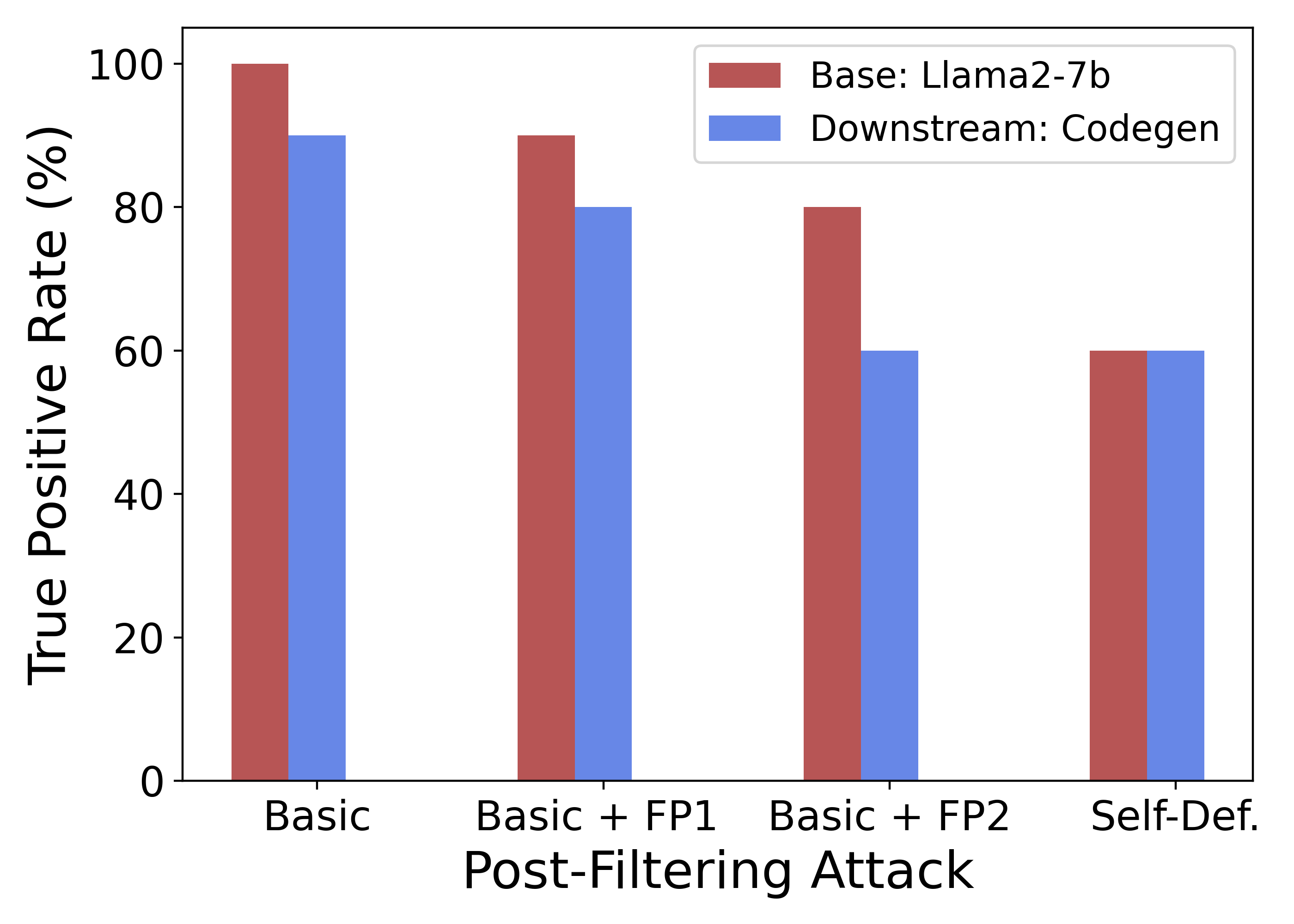
Figure 5: Robustness of RoFL against post-filter attacks—TPR stability under appended filter prompts.
Implications and Outlook
RoFL provides a non-invasive, cryptographically-committable fingerprinting protocol for LLMs, offering a practical means of ownership verification without sacrificing utility and enabling forensic attribution in adversarial deployment scenarios. The methodology sets a benchmark for robustness not matched by watermarking strategies, especially in black-box contexts and under extensive model adaptation.
On the theoretical front, RoFL's lack of formal security proofs stems from elasticity in the model modification space; practical security, however, is demonstrated empirically across a wide operational spectrum. Societally, the deployment of such fingerprinting raises complex privacy and governance issues, with potential for both enhanced accountability and surveillance risk.
Looking forward, exploration of fingerprinting resilience during web-scale training remains critical, specifically in settings with massive, deduplicated corpora. RoFL's statistical pattern mining may inspire future research in dynamic fingerprint rotation and privacy-preserving verification protocols.
Conclusion
RoFL delivers a rigorous solution for robust, harmless, and black-box fingerprinting of LLMs, achieving nearly perfect identification rates across multiple model families and adaptations. Its introduction is significant for computational forensics, digital provenance enforcement, and IP protection in machine learning systems. Future work will address the scalability of fingerprinting in web-scale and regulatory scenarios, balancing the demands of transparency with the imperatives of privacy and free expression.