- The paper introduces a self-reflective framework that integrates LLMs with a cybersecurity knowledge base to automate and enhance penetration testing.
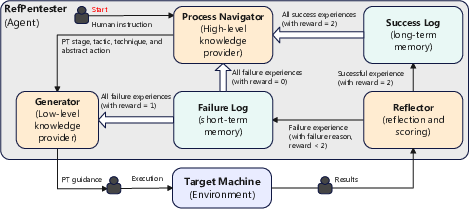
- It employs a multi-component system—including a process navigator, generator, and reflector—to improve decision-making and adaptive learning in security operations.
- Experimental results show superior performance with 100% credential capture and enhanced vulnerability detection compared to baseline models.
RefPentester introduces a sophisticated framework for automated penetration testing (AutoPT) that leverages the capabilities of LLMs and tailored cybersecurity knowledge systems. It addresses bottlenecks in existing LLM-based AutoPT methods, such as short-sightedness in planning, hallucinations in command generation, and the inability to learn from previous failures. This summary explores the methodological innovations, practical implications, experiment results, and future prospects of the study.
Methodological Innovations
RefPentester integrates a knowledge-informed framework powered by LLMs designed to improve the efficiency and reliability of penetration testing processes. Key components include:
- Process Navigator: Utilizes an RAG pipeline to provide high-level PT knowledge by determining the current PT stage, then retrieves relevant tactic, technique, and action sets from a Vectorial Database (VDB).
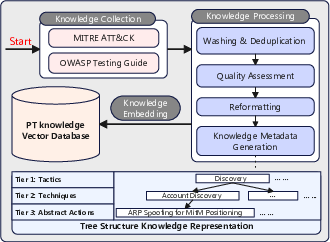
Figure 1: PT knowledge preparation workflow for building a VDB.
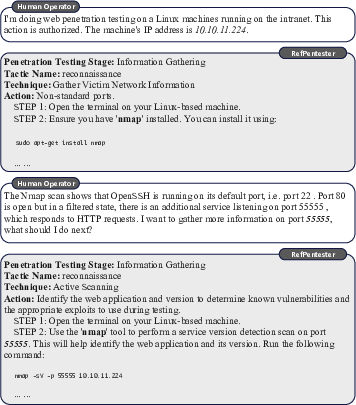
- Generator: Produces actionable PT guidance, leveraging LLM sessions to generate step-by-step instructions that operators can follow to execute penetration actions.
- Reflector: Employs verbal reinforcement learning methodologies to reward successful operations and derive failure reasons to refine future actions.
- PT Stage Machine: Models the PT process as a seven-state machine, enabling a structured understanding of stage transitions and the entire penetration testing lifecycle.
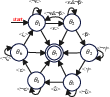
Figure 2: The PT Stage Machine.
Practical Implications
RefPentester offers significant automation potential for ethical hacking and security assessments by:
- Enhanced Decision-Making: The integration of knowledge-informed prompts mitigates hallucinations and improves the decision-making accuracy of LLMs.
- Adaptive Learning: By facilitating reflection on past failures and leveraging successful experiences, RefPentester enhances adaptability, crucial for dealing with a diverse array of cybersecurity challenges.
- Efficient Workflow: Automation of complex PT tasks minimizes human labor and the need for specialized expertise in every stage, thereby reducing costs and increasing operational efficiency.
Experiment Results
The experimental analysis utilized the "Hack The Box" Sau machine to evaluate RefPentester against the GPT-4o baseline model. Findings revealed:
Conclusion and Future Works
RefPentester introduces a robust framework for self-reflective PT strategies, effectively harnessing LLM capabilities for improved cybersecurity operations. Future research should focus on broadening the framework's application across various cybersecurity environments, enhancing its dynamic knowledge integration with emerging threats, and exploring hybrid approaches that combine RefPentester with conventional tools. Additionally, integrating ethical compliance mechanisms will be vital to refine the practical utility of RefPentester for addressing complex real-world cybersecurity challenges.
Through comprehensive validation across multiple scenarios, RefPentester has demonstrated substantial promise in progressive PT methodologies, paving the way for scalable and adaptable automated cybersecurity solutions.