- The paper presents a novel MSC protocol that cultivates logical T states on rotated surface codes using a projective RP² framework.
- It leverages non-local connectivity and innovative code morphing between RP² and self-dual CSS codes to achieve error rates down to 1×10⁻⁹ while significantly reducing space-time costs.
- Monte Carlo simulations validate the protocol’s high survival rate and demonstrate its potential for practical fault-tolerant quantum computation in platforms like neutral atoms and ion traps.
Efficient Magic State Cultivation on RP2
Abstract
The paper presents an innovative approach to preparing logical magic states essential for fault-tolerant quantum computation. It introduces a new Magic State Cultivation (MSC) procedure designed to produce logical T states on rotated surface codes with reduced costs. The protocol defines a novel family of codes, RP2, along with self-dual CSS codes, SRP-3 and SRP-5. By leveraging non-local connectivity and efficient morphing circuits between these codes, the MSC protocol achieves high accuracy and efficiency. Simulation results indicate that the MSC protocol requires significantly lower space-time volume compared to previous methods, reaching logical error rates as low as 10−9.
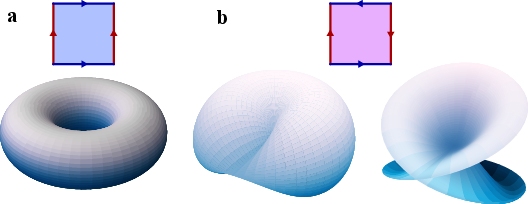
Figure 1: Torus and RP2 obtained by identifying the sides of a square. Red (Blue) arrows on the sides of a square patch are identified.
Introduction to Magic State Cultivation
Fault-tolerant quantum computation (FTQC) is crucial due to the presence of noisy physical operations in quantum computers. Among various codes, rotated surface codes exhibit a high circuit noise threshold and have been demonstrated successfully below this threshold, making them viable for FTQC. The manuscript focuses on preparing T states using a new MSC protocol that reduces the spatial-temporal volume compared to traditional methods. Inspired by recent advancements, the paper builds upon the concept of logical processing and magic state preparations, aiming to efficiently utilize rotated surface codes placed on projective surfaces like RP2.
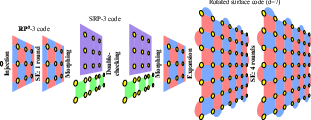
Figure 2: The MSC-3 protocol. Data qubits are marked by yellow circles. Red (blue) tiles represent Pauli X (Z) stabilizers. Each stage of the protocol is illustrated between two code patches.
Code Design and Morphing Protocol
The core concept revolves around constructing RP2-3 and RP2-5 codes and their morphing into self-dual CSS codes, namely SRP-3 and SRP-5. These constructions utilize fold-duality inherent to RP2 codes, permitting efficient transformation between code variants. The SRP codes provide a platform for logical double-checking through transversal single-qubit gates, essential for detecting and correcting logical errors during the cultivation process.
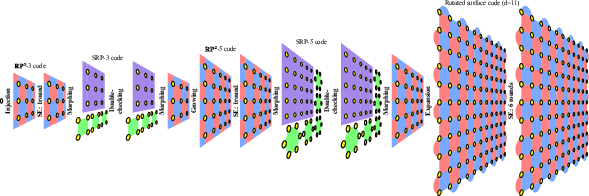
Figure 3: The MSC-5 protocol. Illustration convention follows from Fig.~2. A few stabilizers of the [[35,1,5]] SRP-5 code are illustrated by green hexagons, each representing an X stabilizer and a Z stabilizer.
Simulation and Results
Monte Carlo simulations demonstrate that the new MSC procedure achieves magical T state cultivation with about an order of magnitude less space-time cost compared to traditional methods. Specifically, the protocol maintains a high survival rate through cultivation and expansion processes, reaching logical error rates around 1.5×10⁻⁶ and 1×10⁻⁹.
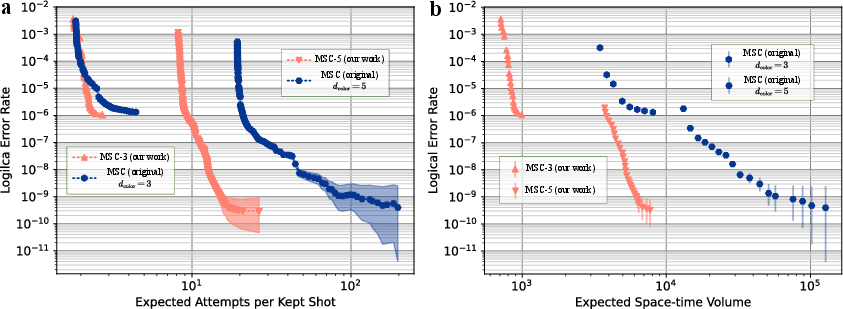
Figure 4: Monte Carlo sampling results under uniform depolarizing circuit noise with space-time cost comparison.
The simulations were benchmarked with surface codes and demonstrated superior performance, particularly in achieving target logical error rates with markedly reduced spatial and temporal resources.
Discussion and Implications
The MSC protocol introduces an architectural shift in quantum computation, offering reduced overhead and increased accuracy while catering to experimental platforms that support non-local connectivity. The projective surface placement of the MSC procedure facilitates easier implementations, particularly in neutral atom arrays and ion trap systems. The paper accentuates the theoretical implications and encourages further exploration into self-dual and fold-dual codes as viable options for enhancing quantum computation fidelity.
Conclusion
The study proposes a promising alternative for magic state preparation, emphasizing efficiency and practicality for fault-tolerant quantum computation systems. The proposed MSC protocol on RP2 platforms illustrates potential in reducing computation resources while maintaining robustness against errors. Future developments may explore broader implications and other applications of the MSC protocol in contemporary quantum computing architectures and experimental validations in neutral atom and ion trap platforms.