- The paper demonstrates a framework using generative AI to create personalized learning paths and adaptive assessments for enhanced student engagement.
- It details the integration of SocratiQ in Harvard’s CS249r course, showcasing dynamic content adjustment and real-time quiz generation through a scalable architecture.
- The study highlights future directions for AI in education, emphasizing open-source access, gamification, and scalability to broaden educational opportunities.
SocratiQ: An AI-Powered Learning Companion
Introduction
The paper on SocratiQ presents an AI-driven educational assistant designed to enhance personalized and interactive learning experiences by implementing the Socratic method. It comprises a generative AI-based framework that dynamically constructs learning paths customized according to students' comprehension and response patterns. By integrating SocratiQ into the machine learning systems textbook, the authors aim to advance the systemic incorporation of generative AI in education, focusing on overcoming pedagogical challenges and expanding the accessibility of high-quality educational resources.
Integration and Features
SocratiQ is embedded into the online Machine Learning Systems course textbook developed for Harvard University’s CS249r course. This integration leverages a variety of AI capabilities to provide personalized explanations, adaptive assessments, bounded learning strategies, and gamified elements to enhance student engagement.
Personalized Explanations
One of the core features of SocratiQ is its ability to tailor explanations at varying difficulty levels, accommodating the range of understanding among learners. This is achieved by adjusting the academic level through a user-interface slider that modifies the LLM's output (Figure 1).
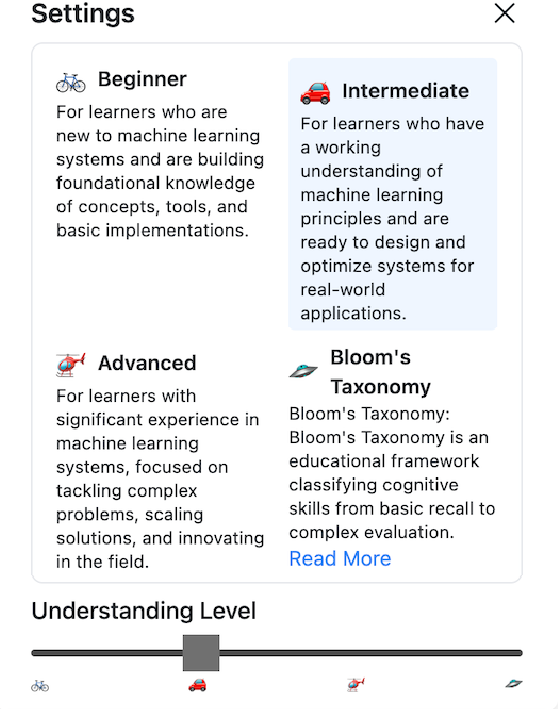
Figure 1: Students can dynamically adjust the academic level to match their learning preferences.
Adaptive Assessment
Adaptive assessments create a personalized evaluation framework where quizzes are dynamically generated, targeting areas yet to be mastered by the student. As students progress through the textbook, a knowledge graph records their reading and quiz performances, providing a clear visual representation of their learning journey (Figure 2).
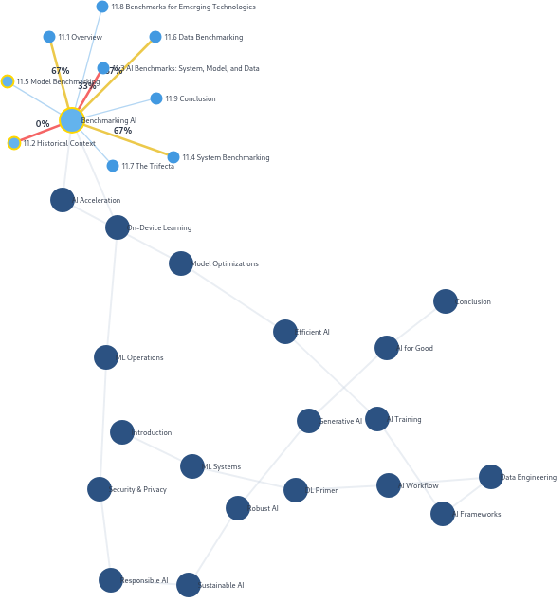
Figure 2: As students progress through the textbook, a knowledge graph is built, tracking their reading progress and quiz performance for each section.
Gamification
SocratiQ incorporates gamification to enhance engagement, featuring interactive elements like badges and progress bars. These elements not only deepen student immersion but also provide insight into their learning progress (Figure 3, Figure 4).

Figure 3: Dashboard showcasing gamification elements, including badges for quiz streaks and progress bars, to enhance engagement and provide learning insights.
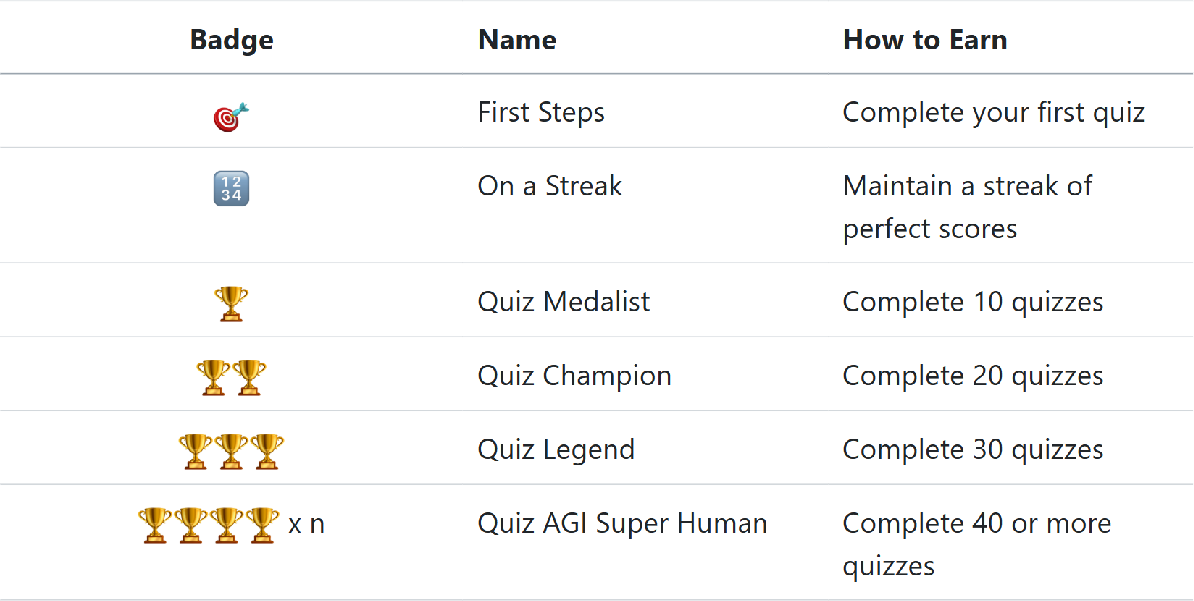
Figure 4: Overview of achievement badges students can earn through quizzes.
System Architecture
The architecture of SocratiQ is divided into the initial setup, learning flow, quiz generation, and gamification. These modules collectively utilize a web interface, local database, Azure serverless functions, and AI models (Figure 5).
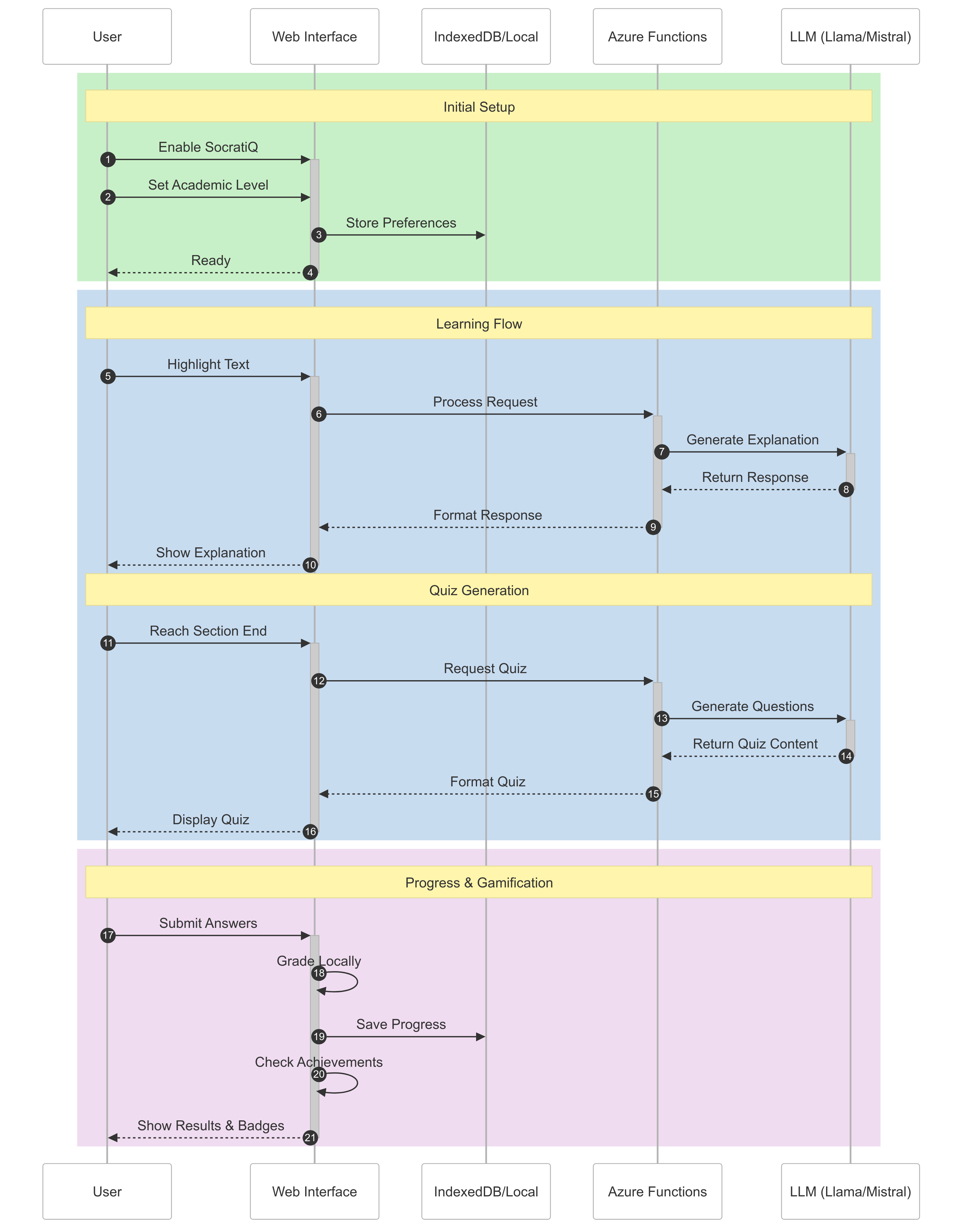
Figure 5: SocratiQ system architecture.
The initial setup involves integrating SocratiQ into any webpage via a JavaScript file, enabling it to index content and serve personalized academic level settings directly to the client-side browser database. The learning flow utilizes cloud-hosted LLMs to process student queries highlighted in the textbook, generating adaptive content in real-time. Quiz generation is initiated by student interaction with embedded quiz buttons, leveraging both caching strategies and dynamic question generation to manage resource use effectively.
Implications and Future Directions
The implementation of SocratiQ marks a significant step in bridging traditional and AI-enhanced educational frameworks. Its multifaceted approach provides consistent, personalized learning paths that are both scalable and economically efficient. As AI models advance, future iterations of SocratiQ could integrate deeper multimodal capabilities, improving the comprehensiveness of educational content delivery.
The challenges in effectively embedding AI into educational contexts remain, particularly in maintaining the instructional integrity and balancing AI's efficiency with the irreplaceable value of human educators. Thus, future developments will require careful collaboration across pedagogical communities to ensure these tools are ethically and effectively aligned with educational goals.
Additionally, the paper demonstrates a commitment to broadening accessibility, evidenced by its open-source textbook catering to a global audience. The optimization strategies discussed address pertinent scalability concerns and pave the way for more inclusive AI-enabled educational opportunities.
Conclusion
SocratiQ represents a promising venture into AI-powered personalized education, demonstrating that generative AI can significantly enhance learner engagement and comprehension across diverse topics in machine learning systems. Its scalable architecture and adaptive features make it a valuable resource for educational institutions aiming to integrate AI into their curriculums. Moving forward, the ongoing evolution of LLMs and AI capabilities will likely fuel further innovations in this field, opening new possibilities for personalized and accessible education worldwide.

