- The paper presents a novel approach by employing six AI agents with distinct personality traits to simulate misinformation persuasion dynamics.
- The paper demonstrates that analytical traits boost evidence-based corrections, achieving up to a 59.4% success rate in countering HIV misinformation.
- The paper underscores non-aggressive, emotionally resonant strategies as effective interventions for enhancing misinformation resistance online.
Introduction
The study outlined in "Personality Modeling for Persuasion of Misinformation using AI Agent" presents a sophisticated approach to understanding the dynamics of misinformation propagation by leveraging AI agents that simulate human personality traits. The paper highlights the use of the Big Five personality model—focusing on Extraversion, Agreeableness, and Neuroticism—to investigate interactions across various misinformation topics. Through 90 unique agent interactions simulated with the AgentScope framework using the GLM-4-Flash model, the study elucidates complex behavior patterns in persuasion and misinformation resistance. These simulations provide empirical insights into designing personality-aware interventions for mitigating misinformation on digital platforms.
Methodology
The study employed a set of six AI agents each characterized by distinct personality traits corresponding to the Big Five model. The agents were programmed to simulate interactions across six misinformation topics: HIV as a biological weapon, QAnon conspiracy, 5G health impacts, MMR vaccine myths, fluoridation concerns, and superfood health claims. The agents engaged in pairwise discussions resulting in outcomes of persuasion, resistance, or bilateral influence.
The experimental setup involved agents with varying levels of Extraversion, Agreeableness, and Neuroticism, using the AgentScope framework to model interactions. The GLM-4-Flash model facilitated personality-specific dialogue, allowing the analysis of how different personality traits influence misinformation dynamics. This approach provided a basis for understanding agent interactions and outcomes based on personality traits.
Results
Personality-Driven Dynamics:
The results demonstrated significant correlations between personality profiles and misinformation dynamics. Notably, agents with critical and analytical traits (i.e., Agent 4) were more effective in evidence-based discussions, achieving a 59.4% success rate in misinformation correction in HIV-related conversations against sensitive counterparts (i.e., Agent 5). This highlights the role of analytical disposition in managing misinformation through rational discourse.
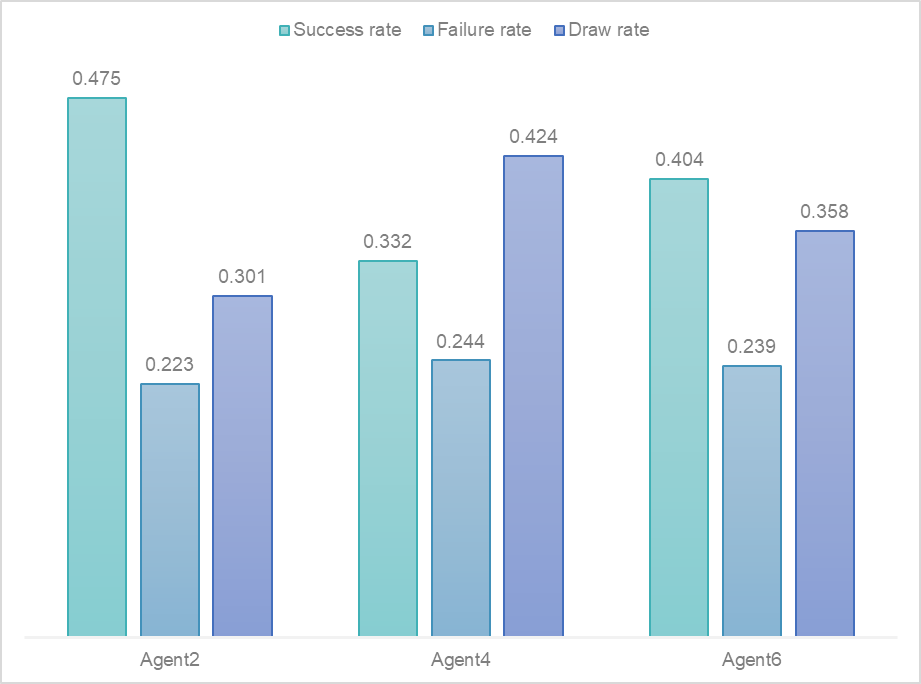
Figure 1: Comparative Analysis of Agent 1's Interaction Outcomes with Agents 2, 4, and 6: Success Rates (47.5%, 33.2%, 40.4%), Failure Rates (22.3%, 24.4%, 23.9%), and Draw Rates (30.1%, 42.4%, 35.8%).
Unexpectedly, Agent 5 demonstrated proficiency in persuasion in specific scenarios, achieving a 55.2% persuasion rate in MMR misinformation discussions against a more resilient agent (i.e., Agent 6). This observation suggests nuanced dynamics where empathetic communication contributes to effective persuasion.
Effectiveness of Non-Aggressive Strategies:
The study underscored the efficacy of non-aggressive persuasion strategies, where agents exhibiting non-confrontational tactics (i.e., Agents 1 and 3) consistently outpaced others in achieving persuasion success rates across multiple interactions. These strategies emphasized emotional connection and trust-building, reaffirming the potential for such approaches in misinformation correction.
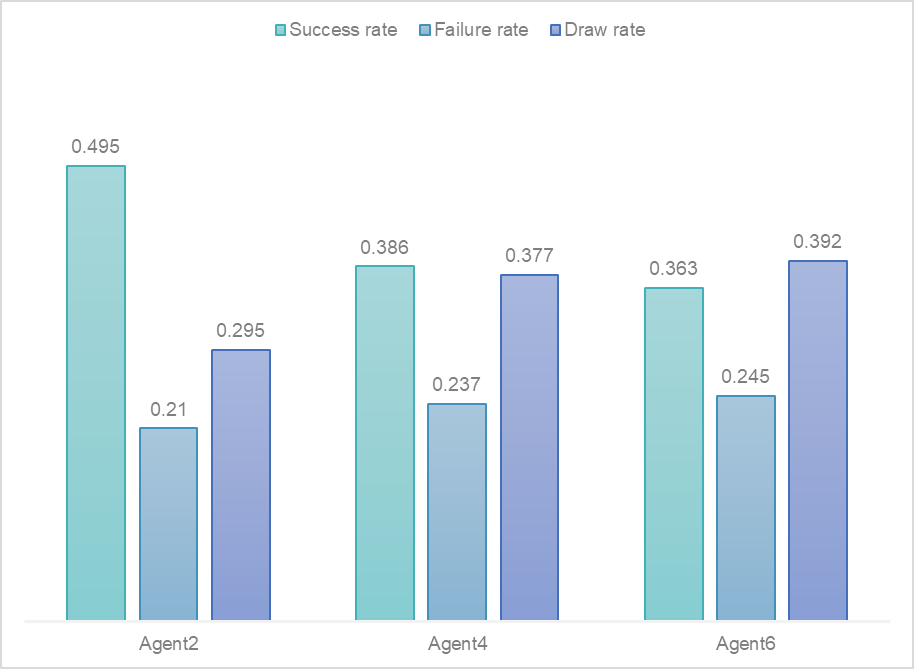
Figure 2: Comparative Analysis of Agent 3's Interaction Outcomes with Agents 2, 4, and 6: Success Rates (49.5%, 38.6%, 36.3%), Failure Rates (21.0%, 23.7%, 24.5%), and Draw Rates (29.5%, 37.7%, 39.2%).
Discussion
This study advances the understanding of misinformation dynamics by empirically demonstrating the influence of personality combinations on misinformation spread and resistance. It highlights the importance of non-aggressive persuasion strategies that prioritize emotional resonance over confrontation. The results suggest that interventions to combat misinformation could be enhanced by integrating personality-aware strategies, focusing on trust and emotional appeal.
Conclusion
The research contributes to the theoretical exploration of personality-misinformation dynamics and offers practical insights for designing AI-driven interventions in digital spaces. It proposes that effective misinformation countermeasures should leverage personality traits and emphasize emotional connections over confrontational methods. This new understanding could guide the development of personalized misinformation correction protocols, optimizing their effectiveness in real-world applications.