- The paper introduces a generalized off-shell free energy framework to classify black holes in a perfect fluid dark matter background.
- It employs topological defect analysis to categorize black holes into four distinct thermodynamic classes based on temperature variations.
- Results highlight how black hole stability transitions correlate with varying thermal regimes and dark matter interactions.
Universal Thermodynamic Topological Classes of Black Holes in Perfect Fluid Dark Matter Background
This paper explores the thermodynamic topology of various black hole solutions embedded in a perfect fluid dark matter (PFDM) background. By leveraging the principles of topological thermodynamics, the paper provides insights into the classification of different types of black holes based on their stability at varying temperature regimes. This analytical approach offers an enhancement to our understanding of black holes in contexts close to quantum gravitational thresholds.
Topological Classification Methodology
The foundation of this research builds upon the introduction of generalized off-shell free energy and topological defect analysis, which categorizes black holes into four distinct thermodynamic classes: W1−, W0+, W0−, and W1+. These classes are characterized by the behavior and stability of black holes under various temperature conditions, which correspond to their winding numbers, indicating thermodynamic stability.
Mathematical Framework
The generalized off-shell free energy F is developed as follows:
F=M−τS
where M is mass, S is entropy, and τ is the inverse temperature parameter. This framework utilizes a vector field ϕ, denoted by:
ϕ=(ϕrh,ϕΘ)=(∂rh∂F~,∂Θ∂F~)
Here, F~ accounts for the generalized free energy including angular considerations. The asymptotic behavior of ϕ along predefined contours (as shown by figures in the original work) informs the topological classification by marking zero points or defects.
Schwarzschild Black Hole in PFDM
The Schwarzschild black hole's behavior in a PFDM background reveals it belongs to the W1− class. This indicates an unstable thermal nature at both low and high-temperature limits with a consistent negative winding number.
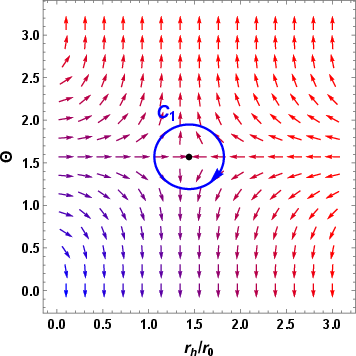
Figure 1: The n-vector field ϕ plot for Schwarzschild black hole in a PFDM background, marking zero points of instability.
Reissner-Nordström and Kerr-Newman Black Holes in PFDM
For Reissner-Nordström and Kerr-Newman black holes, the W0+ class emerges as the dominant categorization. These configurations feature a distinct small, stable state and a large, unstable state, which dissolve at sufficiently high temperatures. This classification is affirmed by zero topological numbers over the parameter space considered.
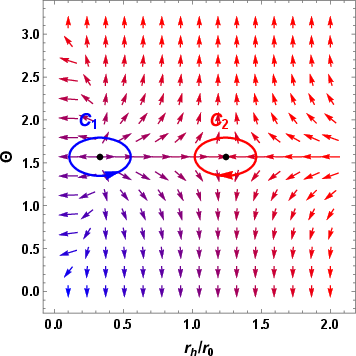
Figure 2: The n-vector field for the Reissner–Nordström black hole depicting discrete topological transitions in PFDM background.
AdS Black Hole Solutions in PFDM
In contrast to their non-AdS counterparts, Schwarzschild-AdS black holes map to the W0− class. This classification reflects the transition from stable small to unstable large black holes with topological characteristics that include annihilation points that guide the transitions.
Conversely, Kerr-AdS black holes fall under the W1+ class, characterized by multiple stable regions at varying temperatures, highlighting their dynamic topological intensity across a broader parameter space.
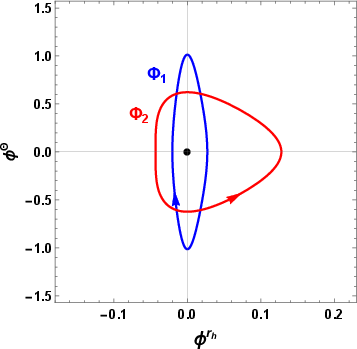
Figure 3: Contour analysis of Schwarzschild-AdS illustrating change across topological domains in PFDM.
Conclusion
This research has systematically classified black holes in PFDM environments using topological defects of thermodynamic properties. It provides a compelling unified model to understand various black holes' stability across temperatures, significantly contributing to the theoretical modeling near quantum gravity regimes. The outlined topological classes encapsulate complex interactions, allowing further exploration into other spacetimes and dark matter interactions. The potential to evolve Probes into more intricate quantum fields remains vast, suggesting pathways for future research into relativistic and quantum domains.