- The paper introduces novel scalar-hairy black holes in EMS theory using positive coupling to reveal effects of nonlinear interactions.
- It employs numerical methods to characterize scalar field profiles and deviations from standard Reissner–Nordström solutions.
- Energy and stability analyses indicate that these solutions exhibit reduced Hawking temperatures and constrained charge regimes.
Novel Black Holes with Scalar Hair in the Einstein-Maxwell-Scalar Theory with Positive Coupling
Introduction
This paper explores new black hole solutions with scalar hair in the context of the Einstein-Maxwell-Scalar (EMS) theory, focusing on positive coupling scenarios. Contrary to the traditional spontaneous scalarization induced by tachyonic instabilities seen in Reissner–Nordström (RN) black holes with negative coupling, this research identifies a class of scalar-hairy black holes arising due to nonlinear effects associated with positive coupling. Such configurations provide an intriguing alternative perspective on black hole scalarization mechanisms, emphasized by their distinct properties and stability.
The framework under consideration involves a 4-dimensional EMS theory with a massless scalar field ψ that interacts nonminimally with the Maxwell field. The interaction is governed by the action:
S=∫dx4(R−21∇μψ∇μψ−41f(ψ)Fμν2),
where R is the Ricci scalar, and Fμν is the electromagnetic field tensor. The coupling function f(ψ)=e−λψ2 is central, with the parameter λ influencing the emergent scalar hair dynamics.
Numerical Solution and Field Profiles
Numerical explorations reveal that scalar-hairy black holes manifest a monotonic increase in scalar field value with radial distance, converging to a constant asymptotic value distinct from the conventional RN behavior. This divergence is a critical indicator of how the positive coupling parameter influences field dynamics.
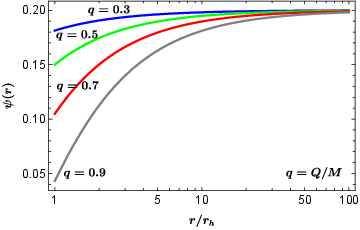
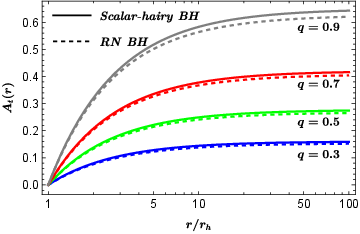
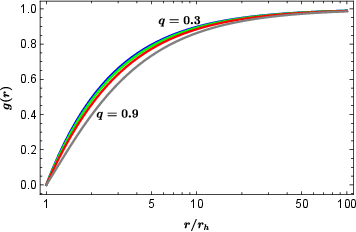
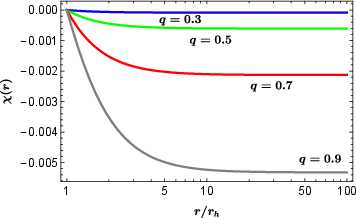
Figure 1: The profile of the field functions with λ=1 for different q.
Moreover, analysis indicates that scalar charge ψe, defined as ψ0−ψh0, escalates with increasing charge q, reflecting the increase in deviation from trivial solutions.
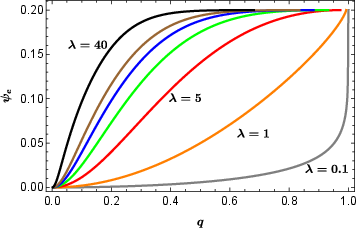
Figure 2: The dependence of the scalar charge ψe≡ψ0−ψh0 on the reduced charge q for various coupling values. The curves, from lowest to highest, correspond to λ=0.1,1,5,10,15,20,40, respectively.
Energy Dynamics and Stability
Energy assessments of the scalar and electromagnetic fields show distinct behaviors contrasting spontaneous scalarization. Energy storage increases with both field energy and coupling, suggesting that nonlinear coupling rather than instability drives these hairy solutions.
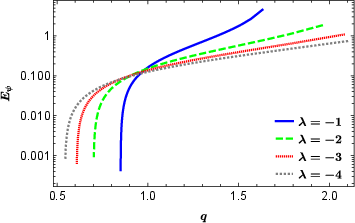
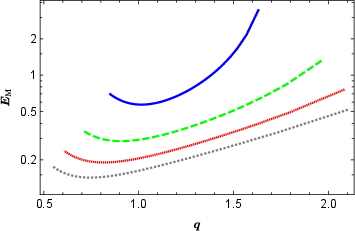
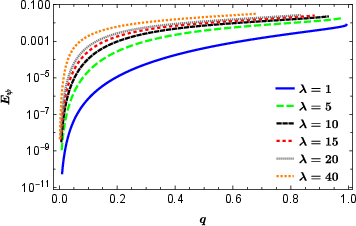
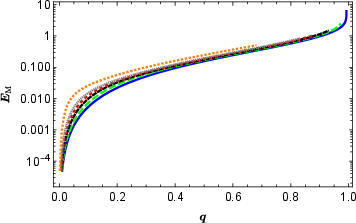
Figure 3: The energy of the scalar field and Maxwell field outside the horizon as a function of the charge q for scalarization (top panel) and scalar-hairy solutions (bottom panel).
Stability analyses using effective potentials and QNM calculations demonstrate that these structures are stable under scalar perturbations, with positive effective potentials mitigating the prospect of instabilities.
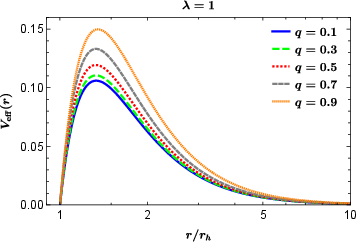
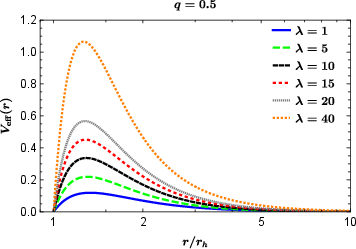
Figure 4: Left: The profiles of the effective potential for different reduced charge q with λ=1;Right:theprofileoftheeffectivepotentialfordifferentvaluesofthecouplingparameter\lambdawithq=0.5.
Hawking Temperature and Chemical Potential
The scalar-hairy black holes exhibit a generalized reduction in Hawking temperature compared to RN black holes across the explored parameter space. Higher coupling constrains the feasible charge domain, with transitions back to RN-like configurations linked to potential overcharging scenarios.
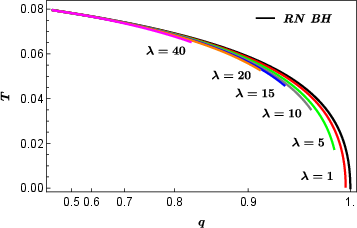
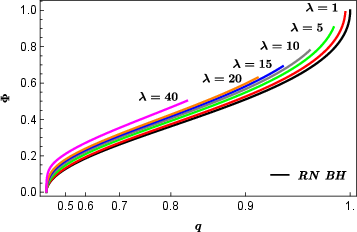
Figure 5: Left: Hawking temperature of the scalar-hairy black hole as a function of the reduced charge q for different coupling value λ; Right: Chemical potential of the scalar-hairy solutions as a function of q for different coupling value $\lambda.
Conclusion
The identification of scalar-hairy black holes in the EMS framework with positive coupling expands the understanding of scalarized black hole dynamics beyond traditional spontaneous scalarization paradigms. These solutions demonstrate significant deviations from RN states when positively coupled, driven by robust nonlinear interactions rather than tachyonic instabilities. Future work might explore the electromagnetic and gravitational perturbation stability further or integrate these findings into holographic models to refine understanding of phase transitions in complex field theories.