Papers
Topics
Authors
Recent
Search
2000 character limit reached

Detecting Scams Using Large Language Models

Published 5 Feb 2024 in cs.CR | (2402.03147v1)

Abstract: LLMs have gained prominence in various applications, including security. This paper explores the utility of LLMs in scam detection, a critical aspect of cybersecurity. Unlike traditional applications, we propose a novel use case for LLMs to identify scams, such as phishing, advance fee fraud, and romance scams. We present notable security applications of LLMs and discuss the unique challenges posed by scams. Specifically, we outline the key steps involved in building an effective scam detector using LLMs, emphasizing data collection, preprocessing, model selection, training, and integration into target systems. Additionally, we conduct a preliminary evaluation using GPT-3.5 and GPT-4 on a duplicated email, highlighting their proficiency in identifying common signs of phishing or scam emails. The results demonstrate the models' effectiveness in recognizing suspicious elements, but we emphasize the need for a comprehensive assessment across various language tasks. The paper concludes by underlining the importance of ongoing refinement and collaboration with cybersecurity experts to adapt to evolving threats.

Definition Search Book Streamline Icon: https://streamlinehq.com
References (16)
  1. Y. Chang, X. Wang, J. Wang, Y. Wu, K. Zhu, H. Chen, L. Yang, X. Yi, C. Wang, Y. Wang et al., “A survey on evaluation of large language models,” arXiv preprint arXiv:2307.03109, 2023.
  2. W. X. Zhao, K. Zhou, J. Li, T. Tang, X. Wang, Y. Hou, Y. Min, B. Zhang, J. Zhang, Z. Dong et al., “A survey of large language models,” arXiv preprint arXiv:2303.18223, 2023.
  3. J. Wu, S. Yang, R. Zhan, Y. Yuan, D. F. Wong, and L. S. Chao, “A survey on llm-gernerated text detection: Necessity, methods, and future directions,” arXiv preprint arXiv:2310.14724, 2023.
  4. M. U. Hadi, R. Qureshi, A. Shah, M. Irfan, A. Zafar, M. Shaikh, N. Akhtar, J. Wu, and S. Mirjalili, “A survey on large language models: Applications, challenges, limitations, and practical usage,” TechRxiv, 2023.
  5. X. Wu, R. Duan, and J. Ni, “Unveiling security, privacy, and ethical concerns of chatgpt,” 2023.
  6. S. R. Bowman, “Eight things to know about large language models,” arXiv preprint arXiv:2304.00612, 2023.
  7. W. Zhao, Y. Liu, Y. Wan, Y. Wang, Q. Wu, Z. Deng, J. Du, S. Liu, Y. Xu, and P. S. Yu, “knn-icl: Compositional task-oriented parsing generalization with nearest neighbor in-context learning,” 2023.
  8. A. Fan, B. Gokkaya, M. Harman, M. Lyubarskiy, S. Sengupta, S. Yoo, and J. M. Zhang, “Large language models for software engineering: Survey and open problems,” 2023.
  9. X. Hou, Y. Zhao, Y. Liu, Z. Yang, K. Wang, L. Li, X. Luo, D. Lo, J. Grundy, and H. Wang, “Large language models for software engineering: A systematic literature review,” arXiv preprint arXiv:2308.10620, 2023.
  10. A. J. Thirunavukarasu, D. S. J. Ting, K. Elangovan, L. Gutierrez, T. F. Tan, and D. S. W. Ting, “Large language models in medicine,” Nature medicine, vol. 29, no. 8, pp. 1930–1940, 2023.
  11. J. Clusmann, F. R. Kolbinger, H. S. Muti, Z. I. Carrero, J.-N. Eckardt, N. G. Laleh, C. M. L. Löffler, S.-C. Schwarzkopf, M. Unger, G. P. Veldhuizen et al., “The future landscape of large language models in medicine,” Communications Medicine, vol. 3, no. 1, p. 141, 2023.
  12. P. Caven, “A more insecure ecosystem? chatgpt’s influence on cybersecurity,” ChatGPT’s Influence on Cybersecurity (April 30, 2023), 2023.
  13. M. Al-Hawawreh, A. Aljuhani, and Y. Jararweh, “Chatgpt for cybersecurity: practical applications, challenges, and future directions,” Cluster Computing, vol. 26, no. 6, pp. 3421–3436, 2023.
  14. J. Marshall, “What effects do large language models have on cybersecurity,” 2023.
  15. Y. Yao, J. Duan, K. Xu, Y. Cai, E. Sun, and Y. Zhang, “A survey on large language model (llm) security and privacy: The good, the bad, and the ugly,” arXiv preprint arXiv:2312.02003, 2023.
  16. P. Dhoni and R. Kumar, “Synergizing generative ai and cybersecurity: Roles of generative ai entities, companies, agencies, and government in enhancing cybersecurity,” 2023.
Citations (13)

Summary

  • The paper introduces a novel approach using LLMs for scam detection by leveraging expansive datasets and fine-tuned models.
  • It employs rigorous data preprocessing, labeling, and hyperparameter tuning to optimize model performance and reduce false detections.
  • Preliminary evaluations with GPT-3.5 and GPT-4 highlight improved identification of scam indicators, underscoring the potential for enhanced cybersecurity strategies.

Detecting Scams Using LLMs

Introduction

The paper "Detecting Scams Using LLMs" (2402.03147) explores the application of LLMs in cybersecurity, particularly focusing on scam detection. LLMs, such as GPT-3.5 and GPT-4, have been leveraged for various text analysis tasks due to their ability to process and generate coherent human-like text. This paper proposes a novel application of LLMs to identify scams, including phishing, advance fee fraud, and romance scams.

Methodology

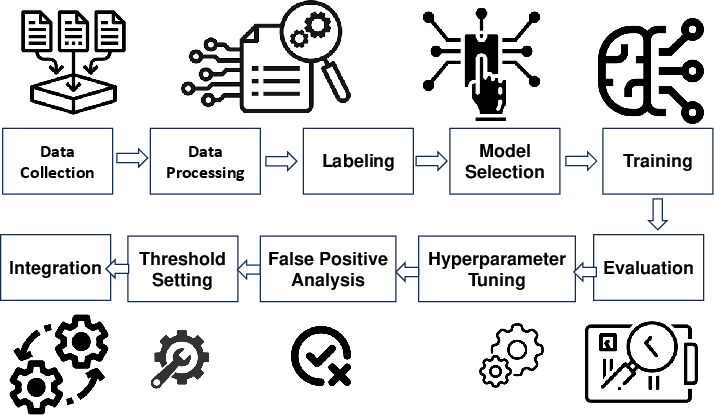
To build an effective scam detector using LLMs, the paper outlines a comprehensive workflow involving several steps:

  1. Data Collection: Acquisition of a diverse and comprehensive dataset that includes both scam and legitimate content to train the model effectively.
  2. Data Preprocessing: Cleaning and standardizing the text, ensuring uniformity in the dataset for accurate training.
  3. Labeling: Annotating text data to clearly identify content as either "scam" or "legitimate."
  4. Model Selection: Choosing an appropriate LLM, such as GPT-3 or BERT, and fine-tuning it on the specific task of scam detection.
  5. Training and Evaluation: Employing supervised learning techniques to train the LLM and rigorously evaluating its performance using metrics like precision, recall, and accuracy.
  6. Hyperparameter Tuning: Adjusting model parameters to optimize performance, alongside setting appropriate confidence thresholds to minimize false positives and negatives.
  7. Integration and Continuous Collaboration: Deploying the model within cybersecurity systems and involving experts to stay abreast of evolving threats. Figure 1

    Figure 1: Workflow of the method.

Preliminary Evaluation

The study includes a preliminary evaluation where duplicated scam emails are analyzed using GPT-3.5 and GPT-4. Both models demonstrated proficiency in identifying typical scam indicators, such as unusual email addresses and poor language quality, affirming their potential utility in scam detection tasks. However, the paper highlights the necessity of a broader evaluation to assess the models' performance across varied language tasks and complexities.

Literature Review

The paper contextualizes its research within existing literature, acknowledging that while LLMs have demonstrated potential in applications like malware analysis and threat intelligence, the domain of scam detection remains underexplored. Previous surveys have extensively covered LLM applications across domains such as medicine and software engineering, yet few have focused solely on cybersecurity implications. This paper contributes by filling that gap.

Implications and Future Research

The implication of this research extends to enhancing cybersecurity protocols with LLMs. By successfully integrating scam detection capabilities, LLMs can play a pivotal role in safeguarding individuals and organizations against financial and identity fraud. Future research should aim to improve model robustness and adaptability to sophisticated scam tactics. Ongoing collaboration with domain experts will be crucial in maintaining the effectiveness of such systems as cybersecurity threats evolve.

Conclusion

The paper demonstrates the potential of LLMs in the field of scam detection, suggesting a promising avenue for their application in cybersecurity. Despite promising preliminary results, a comprehensive evaluation is necessary to fully understand the capabilities and limitations of LLMs in this domain. Further research and development are essential to optimize these models for real-world deployment, ensuring they remain effective against an ever-changing landscape of fraudulent activities.

Paper to Video (Beta)

Whiteboard

No one has generated a whiteboard explanation for this paper yet.

Open Problems

We haven't generated a list of open problems mentioned in this paper yet.

Authors (1)

Collections

Sign up for free to add this paper to one or more collections.