Non-Atomic Arbitrage in Decentralized Finance
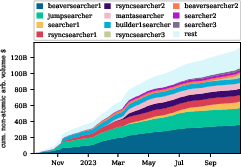
Abstract: The prevalence of maximal extractable value (MEV) in the Ethereum ecosystem has led to a characterization of the latter as a dark forest. Studies of MEV have thus far largely been restricted to purely on-chain MEV, i.e., sandwich attacks, cyclic arbitrage, and liquidations. In this work, we shed light on the prevalence of non-atomic arbitrage on decentralized exchanges (DEXes) on the Ethereum blockchain. Importantly, non-atomic arbitrage exploits price differences between DEXes on the Ethereum blockchain as well as exchanges outside the Ethereum blockchain (i.e., centralized exchanges or DEXes on other blockchains). Thus, non-atomic arbitrage is a type of MEV that involves actions on and off the Ethereum blockchain. In our study of non-atomic arbitrage, we uncover that more than a fourth of the volume on Ethereum's biggest five DEXes from the merge until 31 October 2023 can likely be attributed to this type of MEV. We further highlight that only eleven searchers are responsible for more than 80% of the identified non-atomic arbitrage volume sitting at a staggering $132 billion and draw a connection between the centralization of the block construction market and non-atomic arbitrage. Finally, we discuss the security implications of these high-value transactions that account for more than 10% of Ethereum's total block value and outline possible mitigations.
- Y. Wang, Y. Chen, H. Wu, L. Zhou, S. Deng, and R. Wattenhofer, “Cyclic Arbitrage in Decentralized Exchanges,” in Companion Proceedings of the Web Conference 2022. ACM, 4 2022, pp. 12–19.
- “Total Value Locked,” https://defillama.com/chains.
- “MEV-Boost Dashboard,” https://mevboost.pics/.
- T. Gupta, M. M. Pai, and M. Resnick, “The centralizing effects of private order flow on proposer-builder separation,” in 5th Conference on Advances in Financial Technologies, 10 2023.
- “Proposer-Builder Separation,” https://ethereum.org/roadmap/pbs/.
- P. Daian, S. Goldfeder, T. Kell, Y. Li, X. Zhao, I. Bentov, L. Breidenbach, and A. Juels, “Flash boys 2.0: Frontrunning in decentralized exchanges, miner extractable value, and consensus instability,” in 2020 IEEE Symposium on Security and Privacy (SP), 5 2020, pp. 910–927.
- K. Qin, L. Zhou, P. Gamito, P. Jovanovic, and A. Gervais, “An empirical study of defi liquidations: incentives, risks, and instabilities,” in Proceedings of the 21st ACM Internet Measurement Conference. ACM, 11 2021, pp. 336–350.
- “DefiLlama,” https://defillama.com/protocols/dexes/Ethereum.
- “Zeromev,” https://zeromev.org/.
- Mempool Guru, “Mempool Guru,” https://mempool.guru/, 2023.
- S. Yang, F. Zhang, K. Huang, X. Chen, Y. Yang, and F. Zhu, “SoK: MEV Countermeasures: Theory and Practice,” arXiv preprint arXiv:2212.05111, 2023.
- Binance, “Historical Market Data,” https://www.binance.com/en/landing/data, 2023.
- “Today’s cryptocurrency prices by market cap,” 2023. [Online]. Available: https://coinmarketcap.com/
- H. Adams, N. Zinsmeister, and D. Robinson, “Uniswap v2 core,” 2020.
- H. Adams, N. Zinsmeister, M. Salem, R. Keefer, and D. Robinson, “Uniswap v3 core,” 2021.
- Sushiswap, “Be a Crypto Chef with Sushi,” https://docs.sushi.com/pdf/whitepaper.pdf, 2023.
- K. Qin, L. Zhou, and A. Gervais, “Quantifying blockchain extractable value: How dark is the forest?” in 2022 IEEE Symposium on Security and Privacy (SP). IEEE, 5 2022, pp. 198–214.
- L. Zhou, K. Qin, C. F. Torres, D. V. Le, and A. Gervais, “High-Frequency Trading on Decentralized On-Chain Exchanges,” in 2021 IEEE Symposium on Security and Privacy (SP). IEEE, 5 2021, pp. 428–445.
- C. F. Torres, R. Camino, and R. State, “Frontrunner Jones and the Raiders of the Dark Forest: An Empirical Study of Frontrunning on the Ethereum Blockchain,” in 30th USENIX Security Symposium, 8 2021, pp. 1343–1359.
- L. Heimbach, L. Kiffer, C. Ferreira Torres, and R. Wattenhofer, “Ethereum’s Proposer-Builder Separation: Promises and Realities,” in 2023 ACM Internet Measurement Conference (IMC), Montreal, QC, Canada, Oct. 2023.
- “DefiLlama API,” https://defillama.com/docs/api.
- “Jump Etherscan,” https://etherscan.io/address/0x9507c04b10486547584c37bcbd931b2a4fee9a41, 2023.
- Investopedia, “The Collapse of FTX: What Went Wrong With the Crypto Exchange?” https://www.investopedia.com/what-went-wrong-with-ftx-6828447, 2023.
- Cointelegraph, “TUSDC depegs as Circle confirms $3.3B stuck with Silicon Valley Bank,” https://cointelegraph.com/news/usdc-depegs-as-circle-confirms-3-3b-stuck-with-silicon-valley-bank, 2023.
- Blockworks, “The Investor’s Guide to Crypto Correlation,” https://blockworks.co/news/the-investors-guide-to-crypto-correlation, 2023.
- K. Q. Nguyen, “The correlation between the stock market and bitcoin during covid-19 and other uncertainty periods,” Finance Research Letters, vol. 46, p. 102284, 2022. [Online]. Available: https://www.sciencedirect.com/science/article/pii/S1544612321003238
- “Meeting calendars, statements, and minutes (2018-2024),” https://www.federalreserve.gov/monetarypolicy/fomccalendars.html, 2023.
- “How the fed impacts stocks, crypto and other investments,” https://www.bankrate.com/investing/federal-reserve-impact-on-stocks-crypto-other-investments/#crypto, 2023.
- G. Konstantopoulos and V. Buterin, “Ethereum Reorgs After The Merge,” https://www.paradigm.xyz/2021/07/ethereum-reorgs-after-the-merge, 2021.
- D. Grandjean, L. Heimbach, and R. Wattenhofer, “Ethereum Proof-of-Stake Consensus Layer: Participation and Decentralization,” arXiv preprint arXiv:2306.10777, 2023.
- J. Milionis, C. C. Moallemi, T. Roughgarden, and A. L. Zhang, “Automated Market Making and Loss-Versus-Rebalancing,” arXiv preprint arXiv:2208.06046, 2022.
- J. Milionis, C. C. Moallemi, and T. Roughgarden, “Automated Market Making and Arbitrage Profits in the Presence of Fees,” arXiv preprint arXiv:2305.14604, 2023.
- S. Eskandari, S. Moosavi, and J. Clark, “SoK: Transparent Dishonesty: Front-Running Attacks on Blockchain,” in Financial Cryptography and Data Security, vol. 11599. Springer International Publishing, 2020, pp. 170–189.
- I. Bentov, Y. Ji, F. Zhang, L. Breidenbach, P. Daian, and A. Juels, “Tesseract: Real-time cryptocurrency exchange using trusted hardware,” in Proceedings of the 2019 ACM SIGSAC Conference on Computer and Communications Security, ser. CCS ’19, 2019, p. 1521–1538.
- C. Stathakopoulou, S. Rüsch, M. Brandenburger, and M. Vukolić, “Adding Fairness to Order: Preventing Front-Running Attacks in BFT Protocols using TEEs,” in 2021 40th International Symposium on Reliable Distributed Systems (SRDS). IEEE, 2021, pp. 34–45.
- M. Kelkar, F. Zhang, S. Goldfeder, and A. Juels, “Order-Fairness for Byzantine Consensus,” in Annual International Cryptology Conference. Springer, 2020, pp. 451–480.
- L. Baird, “The Swirlds Hashgraph Consensus Algorithm: Fair, Fast, Byzantine Fault Tolerance,” Swirlds Tech Reports SWIRLDS-TR-2016-01, Tech. Rep, 2016.
- K. Kursawe, “Wendy, the Good Little Fairness Widget: Achieving Order Fairness for Blockchains,” in Proceedings of the 2nd ACM Conference on Advances in Financial Technologies, 2020, pp. 25–36.
- Y. Zhang, S. Setty, Q. Chen, L. Zhou, and L. Alvisi, “Byzantine Ordered Consensus Without Byzantine Oligarchy,” in 14th {normal-{\{{USENIX}normal-}\}} Symposium on Operating Systems Design and Implementation ({normal-{\{{OSDI}normal-}\}} 20), 2020, pp. 633–649.
- M. Kelkar, S. Deb, and S. Kannan, “Order-Fair Consensus in the Permissionless Setting,” IACR Cryptol. ePrint Arch., vol. 2021, p. 139, 2021.
- M. Kelkar, S. Deb, S. Long, A. Juels, and S. Kannan, “Themis: Fast, Strong Order-Fairness in Byzantine Consensus,” Cryptology ePrint Archive, Report 2021/1465, 2021.
- C. Cachin, J. Mićić, and N. Steinhauer, “Quick Order Fairness,” in Financial Cryptography and Data Security (FC), Grenada, 2022.
- M. K. Reiter and K. P. Birman, “How to Securely Replicate Services,” ACM Transactions on Programming Languages and Systems (TOPLAS), vol. 16, no. 3, pp. 986–1009, 1994.
- A. Miller, Y. Xia, K. Croman, E. Shi, and D. Song, “The Honey Badger of BFT Protocols,” ser. CCS ’16, 2016, p. 31–42.
- A. Asayag, G. Cohen, I. Grayevsky, M. Leshkowitz, O. Rottenstreich, R. Tamari, and D. Yakira, “A Fair Consensus Protocol for Transaction Ordering,” in 2018 IEEE 26th International Conference on Network Protocols (ICNP), 2018.
- A. Orda and O. Rottenstreich, “Enforcing Fairness in Blockchain Transaction Ordering,” Peer-to-peer Networking and Applications, vol. 14, no. 6, pp. 3660–3673, 2021.
- H. Zhang, L.-H. Merino, V. Estrada-Galinanes, and B. Ford, “Flash freezing flash boys: Countering blockchain front-running,” in 2022 IEEE 42nd International Conference on Distributed Computing Systems Workshops (ICDCSW). IEEE, 2022, pp. 90–95.
- A. Constantinescu, D. Ghinea, L. Heimbach, Z. Wang, and R. Wattenhofer, “A Fair and Resilient Decentralized Clock Network for Transaction Ordering,” in 27th International Conference on Principles of Distributed Systems (OPODIS), Tokyo, Japan, Dec. 2023.
- P. Momeni, S. Gorbunov, and B. Zhang, “Fairblock: Preventing Blockchain Front-Running with Minimal Overheads,” in Security and Privacy in Communication Networks: 18th EAI International Conference, SecureComm 2022, Virtual Event, October 2022, Proceedings. Springer, 2023, pp. 250–271.
- A. Tatabitovska, O. Ersoy, and Z. Erkin, “Mitigation of Transaction Manipulation Attacks in UniSwap,” 2021.
- L. Breidenbach, P. Daian, F. Tramèr, and A. Juels, “Enter the Hydra: Towards Principled Bug Bounties and Exploit-Resistant Smart Contracts,” in 27th USENIX Security Symposium, 2018, pp. 1335–1352.
- Y. Doweck and I. Eyal, “Multi-Party Timed Commitments,” arXiv preprint arXiv:2005.04883, 2020.
- L. Heimbach and R. Wattenhofer, “Eliminating Sandwich Attacks with the Help of Game Theory,” in ACM Asia Conference on Computer and Communications Security (ASIA CCS), Nagasaki, Japan, Jun. 2022.
- L. Zhou, K. Qin, and A. Gervais, “A2MM: Mitigating Frontrunning, Transaction Reordering and Consensus Instability in Decentralized Exchanges,” 2021.
- L. Heimbach and R. Wattenhofer, “SoK: Preventing Transaction Reordering Manipulations in Decentralized Finance,” in 4th ACM Conference on Advances in Financial Technologies (AFT), Cambridge, MA, USA, Sep. 2022.
- L. Heimbach, Y. Wang, and R. Wattenhofer, “Behavior of Liquidity Providers in Decentralized Exchanges,” in 2021 Crypto Valley Conference on Blockchain Technology (CVCBT), Rotkreuz, Switzerland, Oct. 2021.
- L. Heimbach, E. Schertenleib, and R. Wattenhofer, “Risks and Returns of Uniswap V3 Liquidity Providers,” in 4th ACM Conference on Advances in Financial Technologies (AFT), Cambridge, MA, USA, Sep. 2022.
- A. Wahrstätter, J. Ernstberger, A. Yaish, L. Zhou, K. Qin, T. Tsuchiya, S. Steinhorst, D. Svetinovic, N. Christin, M. Barczentewicz, and A. Gervais, “Blockchain Censorship,” arXiv preprint arXiv:2305.18545, 2023.
- A. Wahrstätter, L. Zhou, K. Qin, D. Svetinovic, and A. Gervais, “Time to Bribe: Measuring Block Construction Market,” arXiv preprint arXiv:2305.16468, 2023.
- C. Schwarz-Schilling, F. Saleh, T. Thiery, J. Pan, N. Shah, and B. Monnot, “Time is Money: Strategic Timing Games in Proof-of-Stake Protocols,” arXiv preprint arXiv:2305.09032, 2023.
Paper Prompts
Sign up for free to create and run prompts on this paper using GPT-5.
Top Community Prompts
Collections
Sign up for free to add this paper to one or more collections.