- The paper introduces novel SVARM and Stratified SVARM algorithms to approximate Shapley values without costlier marginal contributions.
- The methods achieve improved computational efficiency with theoretical variance bounds and fixed space complexity.
- Empirical results show competitive performance in both synthetic games and real-world explainability tasks, outperforming traditional approaches.
Approximating the Shapley Value without Marginal Contributions
Introduction
The Shapley value provides a theoretically strong solution for determining the contribution of individual players to the overall benefit in cooperative games. However, the computational complexity of calculating the exact Shapley value renders it impractical for large-scale applications, especially in scenarios where function evaluations are costly, such as assessing feature importance in machine learning models. Traditional approximation methods rely heavily on an agent's marginal contributions, leading to inefficiencies when the number of players increases.
This paper introduces two novel algorithms, SVARM and Stratified SVARM, to efficiently approximate the Shapley value without relying on marginal contributions. These algorithms provide unmatched theoretical guarantees concerning approximation quality, featuring properties such as being unbiased, parameter-free, and domain-independent.
Methodology
SVARM
SVARM, or Shapley Value Approximation without Requesting Marginals, leverages a reformulated expression of the Shapley value that separates the positive and negative contributions, ϕi+ and ϕi−. Using two separate sampling processes P+ and P−, SVARM directly samples coalition values, enabling updates of multiple Shapley value estimates concurrently. This approach greatly enhances computational efficiency compared to traditional marginal contribution methods.
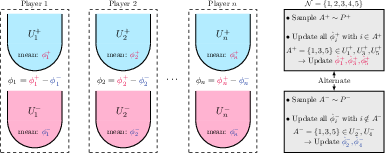
Figure 1: Illustration of SVARM's sampling process and update rule: Each player i has two urns for sampling.
The pseudocode for SVARM involves initializing estimates and sample counts for players, performing a warm-up phase, and iterating through updates by sampling coalitions and updating all affected Shapley values. The algorithm proves computationally efficient with theoretical bounds on variance being constrained by O(T−nlogn), indicating improved precision with increased budget allocation.
Stratified SVARM
Stratified SVARM enhances SVARM by incorporating a stratified sampling approach. It divides the coalition population into homogeneous strata based on their size, allowing the variance within each stratum to be reduced. This significantly accelerates the convergence of estimates by leveraging the maximum sample reuse principle, where the estimates for all players can be updated with a single coalition sample.
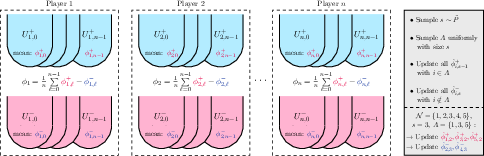
Figure 2: Illustration of Stratified SVARM's sampling process and update rule.
Theoretical guarantees show Stratified SVARM's variance is bounded by O(T−nlognlogn). This method is incremental and operates with a fixed computational space complexity of O(n2).
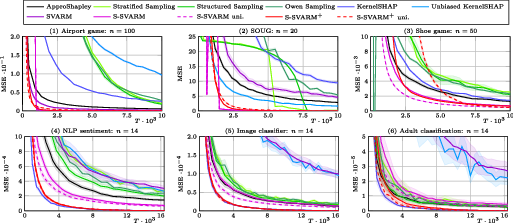
Figure 3: Averaged MSE and standard errors over 100 repetitions in dependence of fixed budget T: (1) Airport game, (2) Shoe game, (3) SOUG game, (4) NLP sentiment analysis, (5) Image classifier, (6) Adult classification.
Empirical Results
The empirical assessment of SVARM and Stratified SVARM algorithms has been conducted using both synthetic and real-world explainability scenarios. The evaluation emphasized the accuracy of the Shapley value approximations under fixed computational budget constraints.
Synthetic Games
For synthetic games such as the Airport, Shoe, and SOUG games, both SVARM and Stratified SVARM were compared against established methodologies. The evaluations demonstrated that Stratified SVARM consistently outperformed its competitors, offering superior theoretical guarantees without necessitating additional constraints or domain-specific knowledge. This was observed across a broad range of player numbers, with Stratified SVARM achieving a logarithmic dependence on n, a notable improvement over traditional approaches like ApproShapley.
Explainability Games
In real-world explainability scenarios including NLP sentiment analysis, image classification, and adult income classification, the performance of Stratified SVARM was robust and comparable to the state-of-the-art KernelSHAP. Stratified SVARM+, which samples without replacement for better empirical results, demonstrated notable competitive accuracy, achieving similar if not superior results across various test scenarios.
Conclusion
This study introduces the SVARM and Stratified SVARM algorithms as novel methods for approximating the Shapley value without the need for marginal contributions. By directly sampling coalition values and applying a dual distribution approach, these algorithms significantly improve computational efficiency while providing theoretical performance guarantees. Stratified SVARM further enhances precision through a refined stratified approach, achieving remarkable empirical results, particularly in synthetic games. These algorithms offer practical and effective solutions for Shapley value approximation in complex cooperative scenarios. Future research may focus on extending these methods to larger player scenarios and exploring structural impacts on approximation quality.