- The paper demonstrates that minimal sufficient representations in contrastive learning omit key task-relevant information, prompting a need for increased mutual information.
- It provides a rigorous theoretical analysis quantifying the gap between minimal and optimal representations using mutual information metrics.
- Extensive experiments on CIFAR10, STL-10, and ImageNet validate that augmenting mutual information significantly improves performance, especially in cross-domain tasks.
Rethinking Minimal Sufficient Representation in Contrastive Learning
Introduction
The paper "Rethinking Minimal Sufficient Representation in Contrastive Learning" addresses the inherent limitations of contrastive learning frameworks regarding representation sufficiency. Contrastive learning methods aim to optimize the mutual information between representations of different data views, thereby typically capturing the shared information. The work lays out a theoretical foundation that critiques the conventional assumption that minimal sufficient representations—those retaining shared information while discarding non-shared information—are adequate for diverse downstream tasks. The authors demonstrate the insufficiency of such representations, spotlighting risks of overfitting solely to shared information and propose increasing mutual information between input and representation as regularization to incorporate more task-relevant information.
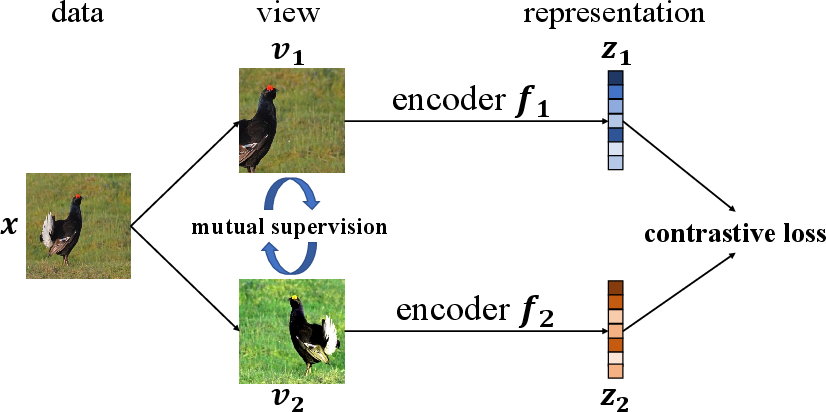
Figure 1: Demonstration of our motivation using information diagrams. Based on the (approximately minimal) sufficient representation learned in contrastive learning, increasing I(z1,v1) approximately introduces more non-shared task-relevant information.
Theoretical Analysis
The authors provide a rigorous theoretical analysis that challenges the adequacy of minimal sufficient representations by proving they contain less task-relevant information compared to other sufficient representations. Specifically, they argue that such representations often exclude critical non-shared information that might be relevant to certain downstream tasks. In scenarios where the information required for these tasks is not shared between views, performance degradation is inevitable. The paper emphasizes the significance of mutual information, illustrating that enhancing the mutual information between representations and input can mitigate overfitting to shared information.
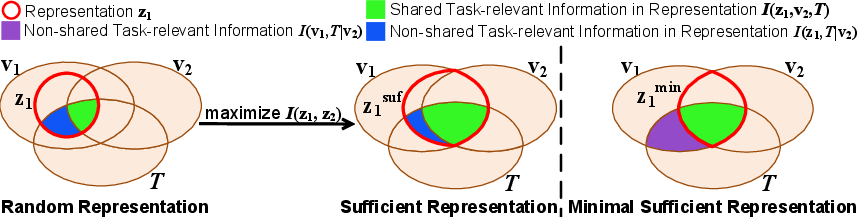
Figure 2: Internal mechanism of contrastive learning: the views provide supervision information to each other.
The study further formalizes and proves the gap between minimal sufficient representations and optimal representations concerning downstream tasks. This gap is characterized by a lack of non-shared task-relevant information, quantified using mutual information metrics. The detailed mathematical exposition offered not only supports their conjecture but also highlights potential avenues for improving representation learning.
Experimental Results
The paper presents extensive empirical validation across various tasks, including classification, detection, and segmentation. Experiments conducted on well-established datasets such as CIFAR10, STL-10, and ImageNet confirm the hypothesis that increasing mutual information between representations and input significantly enhances downstream task performance. This effect is particularly pronounced in cross-domain transfer tasks, where shared information is often inadequate.
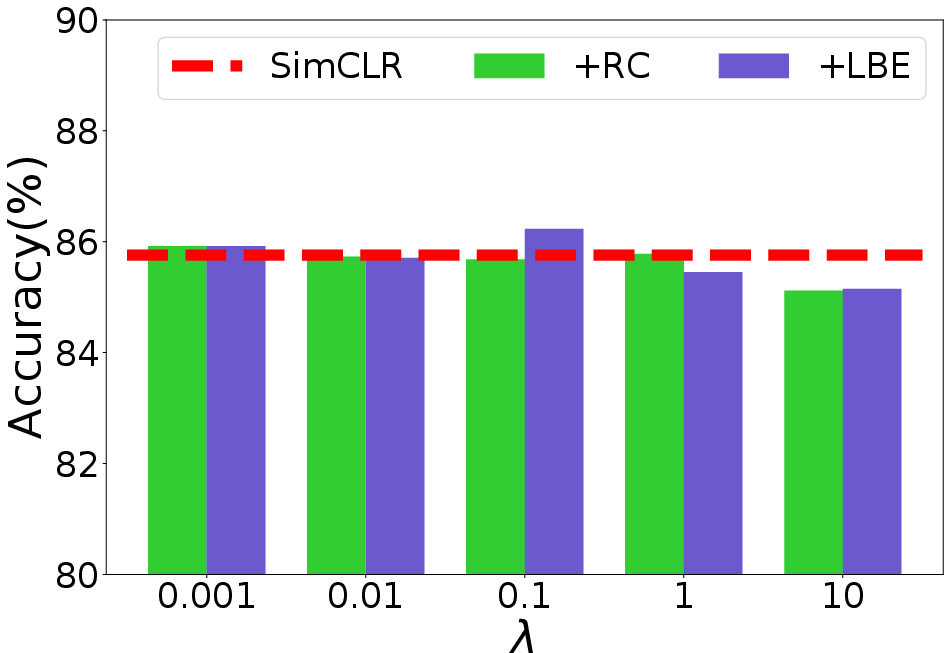
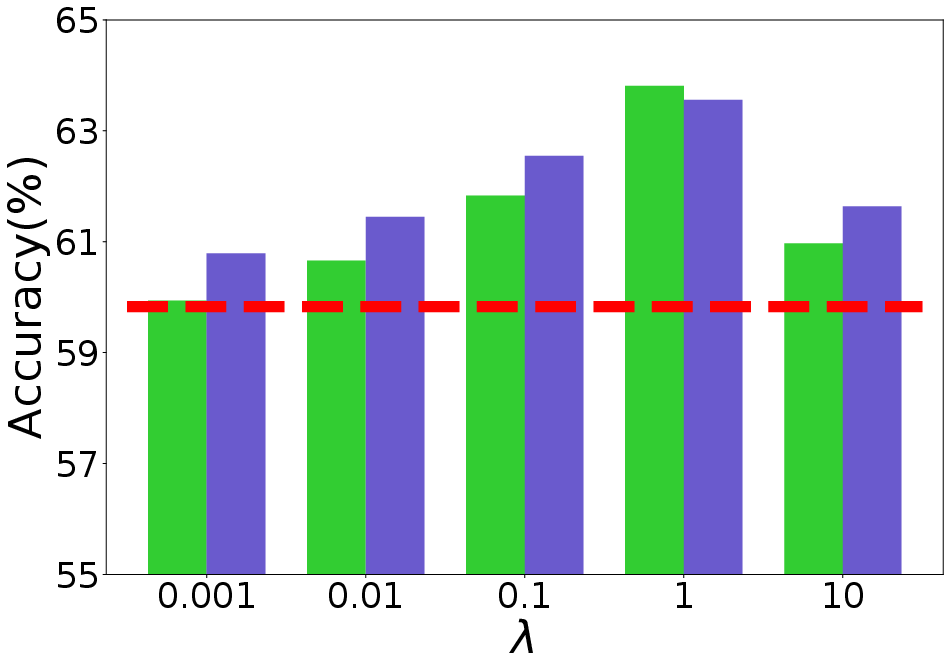
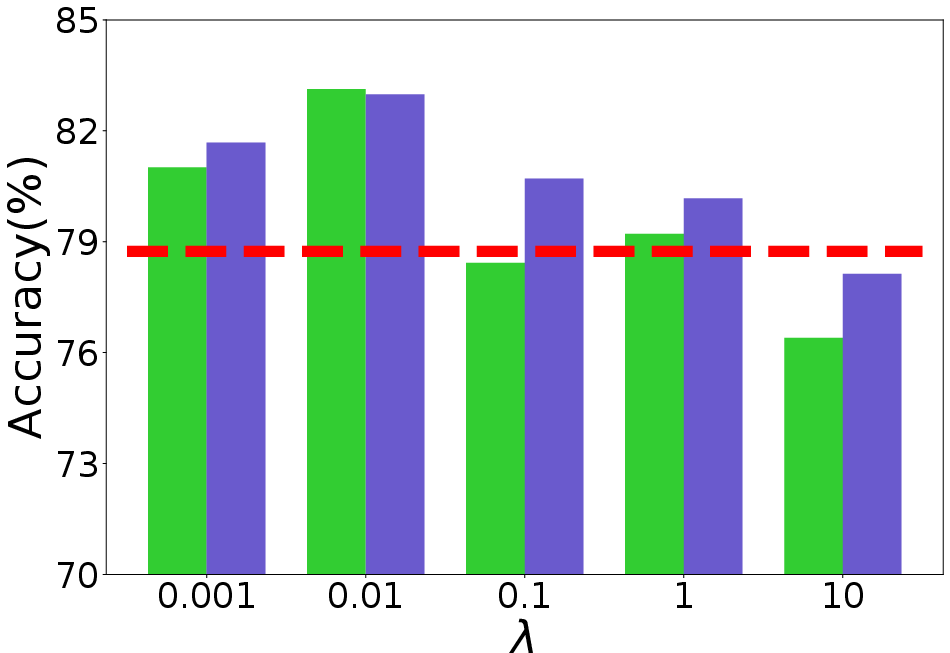
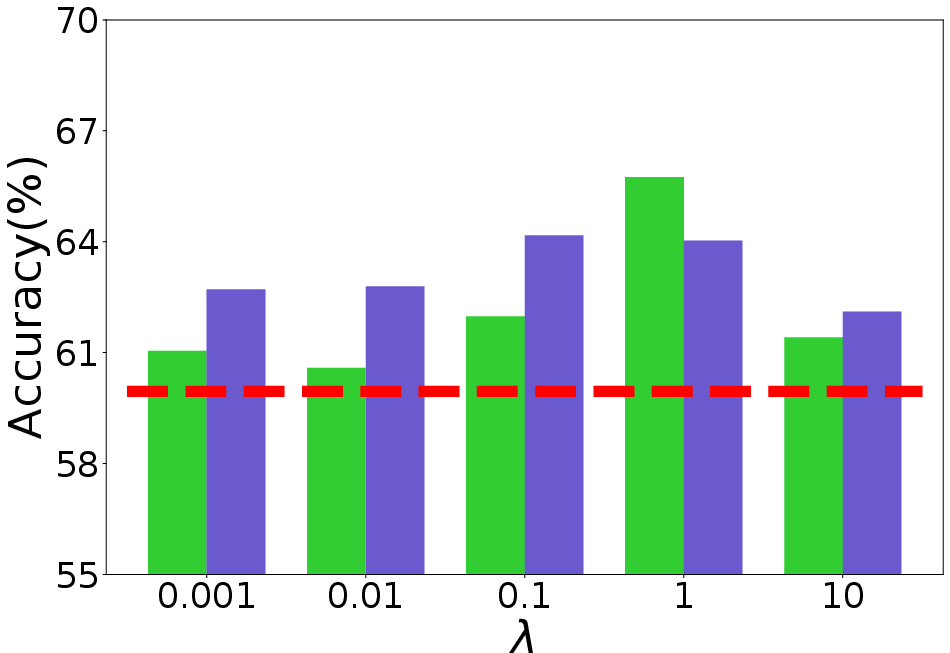
Figure 3: Linear evaluation accuracy on the source dataset (CIFAR10 or STL-10) and the averaged accuracy on all transfer datasets with varying hyper-parameter lambda.
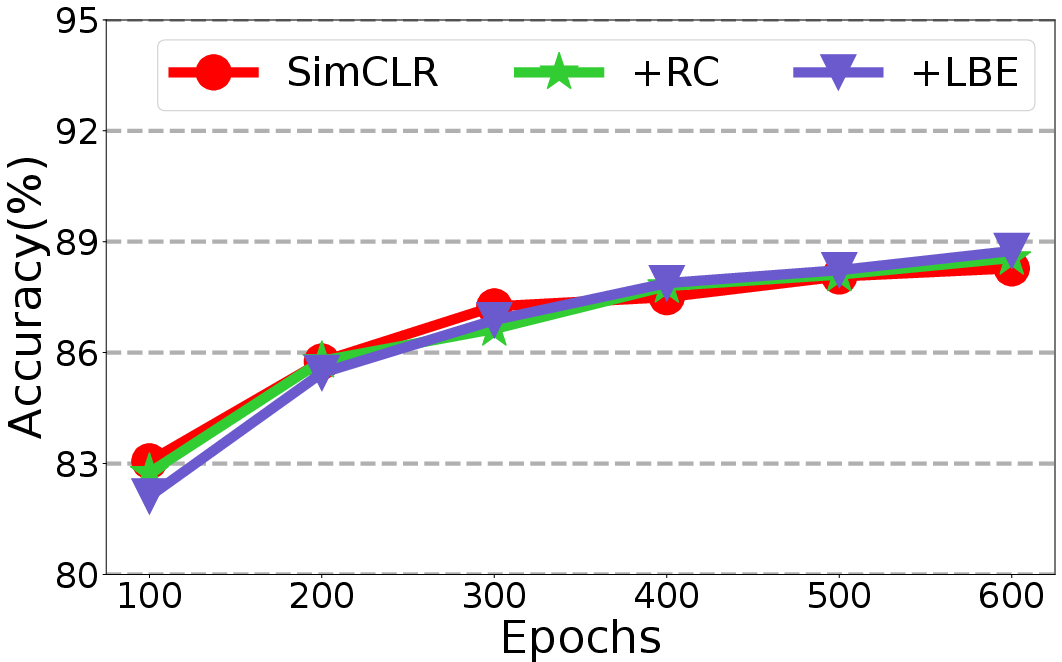
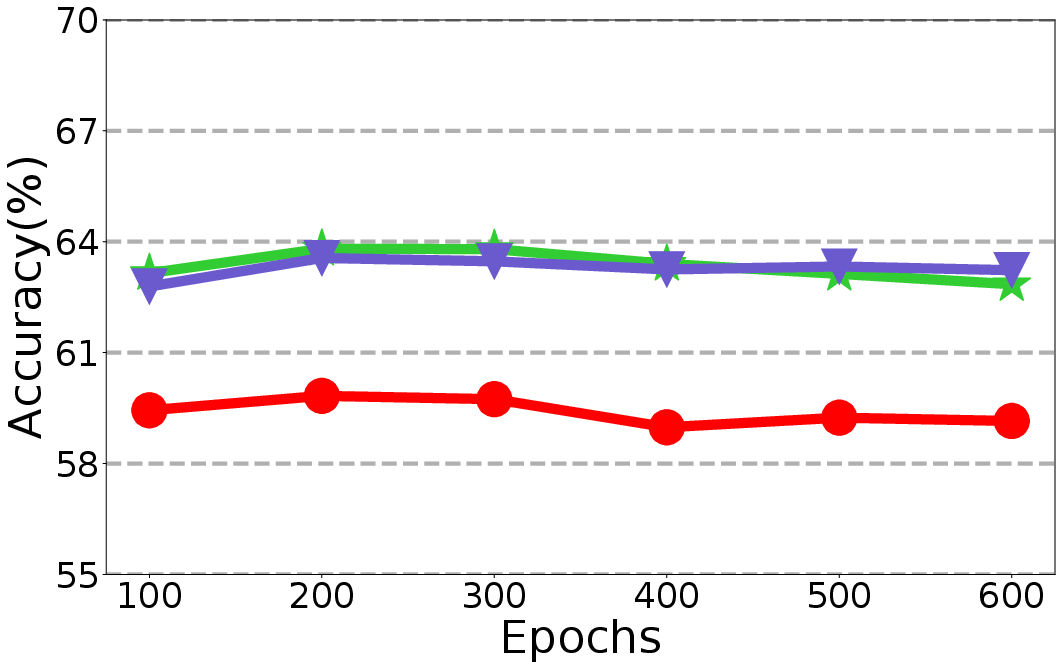
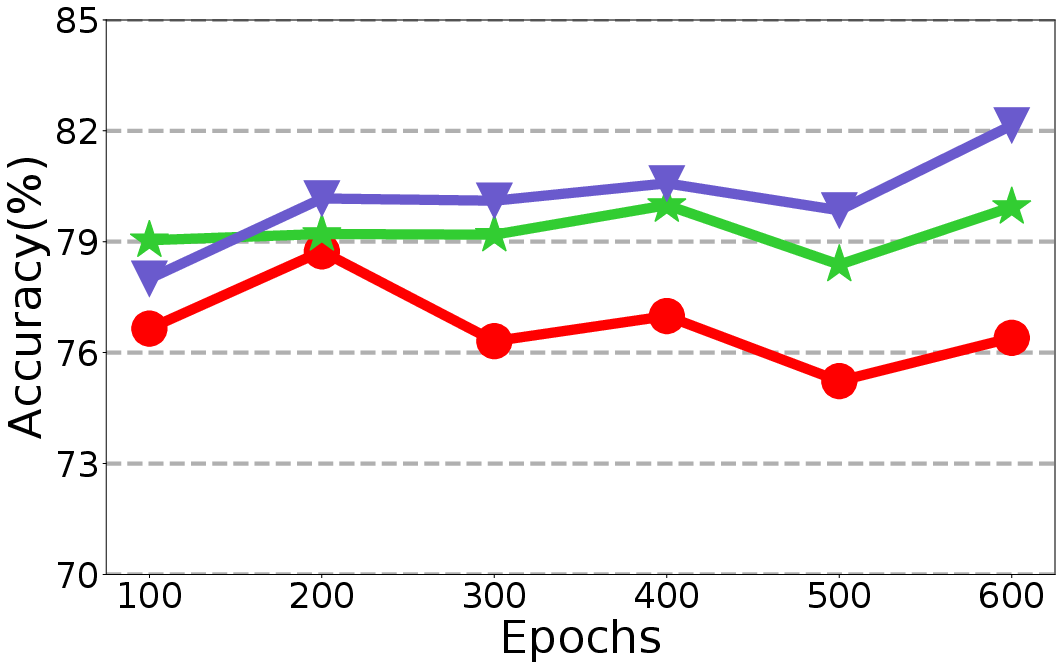
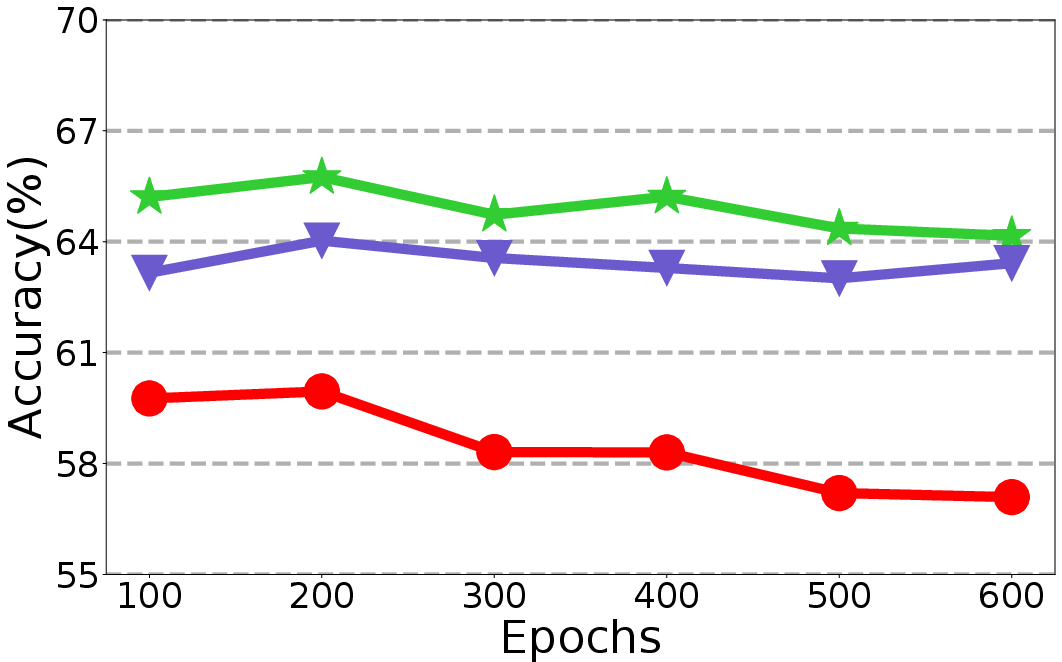
Figure 4: Linear evaluation accuracy on the source dataset (CIFAR10 or STL-10) and the averaged accuracy on all transfer datasets with varying epochs.
Moreover, the experiments verify the robustness of the proposed method across different contrastive learning models, including SimCLR, BYOL, and Barlow Twins. The approach consistently yields improvements in precision for object detection and instance segmentation tasks, as demonstrated by the experiments on VOC07+12 and COCO datasets.
Implications and Future Directions
The insights offered by this study are significant for the design of future contrastive learning models. By elucidating the intrinsic inefficiencies of minimal sufficient representations, the paper lays groundwork for more comprehensive frameworks that ensure sufficiency across a broader range of tasks. Enhancing mutual information as regularization opens new avenues for research into unsupervised representation learning without reliance on downstream task information during training.
The proposed method is versatile, applicable to various contrastive learning architectures, thereby broadening its impact. The authors suggest potential integrations with reconstruction models, heralding a promising direction for future work in achieving richer representations that combine sufficiency and discriminative power.
Conclusion
The investigation into minimal sufficient representations reveals crucial shortcomings that can lead to decreased performance in downstream applications. By increasing mutual information between input and representations, robust enhancements in task relevance and model generalization are achieved. The rigorous theoretical and empirical analysis provide a solid foundation for advancements in self-supervised learning methodologies. This work stimulates further explorations into the delicate interplay between shared and non-shared information in view-centric learning frameworks, setting the stage for the next generation of contrastive learning paradigms.

