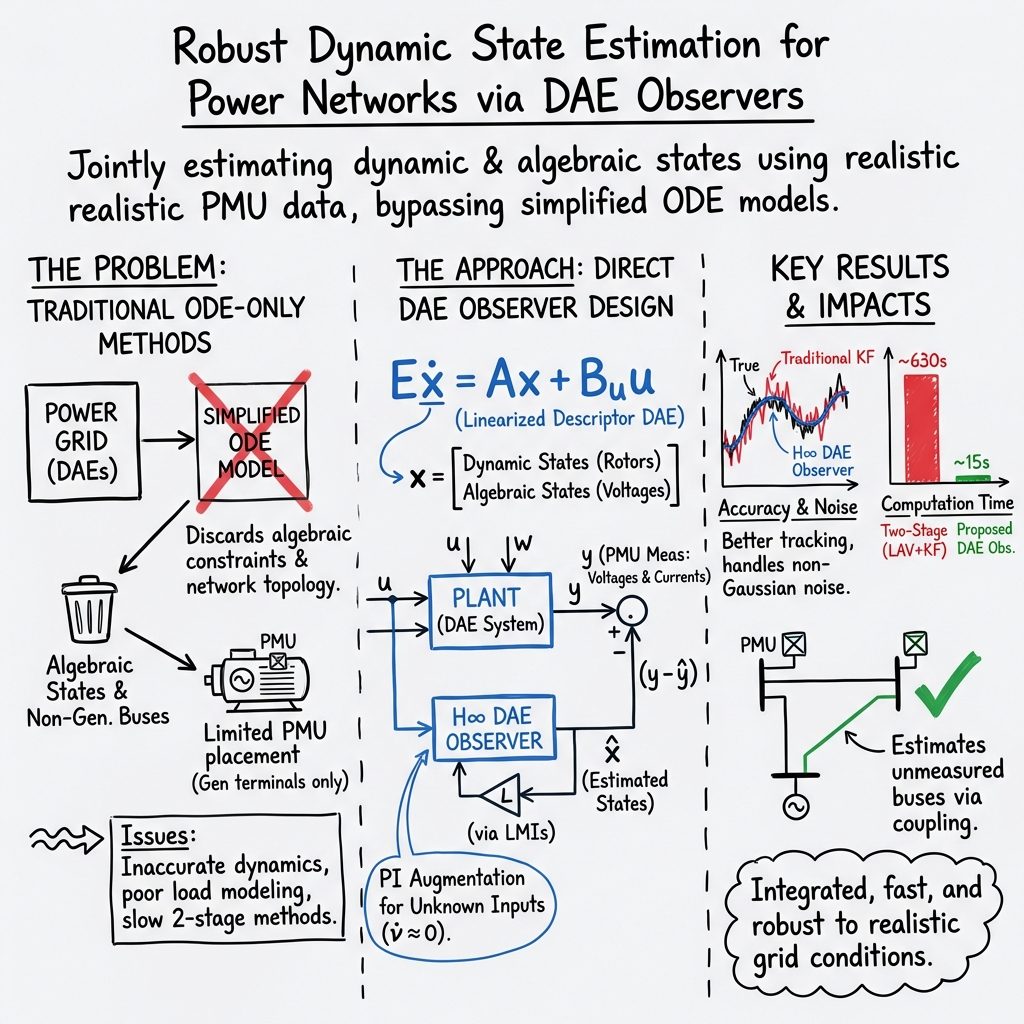
- The paper introduces an H-infinity observer for simultaneous estimation of dynamic and algebraic states in DAE-modeled power networks.
- It employs LMIs for robust design to mitigate process noise and sensor failures, validated on IEEE test systems.
- The approach significantly improves state estimation accuracy and computational efficiency in contingency scenarios.
Observers for Differential Algebraic Equation Models of Power Networks
Introduction
The paper "Observers for Differential Algebraic Equation Models of Power Networks: Jointly Estimating Dynamic and Algebraic States" (2202.13254) presents a differential-algebraic equation (DAE)-based framework for dynamic state estimation (DSE) in power networks. The authors focus on leveraging the differential-algebraic nature of power networks by proposing an observer-based method that simultaneously estimates both dynamic and algebraic states using phasor measurement units (PMUs). This approach addresses the limitations of traditional DSE methods that typically overlook algebraic components within power networks.
Methodology
The authors develop a robust H∞ observer to handle various system uncertainties, including process noise and sensor failures. The development begins with a detailed modeling of power networks using DAEs, capturing the complex interactions between generators, loads, and network elements. These models incorporate generator transient dynamics, stator algebraic constraints, and bus power flow equations, resulting in a model that better reflects the network's actual state.
Key features of the proposed observer include the following:
- Unified DAE Model: The model combines complex generator dynamics and bus-level measurements to better capture the state of power networks.
- H∞ Observer Design: The observer is designed using linear matrix inequalities (LMIs), which allows it to be robust against disturbances and uncertainties without relying on noise statistics.
- Simultaneous State Estimation: Both dynamic states (e.g., rotor speeds, voltages) and algebraic states (e.g., bus voltages) are estimated concurrently, using partial-state measurements provided by PMUs.
Numerical Simulations and Results
The paper validates the proposed framework through extensive simulations on IEEE standard test systems, notably the 9-bus and 39-bus systems. The simulations demonstrate the capability of the proposed observers to accurately estimate states under various operating conditions, including contingency scenarios like three-phase faults. Comparative analyses with traditional two-stage methods (e.g., LAV and KF) highlight the proposed method's effectiveness in terms of estimation accuracy and computational efficiency.
Notable results include substantial error reduction in state estimation compared to existing methods, especially under scenarios with noise and unknown inputs. These improvements highlight the robustness of the H∞ observer in dynamic environments subject to real-world conditions.
Implications and Future Directions
The development of a robust observer for DAE models of power networks has significant implications for real-time power system monitoring and control. By accounting for the network's algebraic constraints, the proposed framework enhances the accuracy and reliability of state estimation, which is crucial for grid stability and fault management.
Potential future research directions include extending the approach to nonlinear DAE models, exploring decentralized estimation strategies, and integrating the framework with advanced control schemes to support autonomous grid operations. Additionally, investigation into the broader applicability of the observer formulation in other domains characterized by DAE dynamics may offer further advancements.
Conclusion
The proposed observer-based DSE framework represents a significant advancement in power system monitoring, particularly by integrating dynamic and algebraic state estimation within a single unified model. The research demonstrates that robust and efficient state estimation can be achieved even in complex and uncertain environments, paving the way for future developments in grid management and control applications.