- The paper demonstrates that high-resolution intra-day activity data significantly improves CNN-based predictions of chronic conditions, achieving an AUC up to 0.821.
- It employs CNNs with temporal convolutions and multi-task learning, integrating minute-level data to outperform traditional models.
- The results indicate potential for personalized health monitoring, particularly enhancing diagnosis of mental health and metabolic conditions.
Intra-day Activity Better Predicts Chronic Conditions
Introduction
The study investigates the utility of intra-day activity data collected via mobile health (mHealth) devices to predict chronic health conditions. It posits that fine-grained data collected at the minute level can enhance classification accuracy for self-reported chronic conditions, particularly those related to mental health and nervous system disorders. The paper leverages Convolutional Neural Networks (CNNs) to assess the predictive power of multivariate time series data, and explores the applicability of multi-task learning to improve classification performance across various conditions.
Data and Methodology
Data was sourced from 7,261 users of a wellness platform, comprising demographic, health metrics, and intra-day activity data recorded by passive trackers. Users self-reported diagnoses across two condition clusters: mental health/nervous system (MH/NS) and metabolic/circulatory (M/C). The study evaluates the contribution of data collected at varying resolutions (e.g., daily vs. minute-level) in diagnosing these conditions, employing CNNs trained via both single-task (ST) and multi-task (MT) settings.
The CNN architecture consists of two primary components: a feature extraction stage through temporal convolutions using tanh activation and max pooling layers, followed by a fully connected MLP layer with ReLU activation. The learning objective minimizes the negative log likelihood of true labels, with dropout applied before pooling and MLP layers for regularization.
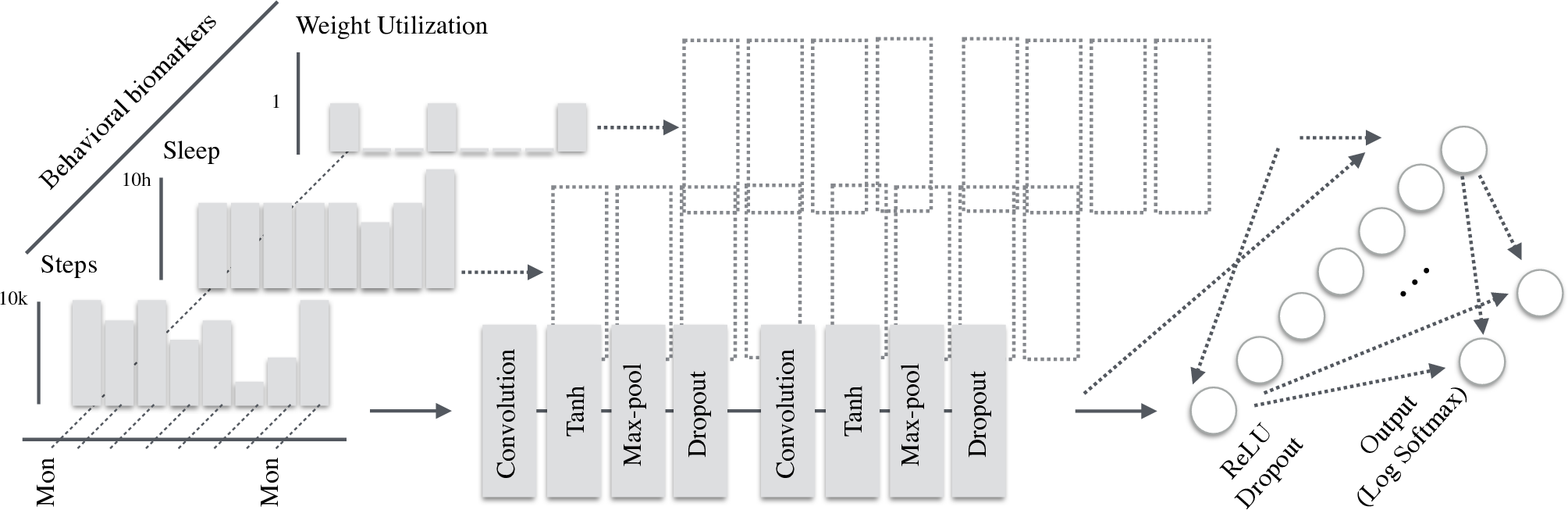
Figure 1: The temporal CNN architecture.
Results and Evaluation
The study measured model performance using AUC scores from binary classification over four cross-validation folds. The MT CNN configuration consistently outperformed baseline models (e.g., Logistic Regression, Random Forest) with an AUC of 0.719, which was statistically significant compared to ST CNN and other baselines. Particularly high performance was observed in predicting type 2 diabetes, with the MT CNN achieving an AUC of 0.821.
An in-depth layer analysis revealed incremental AUC improvements with the integration of higher granularity data. For MH/NS conditions, minute-level activity data notably enhanced performance metrics, while M/C conditions demonstrated more reliance on demographic and basic health data metrics.
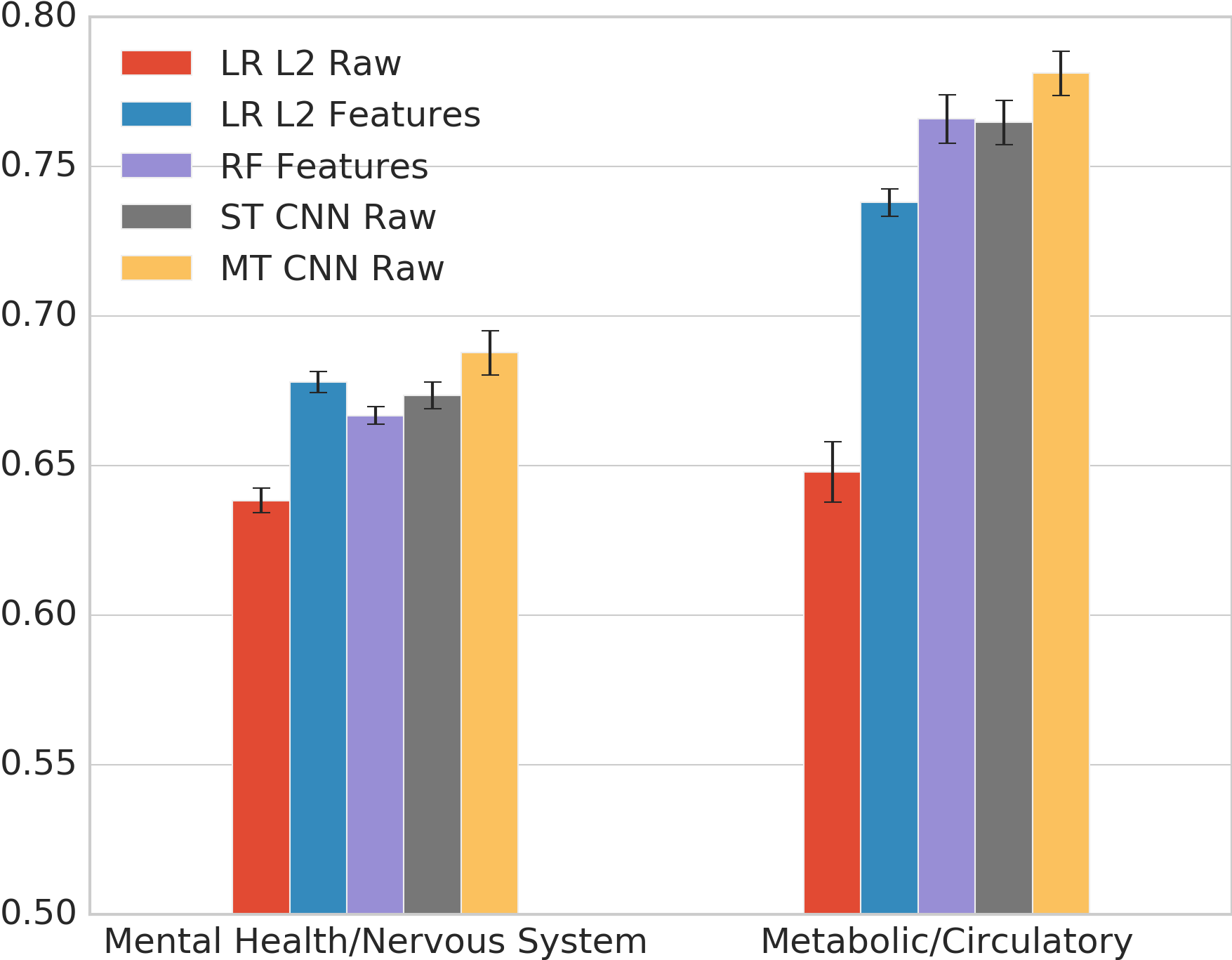
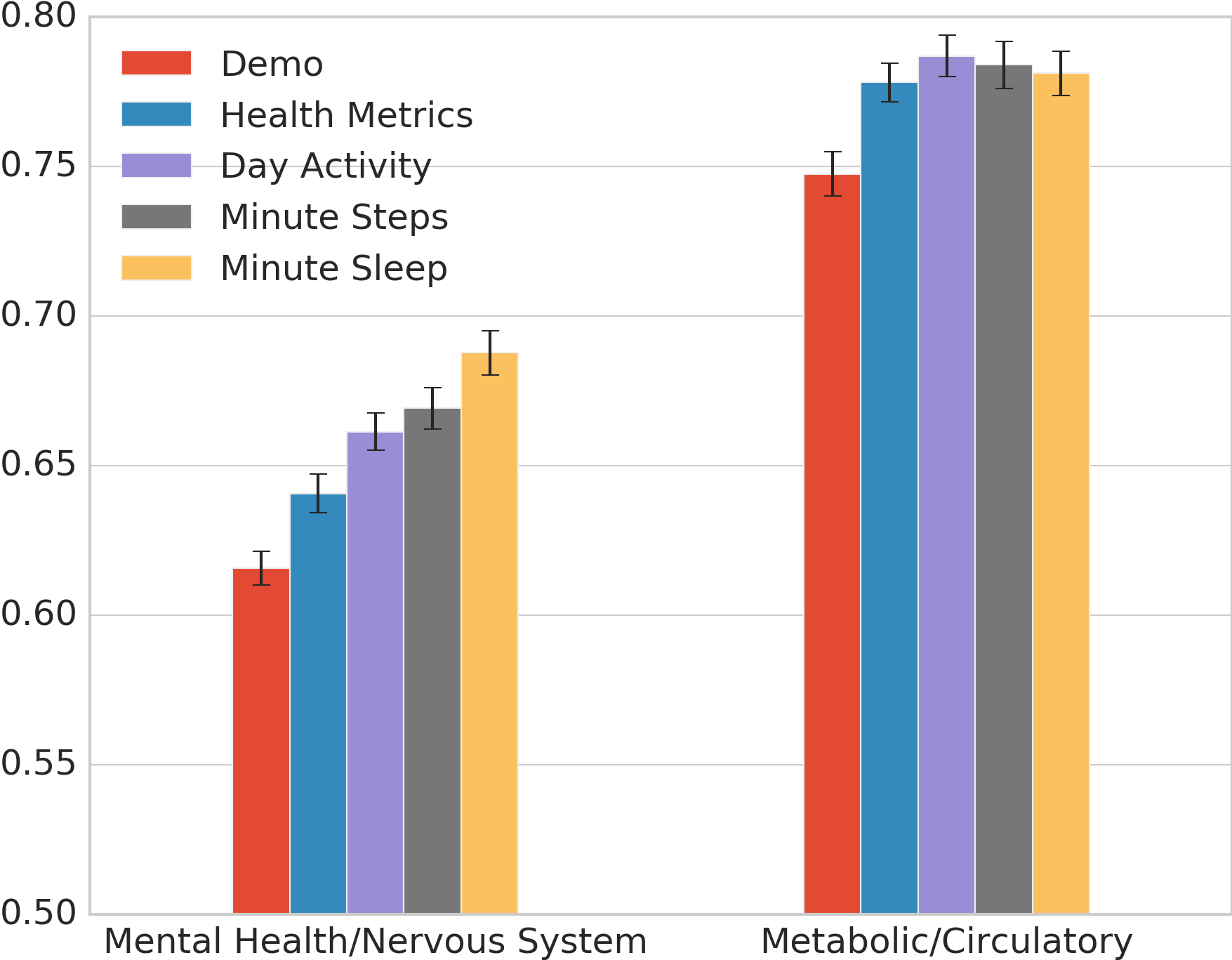
Figure 2: AUC by classifier for the full dataset.
Discussion and Implications
The findings indicate that the integration of high-resolution intra-day data from mHealth devices can significantly enhance prediction capability for specific chronic conditions. Mental health and nervous system disorders, in particular, benefit from more granular data-level insights, underscoring the need for tailored sensing frameworks in developing precision medicine approaches. The multi-task learning paradigm effectively leverages feature generalization across related tasks, providing implications for designing robust models in the presence of limited labeled data.
The study indicates that using CNNs for raw temporal time-series data efficiently circumvents the requirement for manual feature engineering, fostering advancements in application-specific health monitoring systems. Grounded in these insights, future research may focus on refining sensing modalities and exploring additional condition clusters to further enhance predictive accuracy and facilitate personalized healthcare interventions.
Conclusion
This work elucidates the predictive value of intra-day activity data for chronic condition diagnosis, emphasizing the role of CNNs and multi-task learning in extracting meaningful patterns from mHealth data. Such methodologies have substantial potential to improve health monitoring and enable informed health interventions tailored to individual patient profiles. As wearable technology proliferates, further research should continue to explore the potential of data at varying granularities in contributing to the precision health paradigm.