Weight-Space Programming Doesn't Need Transformers
When large language models write neural networks directly instead of training them with gradients, the best architecture changes dramatically. This presentation examines a provocative finding: sparse associative memories outperform dense Transformers when an LLM must construct a model by explicitly writing weights line by line, achieving higher accuracy with 1,800 times fewer parameters and 17 times faster inference on science question benchmarks.Script
What if the best architecture for a neural network depends not on what it learns, but on how you build it? When a large language model writes a model's weights directly instead of training them with gradients, Transformers stop being the obvious choice.
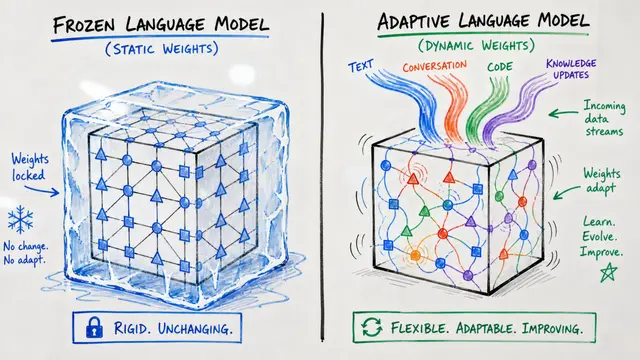
Gradient descent jointly optimizes millions of parameters to fit data. Weight-space programming asks an Large Language Model to write each weight explicitly, line by line, with no training objective. Under this regime, the properties that make Transformers powerful during training become liabilities during authoring.
When allowed to choose freely, three frontier Large Language Models converged on the same design: sparse fact tables where each written line stores an addressable record. Claude Opus 5.5 built a model with 361,150 vocabulary words mapped to 3,368 concepts and 4,288 explicit fact rows. Predictions trace back to individual facts, not distributed activations.
The accuracy advantage is dramatic. Claude's first-generation table model reached 50.8 percent on ARC with 0.94 million parameters, exceeding the best written Transformer at 1,800 times fewer parameters. The proposed associative memory model reached 49.6 percent at 2.53 million parameters while running 7 times faster on a GPU, increasing to 17 times faster by generation five.
Why do tables win? Removing one line from a table model changes fewer than one answer on average. Removing one line from a written Transformer changes 38 percent of predictions because dense representations entangle unrelated facts. The Large Language Model cannot debug what it cannot trace.
This work shows that architecture is not independent of how weights are produced. When an Large Language Model writes a model explicitly, sparse memories provide traceability and locality that dense architectures sacrifice for joint optimization. Visit EmergentMind.com to explore this paper further and create your own video summaries of the latest research.