Vector Balancing via Directional Total Variation
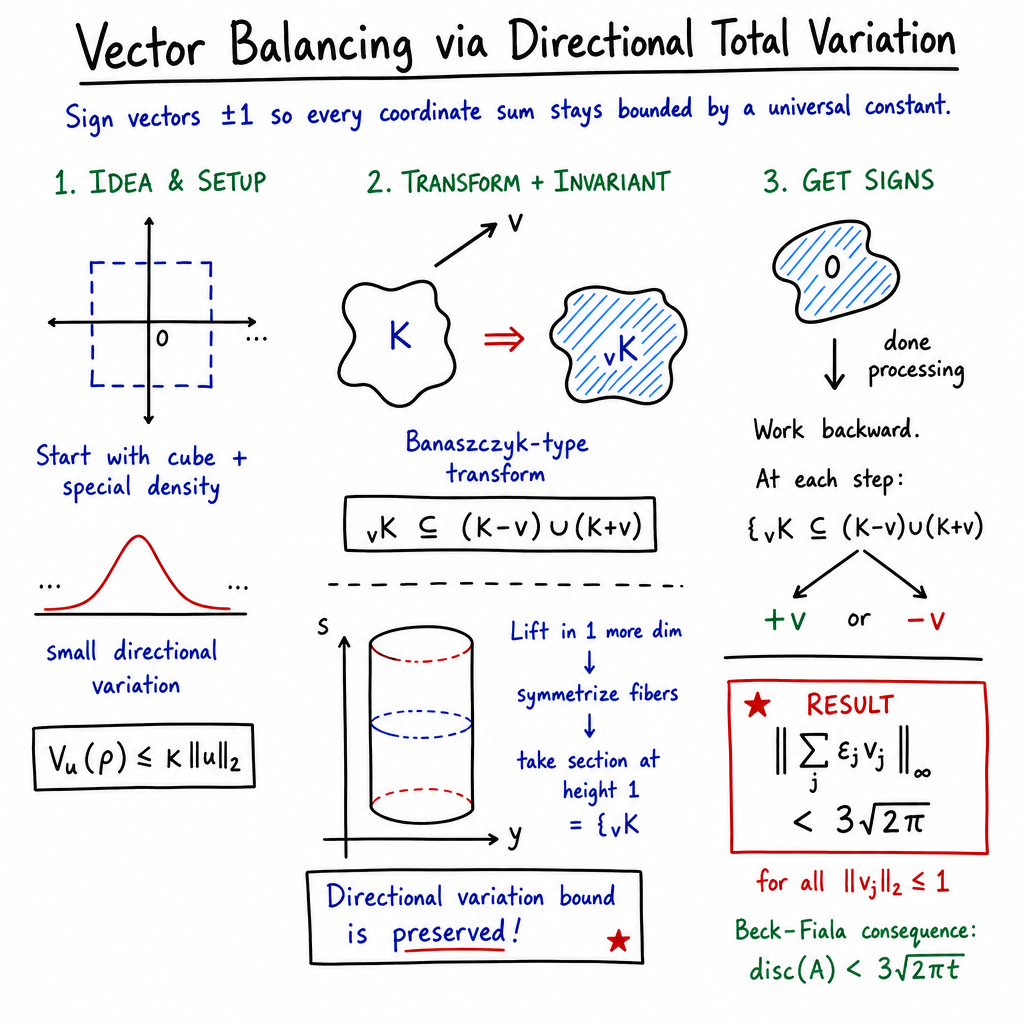
Abstract: Our main result is a bound for the Komlós signing problem: every finite family of real vectors of Euclidean norm at most one admits a signed sum of -norm less than this constant, independently of the dimension and the family size. For any , if a bounded open convex set supports a probability density with directional total variation at most in every unit direction, then its open-set Banaszczyk transform supports another such density with the same , provided the translation vector satisfies . As a consequence, every finite set system in which each element belongs to at most sets, where is an integer, admits a two-coloring whose imbalance in each set is less than . This gives the square-root dependence predicted by the Beck-Fiala conjecture. The proof was discovered by the Odin Automatic AI Research Agent.
Paper Prompts
Sign up for free to create and run prompts on this paper.
Top Community Prompts
Explain it Like I'm 14
1. What is the paper about?
This paper studies how to balance many quantities at the same time by choosing either a plus or minus sign for each vector.
Imagine having arrows pointing in different directions. For each arrow, you must choose either:
- keep it as it is, using
+1, or - turn it around, using
-1.
The goal is to make the final combined arrow small in every coordinate direction.
The paper proves that this can always be done when every arrow has Euclidean length at most 1. In particular, it proves the bound
where each is either or .
Since is about 7.52, the result says that no matter how many vectors there are or how many coordinates they have, their signed sum can be kept below this fixed number in every coordinate.
The paper calls this a solution to the Komlós signing problem.
2. What questions are the researchers asking?
The main research question is:
If every vector is individually small, can we choose plus and minus signs so that their total sum stays small in every coordinate?
The paper also studies a related problem about set systems.
Suppose we have many objects and many sets. Each object may belong to several sets. We want to color every object either red or blue so that, in each set, the numbers of red and blue objects are almost equal.
The researchers ask:
- Can every object be colored one of two colors while keeping every set nearly balanced?
- How does the answer depend on the largest number of sets containing the same object?
- Can the imbalance grow only like the square root of that number?
The paper shows that the answer is yes.
3. How did they approach the problem?
The proof uses geometry, probability, and a mathematical idea called directional total variation.
Choosing signs by keeping a point inside a shape
The researchers first imagine a large, symmetric shape, such as a cube centered at zero.
They try to keep a moving point inside this shape. At each step, they add either or . If they can always choose a sign that keeps the point in the shape, then the final signed sum stays inside the cube.
Being inside the cube means that every coordinate of the sum is small.
Densities as “clouds of probability”
Instead of following just one point, the proof places a probability cloud inside the shape. A probability density describes where the cloud is concentrated.
The cloud is chosen so that it does not change too much when shifted slightly in any direction.
This is measured by directional total variation. In everyday terms, it asks:
If we slide the cloud a little in a particular direction, how much of the cloud fails to overlap its original position?
If the cloud changes only a little, then small movements are unlikely to push too much mass outside the allowed shape.
The vector-balancing transformation
For each vector , the paper changes the current shape in a special way. Roughly speaking, it keeps the points that can be reached by adding either or .
The important result is that the new shape still contains a probability cloud with the same “not changing too quickly” property.
This process can be repeated for all the vectors.
At the end, symmetry guarantees that there is still a possible choice of signs leading to a point inside the original cube.
A geometric lifting trick
A particularly clever part of the proof adds an extra coordinate, like giving every point a temporary vertical position.
The researchers create a higher-dimensional shape and then rearrange the probability cloud along vertical lines so that it becomes symmetric. This rearrangement:
- does not increase the amount of horizontal change,
- preserves the total probability,
- and leaves enough cloud at the required height.
This lets them transfer the useful properties of the higher-dimensional cloud back to the original problem.
Starting with a special cube-shaped density
The proof begins with a carefully chosen probability density inside a cube. It has the form
inside the cube and zero outside.
A reader does not need the exact formula to understand its role. It is a smooth cloud that becomes zero near the cube’s boundary and is easy to analyze. The researchers show that its directional variation is small enough to begin the repeated signing process.
Cheeger-type geometric argument
The paper also uses ideas related to the Cheeger constant, which measures how difficult it is for a shape to have a small boundary compared with its area or volume.
In simple terms, the researchers compare:
- how much boundary a probability cloud has, and
- how much space it occupies.
They use this to show that if average slices of a larger shape behave well, then one particular slice also contains a cloud with the desired properties.
4. What are the main findings?
A constant bound for vector signing
The central theorem says:
Given any finite collection of vectors with Euclidean length at most 1, signs can be chosen so that every coordinate of the signed sum has absolute value less than .
This bound is independent of:
- the number of vectors,
- the number of coordinates,
- and the particular arrangement of the vectors.
That is important because a simple method might produce an error that grows as more vectors or coordinates are added. This theorem shows that the error can remain bounded by one universal constant.
A result for two-coloring set systems
The paper applies the vector result to set systems.
If every object belongs to at most sets, then the objects can be colored red or blue so that the imbalance in every set is less than
The imbalance means the difference between the number of red and blue objects in that set.
For example, if a set contains 20 red objects and 17 blue objects, its imbalance is 3.
The result says that the imbalance grows like rather than like . This is much better when is large.
Connection to the Beck–Fiala conjecture
The Beck–Fiala conjecture predicted that the imbalance should grow proportionally to the square root of .
The paper obtains exactly this square-root type of dependence:
The constant in front is not claimed to be the best possible, but the important part is the square-root behavior.
The proof is existential
The result proves that a good signing or coloring exists.
However, the paper does not provide a practical, efficient algorithm for finding the signs. In other words, it shows that a solution is guaranteed to be somewhere, but it does not explain how to quickly locate it for a large input.
The paper also says that the constant may not be optimal.
5. Why is this research important?
Balancing problems appear in many areas, including:
- scheduling,
- rounding fractional solutions in optimization,
- dividing resources fairly,
- designing experiments,
- distributing workloads,
- and making yes-or-no decisions while keeping many totals accurate.
For instance, an optimization problem may say that each item should be chosen “halfway,” meaning a value of $0.5$. In reality, an item often must be either chosen or not chosen. A good coloring or signing helps convert those halfway choices into definite decisions without creating large errors in many measurements.
This paper is important because it gives a strong theoretical guarantee:
Many small contributions can be assigned positive or negative signs so that all measurements remain simultaneously under control.
Its methods are also interesting because they combine several areas of mathematics:
- geometry of convex shapes,
- probability densities,
- calculus,
- optimization,
- and the study of boundaries and variation.
The paper says that its proof was constructed with help from the Odin Automatic AI Research Agent. Regardless of how the proof was discovered, the mathematical result itself is an existence theorem: it guarantees that balanced sign choices are possible, although an efficient way to find them is not established here.
Simple takeaway
The paper proves that a large collection of small vectors can always be flipped in suitable directions so that their combined effect stays limited in every coordinate. As a consequence, objects in a complicated collection of sets can be divided into two groups with nearly equal sizes in every set. The error grows only like the square root of how many sets contain one object, which is a major improvement over older, more basic bounds.
Knowledge Gaps
Knowledge gaps, limitations, and open questions
- The proof is explicitly existential and does not provide a polynomial-time algorithm for constructing the recursive domains, evaluating membership, selecting the intermediate densities, or recovering the signs.
- It is unclear whether the variation-preserving transform can be implemented efficiently, particularly the steps involving anisotropic Cheeger minimization, convex separation, BV compactness, and fiber rearrangement.
- The constant is not shown to be optimal for the Komlós signing problem; the gap between this bound and the lower bound approaching remains unresolved.
- The coefficient is proved optimal only within the specified product cosine-squared density family, not among all densities supported on a cube or all possible initial domains.
- The stability threshold is not established as optimal; the paper only explains its origin for the chosen truncation, uniform linear translation estimate, and lift construction.
- It remains unknown whether alternative lifts, rearrangements, or variation estimates could permit larger signing steps and thereby improve the final constant.
- The argument does not yield a prefix guarantee: it controls the final signed sum but does not ensure that every partial sum remains uniformly bounded.
- The method is not extended to online or adversarially ordered signing, where signs must be chosen sequentially without knowledge of future vectors.
- The paper does not quantify how the resulting discrepancy depends on numerical approximation errors in densities, domain representations, variation estimates, or sign-recovery queries.
- The directional variation invariant requires one common density controlling every direction, but the existence proof is nonconstructive and does not describe the structure or regularity of such an optimal density.
- The intermediate density may change at every recursive step; the paper does not determine whether a single fixed density, or a more structured family of densities, could preserve the same bound.
- The Cheeger convexity argument is developed for bounded open convex sections and finite mixtures of absolute linear forms; extensions to unbounded domains, nonconvex domains, or more general anisotropic variation functionals are not addressed.
- The proof relies on regularization through smooth strongly convex norms and a limiting argument, but quantitative stability of the eigenvalue and Cheeger estimates under this degeneration is not developed.
- The treatment does not establish uniqueness, existence of minimizers with additional regularity, or geometric descriptions of anisotropic Cheeger sets for the degenerate mixture energies used in the common-density argument.
- The dependence of the prescribed-section construction on the dimension is not quantitatively analyzed beyond the final dimension-free discrepancy constant.
- The method is not applied to weighted discrepancy matrices, signed or real-valued incidence matrices, or vectors in norms other than the Euclidean-to- setting.
- The Beck–Fiala consequence gives the order for every , but does not determine the optimal universal constant or resolve whether the conjectured bound can be achieved with a substantially smaller coefficient.
- The result does not address additional Beck–Fiala regimes, such as bounded row degree, sparse but weighted systems, hereditary discrepancy, or discrepancy under restrictions to subfamilies.
- No lower-bound examples are constructed specifically for the directional-total-variation framework, so it is unclear which features of the method impose genuine barriers and which are artifacts of the proof.
- The relationship between directional total variation and other balancing quantities, such as vector discrepancy, Gaussian measure, Fisher information, or spectral-independence methods, is described qualitatively but not formalized through comparison theorems.
- The paper does not determine whether the directional-variation approach can reproduce the stronger asymptotic Komlós bounds currently known, or whether it inherently yields only an absolute constant.
- The proof’s dependence on external eigenvalue-convexity results leaves open whether a shorter self-contained argument exists for the specific anisotropic functionals required here.
- The stated BV translation identities and compactness arguments are used in a highly structured convex setting; their robustness under weaker regularity assumptions or approximate support constraints is not investigated.
- The claimed proof was constructed with assistance from an automatic AI research agent, but the paper does not analyze reproducibility, formal verification, error detection, or the extent to which the argument can be independently machine-checked.
Practical Applications
Immediate Applications
- Discrepancy-aware rounding in combinatorial optimization — software, operations research, and logistics. The theorem provides a dimension- and family-size-independent guarantee: vectors with can be assigned signs so that every coordinate of the signed sum has magnitude below . This can support rounding fractional solutions in scheduling, resource allocation, facility location, packing, and network design while controlling many linear constraints simultaneously. Potential workflow: represent each decision variable as a vector of its normalized effects on all constraints, compute a signing, and convert signs into a binary rounding direction. Dependency: the paper’s result is existential; it does not provide a polynomial-time signing algorithm. Existing algorithmic discrepancy methods may be needed for deployment, generally with different constants or bounds.
- Balanced two-coloring of bounded-degree incidence systems — supply chains, experimental design, and data partitioning. For a binary incidence matrix in which each item belongs to at most sets, the paper guarantees a coloring with set imbalance below . This can be used to divide items into two groups while keeping inventories, memberships, workloads, or coverage counts approximately equal. Examples: splitting a product catalog across warehouses, assigning observations to two experimental batches, partitioning documents across processing queues, or dividing users into two balanced cohorts. Dependency: the guarantee controls aggregate imbalance, not fairness for individual items or prefixes of an incoming stream.
- Constraint-preserving rounding of fractional allocations — optimization and finance. Since discrepancy is equivalent, up to a factor of two, to rounding the fractional vector into binary decisions, the result can be incorporated into integer-programming pipelines. It is particularly relevant when each variable has bounded total squared influence across constraints. Potential tool: a discrepancy-based post-processing module that takes a fractional allocation and seeks a binary solution with bounded simultaneous constraint error. Dependency: the theorem directly addresses signings and uniform fractional starting points; extensions to arbitrary fractional vectors, weighted variables, or heterogeneous tolerances require additional analysis.
- Balanced sample splitting and experimental allocation — academia, healthcare research, and public policy. Incidence systems can encode covariate memberships, treatment strata, demographic categories, or laboratory batches. The Beck–Fiala consequence gives a principled way to split observations into two groups while controlling imbalance across all categories when each observation participates in at most categories. Potential workflow: construct an observation-by-stratum matrix, normalize columns, and use a discrepancy solver to generate balanced treatment or validation splits. Dependencies: statistical validity also requires attention to randomization, hidden covariates, dependence, and treatment effects; a low combinatorial discrepancy alone does not guarantee unbiased inference.
- Simultaneous balancing of multiple resource or monitoring signals — energy, telecommunications, and computing. Each vector coordinate can represent consumption, load, interference, or risk in a different channel. The result indicates that binary activation or assignment decisions can be selected so that all channels remain within a constant normalized error when individual actions have bounded Euclidean impact. Examples: assigning jobs to two execution modes, dividing sensors into two maintenance groups, or balancing workloads across multiple network links. Dependency: vectors must be accurately modeled and normalized; the guarantee concerns a static finite collection rather than changing system conditions.
- Geometric and variational analysis tools — mathematics and scientific computing. The paper develops reusable results concerning directional variation, anisotropic Cheeger constants, convex sections, fiber rearrangement, and stability of densities under the Banaszczyk transform. These techniques can inform proofs and computational formulations for anisotropic perimeter minimization, shape optimization, convex geometry, and PDE-based analysis. Potential outputs: numerical solvers for anisotropic Cheeger problems, convex-body transformation libraries, or symbolic verification tools for directional-variation inequalities. Dependency: the paper establishes mathematical existence and stability, not numerical convergence rates or practical implementations.
- Evaluation of AI-generated mathematical proofs — academia and AI research. The paper explicitly reports that its proof was constructed by an automatic AI research agent. This supports an immediate research workflow in which AI systems propose geometric, variational, or discrepancy-theoretic arguments that are subsequently checked by formal proof assistants or expert mathematicians. Dependency: AI attribution does not establish correctness; independent verification is essential, particularly because the supplied text contains apparent typesetting and transcription irregularities.
Long-Term Applications
- Polynomial-time constant-quality vector-balancing algorithms — optimization software. A major long-term goal is to convert the existential signing theorem into an efficient algorithm. Such an algorithm could provide dimension-independent constraint guarantees for large-scale integer rounding and binary allocation. The recursive domain construction, membership queries, and reverse sign recovery would need explicit polynomial-time implementations. Key research requirements: efficient representations of transformed convex bodies, tractable density or variation certificates, numerical stability, and provable runtime and approximation guarantees.
- Online and streaming balancing with prefix guarantees — real-time systems and finance. The paper emphasizes that it controls the final signed sum, not every prefix. A future extension could assign signs as vectors arrive while keeping all intermediate discrepancies bounded. Applications: online inventory allocation, streaming load balancing, sequential portfolio exposure control, adaptive sensor activation, and real-time ad or task assignment. Dependencies: online inputs may be adversarial; stronger assumptions such as random order, bounded arrivals, or look-ahead may be necessary. Existing online discrepancy results suggest that final-sum guarantees cannot automatically be transferred to prefix guarantees.
- Multiway and weighted rounding — machine learning, public policy, and integer programming. The current result is a two-coloring theorem. Extensions to -way partitions, nonuniform signs, arbitrary fractional starting points, or categorical assignments could support balanced clustering, fair division, and multi-arm experimental design. Dependencies: the appropriate discrepancy bound may depend on , the geometry of the target body, and the fractional configuration. The present proof does not directly establish these extensions.
- Fairness-aware allocation across many overlapping groups — healthcare, education, and hiring. The Beck–Fiala consequence could eventually be adapted to assign individuals, services, or opportunities across groups while limiting discrepancies across overlapping demographic, geographic, or eligibility categories. Potential products: fairness-constrained scheduling systems, balanced admissions or scholarship allocation tools, and group-aware recommendation pipelines. Dependencies: real fairness settings involve protected attributes, intersectional groups, privacy constraints, and unequal group sizes. Combinatorial balance is only one component of procedural and outcome fairness, and normalization assumptions must be made explicit.
- Robust distributed control and robotics — robotics and autonomous systems. Robot actions, sensor assignments, or control primitives can be represented as vectors whose coordinates encode effects on position, energy, communication, and collision-risk constraints. A future algorithm could select binary action patterns with bounded simultaneous deviation. Dependencies: the theorem is static and assumes exact vector knowledge. Real robots require dynamic, noisy, feedback-based, and often nonconvex control; stability under model error and temporal coupling would need to be proved.
- Portfolio and risk balancing — finance. Assets or trades could be represented by vectors of exposures to sectors, factors, stress scenarios, or liquidity constraints. A discrepancy-based signing or rounding mechanism might convert fractional hedges into discrete buy/sell decisions while controlling aggregate exposures. Dependencies: financial returns and risks are stochastic, correlated, and time-varying. The Euclidean column-norm condition may be difficult to satisfy without conservative normalization, and transaction costs or market impact are not modeled.
- Energy and network scheduling — energy systems and telecommunications. A scalable algorithm based on the theorem could split or round flexible loads, renewable commitments, routing decisions, or channel assignments while maintaining bounded error across many operational constraints. Dependencies: practical deployment requires handling capacity inequalities rather than only symmetric signed errors, temporal ramping constraints, uncertainty, and physical feasibility. These may require embedding the discrepancy problem into a larger optimization model.
- Improved constants and near-optimal discrepancy guarantees — theoretical and applied optimization. The bound is not claimed to be optimal, and the paper notes lower-bound constructions approaching . Sharpening the constant could materially improve worst-case tolerances in applications where constraint violations are expensive. Research dependencies: better initial densities, improved directional-variation estimates, or alternative convex-body transforms are needed. The optimal constant may require methods beyond the current product-density and stability argument.
- Formal verification and automated theorem discovery — AI-assisted mathematics. The geometric proof architecture could become a benchmark for AI systems that discover arguments involving functions, convex geometry, anisotropic eigenvalues, and measure-theoretic compactness. Formalized versions could support reliable theorem-proving assistants and reusable libraries for discrepancy theory. Dependencies: the proof must first be independently validated and encoded in a proof assistant. Automated systems would also need robust handling of measure-theoretic definitions, open-set conventions, boundary terms, and strict inequalities.
Glossary
- Affine spectral independence: A property controlling interactions among rows through affine or matrix-dependent spectral quantities. “Its proof controls interactions among rows through affine spectral independence”
- Anisotropic Cheeger constant: A weighted perimeter-to-volume ratio minimizing boundary cost relative to enclosed volume. “For a norm , this is the anisotropic Cheeger constant”
- Anisotropic perimeter: A perimeter functional that assigns direction-dependent costs to boundary orientations. “the uniform density on a set of finite perimeter and positive volume has energy equal to its anisotropic perimeter divided by its volume”
- Banaszczyk transform: A geometric transformation of a convex body used to maintain the possibility of recovering signs in vector balancing. “This is an open-set version of Banaszczyk's convex-body transform”
- Beck–Fiala conjecture: The conjecture that set systems with maximum element degree have discrepancy bounded on the order of . “This gives the square-root dependence predicted by the Beck--Fiala conjecture”
- Bounded variation (BV): A function class whose distributional derivative is a finite vector measure, allowing discontinuities such as boundary jumps. “The extension to functions of bounded variation (BV) includes boundary jumps.”
- Cauchy–Schwarz inequality: An inequality bounding an inner product by the product of the Euclidean norms of its arguments. “so Cauchy--Schwarz alone would give ”
- Cheeger convexity: Convexity of a Cheeger-type energy or constant under Minkowski combinations of convex domains. “Section~\ref{sec:cheeger} establishes the prescribed-section principle through Cheeger convexity”
- Coarea formula: A measure-theoretic identity decomposing the variation or perimeter of a function into the perimeters of its level sets. “The anisotropic BV coarea formula”
- Convex separation: A theorem-based method for separating disjoint convex sets by a linear functional. “Convex separation and compactness reconstruct a single density controlling all directions on that section.”
- Convex symmetrization: A geometric operation replacing fibers or sections by symmetric ones while preserving relevant convexity properties. “The Gaussian-threshold variant in that paper interacts with Ehrhard symmetrization”
- Directional total variation: The total variation of a function’s distributional derivative in a specified direction. “For a smooth compactly supported density , is its first-order -translation rate in direction .”
- Dirichlet eigenfunction: An eigenfunction of a differential operator subject to zero boundary conditions. “It is the square of the -normalized first Dirichlet eigenfunction of the cube.”
- Dirichlet Poincaré inequality: An inequality relating the norm of a function to the norm of its gradient under zero-boundary conditions. “Norm equivalence and the Dirichlet Poincaré inequality make this quantity positive and finite”
- Distributional derivative: A generalized derivative defined through integration against smooth test functions, applicable to nonsmooth functions. “When finite, this is the total variation of the distributional derivative ”
- Ehrhard symmetrization: A Gaussian-measure-preserving symmetrization technique for convex sets. “The Gaussian-threshold variant in that paper interacts with Ehrhard symmetrization”
- Fisher information: A quantity measuring the sensitivity of a probability density to translations or parameter changes. “using translation Fisher information to bound expected discards”
- Fatou’s lemma: A measure-theoretic result giving a lower bound for the integral of a pointwise limit inferior. “Fatou bounds the lower limit of these expectations from below by one”
- Fiber rearrangement: The replacement of each fiber of a density by a centered, symmetric decreasing fiber of equal measure. “The next lemma relates the geometric symmetral to fiberwise density rearrangement”
- Finite perimeter: A property of a measurable set whose indicator function has finite total variation. “the uniform density on a set of finite perimeter and positive volume”
- Gram–Schmidt walk: A randomized vector-balancing procedure that generates full colorings while controlling discrepancy. “The Gram--Schmidt walk of Bansal, Dadush, Garg, and Lovett samples full colorings”
- Hölder inequality: An inequality bounding an integral of a product using corresponding and norms. “the chain rule and H\"older give”
- Infimal convolution: An operation combining functions by minimizing weighted sums over decompositions of their arguments. “Infimal convolution and its gradients.”
- Jensen’s inequality: An inequality comparing a convex function of an average with the average of the function. “Jensen's inequality then bounds this value at the mass-weighted mean absolute height”
- Komlós signing problem: The problem of finding signs for vectors of bounded Euclidean norm so that their signed sum has uniformly bounded coordinate maximum. “Our main result is a bound for the Komlós signing problem”
- Layer-cake representation: A representation of a nonnegative function or integral through the measures of its superlevel sets. “layer cake give, for ”
- Log-concavity: The property that the logarithm of a function is concave, often yielding strong geometric and analytic regularity. “Thus is log-concave”
- Lower semicontinuity: The property that a functional does not increase under limiting processes from below. “The functional is convex and lower semicontinuous in .”
- Minkowski convexity: Convexity of a functional under Minkowski combinations of sets. “\begin{lemma}[Minkowski convexity]”
- Minkowski sum: The set obtained by adding every point of one set to every point of another. “”
- Partial coloring: A discrepancy-theoretic method that assigns signs or colors to a positive fraction of variables at each stage. “The partial-coloring method fixes a positive fraction of the variables at each stage.”
- Radon–Nikodym derivative: The density of one measure with respect to another measure. “ is the Radon--Nikodym density of the vector measure”
- Rayleigh quotient: A ratio of an energy integral to a norm integral used to define variational eigenvalues. “This same function is a Rayleigh test for every ”
- Reduced boundary: The measure-theoretically well-behaved portion of the boundary of a finite-perimeter set. “where is its reduced boundary”
- Steiner symmetrization: A geometric transformation that replaces fibers by centered intervals while preserving their lengths. “The Steiner symmetral”
- Sub-Gaussian bound: A tail or moment bound comparable to that of a Gaussian random variable. “samples full colorings with a constant sub-Gaussian bound on the discrepancy vector”
- Superlevel set: The set of points where a function exceeds a specified threshold. “Almost every superlevel set at a positive level has finite perimeter.”
- Total variation distance: A metric measuring the difference between two probability distributions, equal here to half their distance. “For probability densities , the total variation distance between their laws is a different quantity”
- Translation Fisher information: Fisher information associated with changes in a density under spatial translations. “using translation Fisher information to bound expected discards”
- Translation modulus: A bound describing how much a function changes in under translations. “so the translation modulus is uniform over the family.”
- Variational eigenvalue: An eigenvalue characterized as the infimum of an energy-to-norm quotient over an admissible function space. “For , put ”
- Vector discrepancy: A discrepancy variant in which scalar signs are replaced by unit vectors and row sums are measured using Euclidean norms. “Nikolov~\cite[Theorem~1.1]{Nik13} proved the constant-one bound for vector discrepancy”
- Weak cutoff argument: A truncation technique used to establish a global weak differential inequality despite singular or critical points. “It handles critical points by a weak cutoff argument”
- Weak derivative: A generalized derivative defined through integration by parts rather than pointwise differentiation. “The differential comparison is first made away from critical gradients; a cutoff then gives the global weak inequality”
- W Sobolev space: The space of functions whose first weak derivatives belong to , with imposing zero boundary values. “”