Bridging Noise and Data: Score-Based Generative Modeling through SDEs
This presentation explores how researchers unified score-based generative modeling with stochastic differential equations to create a powerful framework for generating high-quality images. By transforming data into noise through carefully designed diffusion processes and reversing them with neural networks, the approach achieves state-of-the-art results on CIFAR-10 while enabling flexible controllable generation tasks like inpainting and colorization without retraining.Script
Generating realistic images requires transforming random noise into structured data, but what if we could design that transformation as precisely as a physicist models particle diffusion? The authors of this paper did exactly that, treating image generation as a reversible stochastic process governed by differential equations.
Previous methods for score-based generation and diffusion models existed as separate approaches with different noise schedules and sampling strategies. This work unifies them under continuous stochastic differential equations, revealing they were solving the same underlying problem through different discretizations.
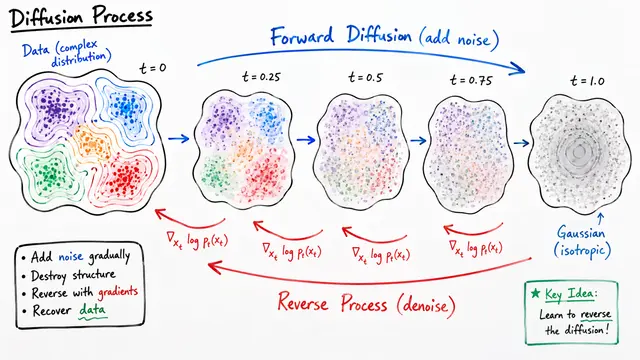
The framework works in two phases. First, a forward SDE gradually injects noise into data until it becomes a simple Gaussian distribution. Then, a neural network learns the score function, the gradient of the log probability, to reverse this process and generate new samples from pure noise.
The authors introduce three sampling strategies: basic numerical solvers that discretize the reverse SDE, predictor-corrector samplers that refine each step with score-based corrections, and probability flow ODEs that enable exact likelihood computation. On CIFAR-10, they achieved a record FID of 2.20 and an Inception Score of 9.89, surpassing previous generative models.
The framework enables controllable generation without retraining by conditioning the reverse SDE on external information. The authors demonstrate class-conditional sampling, image inpainting, and colorization, all achieved by modulating the same trained score function with task-specific conditioning.
By framing generative modeling as a continuous-time stochastic process, this work provides both theoretical elegance and practical power, unifying discrete approaches under a single differential equation framework. To dive deeper into score-based SDEs and explore more cutting-edge research, visit EmergentMind.com and create your own videos.