Quantum Probability from Temporal Structure
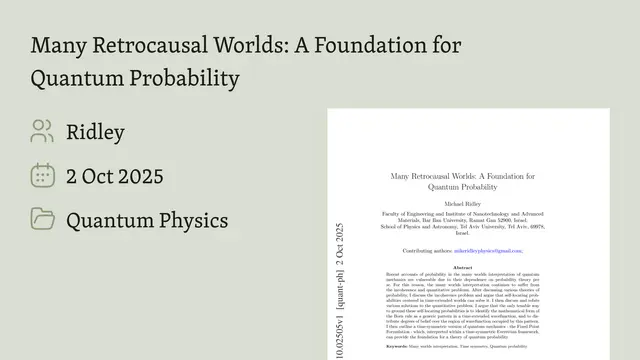
This presentation explores a radical reconceptualization of quantum mechanics that eliminates randomness by deriving the Born probability rule from the temporal structure of a universal wavefunction. Using the Keldysh time contour and a fixed point formulation, the authors demonstrate how quantum probabilities emerge deterministically from regions of the wavefunction rather than from stochastic collapse, offering a cleaner foundation for quantum theory with profound implications for our understanding of measurement and reality.Script
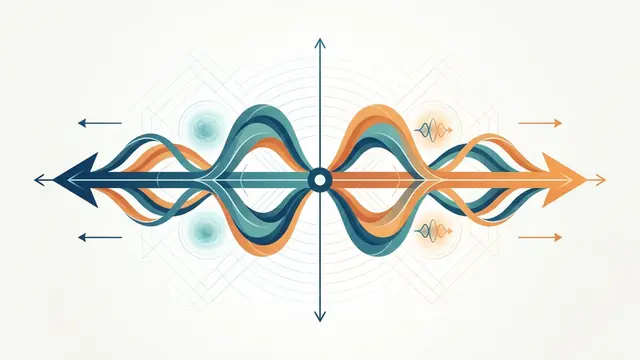
Quantum mechanics has a dirty secret: the Born rule, which tells us how to calculate probabilities, is just tacked on as an extra postulate. This paper shows how to derive it from something deeper—the temporal structure of the wavefunction itself, using a mathematical object called the Keldysh contour that lets time flow both forward and backward.
The authors propose that everything—every particle, every measurement, every outcome—exists within a single universal wavefunction that never collapses. Measurements aren't magical moment of randomness; they're just physical processes occupying specific temporal regions within this eternal structure.
Here's where it gets elegant. Fixed points on the Keldysh contour act as boundary conditions—each one simultaneously a source sending wavefunctions forward in time and a sink receiving them backward. The region where these temporal flows overlap becomes the physical measure of quantum probability.
The Born measure emerges naturally from this geometry. When you calculate the volume of wavefunction connecting boundary conditions through both temporal directions, you recover exactly the Born rule—no stochastic collapse needed. Probability becomes geometry.
This fixed point formulation corrects limitations in earlier time-symmetric approaches and extends naturally to sequences of multiple measurements. The ABL rule, which accounts for pre- and post-selected quantum states, falls out automatically when you consider all temporal regions between fixed points.
By grounding probability in temporal structure rather than randomness, this work offers a deterministic foundation for quantum mechanics with far-reaching implications for quantum gravity and our understanding of reality itself. Explore more cutting-edge physics papers and create your own video summaries at EmergentMind.com.