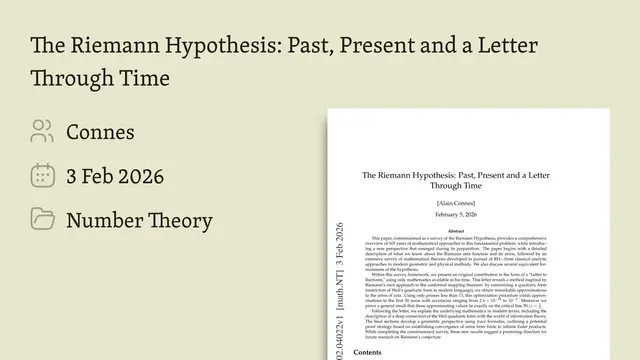
Two Thirds of Zeta Zeros Are Simple: A New Proof
This presentation explains a breakthrough unconditional proof that more than 67% of the Riemann zeta function's non-trivial zeros are both simple and on the critical line. The work replaces classical mollification techniques with a Hilbert-space inequality applied to an unconditional pair-correlation theorem, achieving the sharp Montgomery-Taylor constant without assuming the Riemann Hypothesis. The method demonstrates how conjugation symmetry and quadratic-form estimates can resolve two logically separate features—simplicity and horizontal location—through a single elegant construction.Script
For more than a century, mathematicians have tried to prove that the zeros of the Riemann zeta function lie on a single vertical line. This paper proves unconditionally that more than two thirds of them are not only on that critical line, but also simple, meaning they occur with multiplicity one.
Classical mollification methods, pioneered by Selberg and refined by Levinson and Conrey, had pushed the proportion of simple critical-line zeros to about 40%. Meanwhile, Montgomery's pair-correlation approach reached two thirds, but only by assuming the Riemann Hypothesis.
The new proof constructs nested subspaces in a Hilbert space, one for multiple real elements, one for all real elements, and one including conjugate pairs. An orthonormal basis adapted to this nesting converts the simplicity problem into a single quadratic inequality, avoiding the need to check individual terms for positivity.
The technical obstacle is that the unconditional pair-correlation theorem includes a rational weight factor that depends on the zero spacing. The authors remove it by forming a linear combination of the test function and its second derivative, scaled by one over log T squared, so that the weight cancels exactly at the rescaled zero differences.
Optimization recovers the sharp Montgomery-Taylor constant, 0.6725, which proves that more than 67% of the zeros are simple and on the critical line. The same quadratic bound immediately implies that more than 83% of the zeros are distinct, since distinctness counts each ordinate only once regardless of multiplicity.
This proof replaces matrix rank arguments with a transparent Hilbert-space construction, showing that conjugation symmetry alone is enough to turn two separate questions into one pair-correlation estimate. If you want to explore more breakthroughs like this, visit EmergentMind.com to learn and create your own videos.