Masked Visual Actions for Unified World Modeling
This presentation introduces Masked Visual Actions, a breakthrough pixel-space control interface that transforms how video models understand and predict robotic behavior. By representing actions as masked spatiotemporal regions in visual space, this approach enables a single pretrained video model to perform forward prediction, inverse reasoning, policy evaluation, and cross-embodiment generalization—all without redesigning action representations for different robots. The work demonstrates that dense visual conditioning unlocks robust world modeling capabilities with just 15 hours of training data.Script
Most robotics world models force you to choose: either predict what happens given an action, or figure out which action achieves a goal. This paper refuses that trade-off entirely. By masking visual motion in pixel space, a single video model can answer both questions using the same architecture.
Traditional action representations are either compact vectors tied to one robot's joints, or sparse skeletons that force the model to guess geometry and contact. Masked Visual Actions give the model what it actually sees: dense, pixel-aligned motion that works across any embodiment.
The authors finetune a 14 billion parameter video model on just 15 hours of robot data, combining automatic segmentation of real footage with rendered 3D meshes. This dual approach lets the model learn from real interactions while accepting arbitrary user-specified trajectories at inference.
This unification unlocks three core capabilities. The model evaluates policies by simulating their outcomes, supports test-time planning by ranking candidate rollouts with a vision-language judge, and extracts robot actions by inverting from desired object motion—all without separate training for each task.
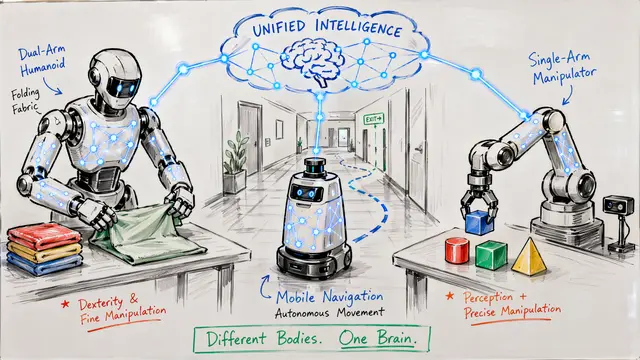
On embodiments never seen during training, competing methods hallucinate the wrong robot or disfigure the morphology entirely. Masked Visual Actions generalize gracefully, maintaining interaction correctness and visual fidelity even on bimanual robots from the BEHAVIOR dataset—achieving LPIPS of 0.0945 and SSIM of 0.887.
By grounding actions in pixels, this work transforms pretrained video models into embodiment-agnostic reasoning engines—achieving 90 percent success on challenging manipulation tasks in zero-shot settings. If you want to explore how visual masking reshapes robotic world modeling, visit EmergentMind.com to dive deeper and create your own research videos.