Large-Language Models as a Cognitive Virus
This presentation introduces a population-dynamical framework for understanding how widespread LLM adoption can alter collective cognition. Using a viral transmission analogy, the paper models how users transition from autonomous cognition to substitutive dependence, revealing conditions under which adoption becomes abrupt, irreversible, and history-dependent. The analysis identifies bistability thresholds, hysteresis loops, and discontinuous competence declines—showing that preventing cognitive lock-in requires fundamentally different interventions than reversing it once established.Script
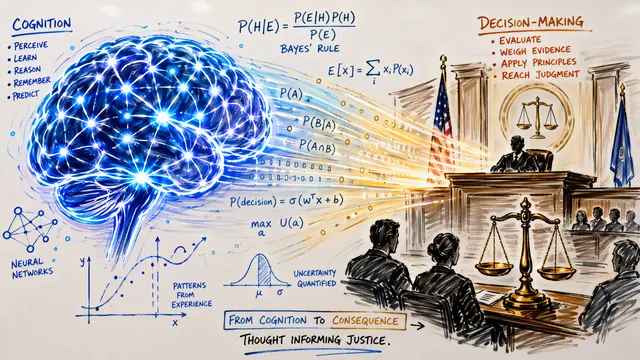
When language models become woven into daily cognitive work, they don't just assist. They can fundamentally reshape how populations think, creating a form of collective dependence that behaves like viral transmission.
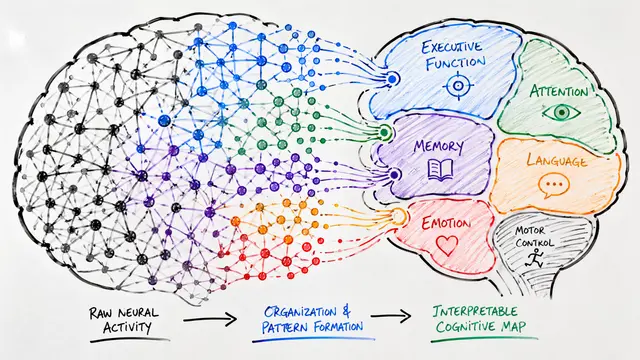
The authors partition users into three behavioral states. Uncoupled users rely on heterogeneous cognitive resources. Coupled but autonomous users integrate Large Language Models while retaining independent reasoning, verification, and access to alternatives. Persistently dependent users have shifted to substitutive coupling where the model performs operations that humans no longer maintain.
The mathematical core reveals saddle-node bifurcations and bistability. When collective reinforcement of autonomy is strong enough, two stable equilibria coexist across a range of adoption pressure. Increasing exposure drives an abrupt shift to coupled cognition at the transcritical threshold. But reducing exposure afterward does not restore autonomy until a much lower saddle-node threshold is crossed, creating a hysteresis loop.
Under substitutive coupling assumptions, equilibrium competence drops discontinuously from 1 to roughly 0.4 at the adoption threshold. Reversing course does not recover competence until transmission pressure falls below the lower threshold. The same parameter produces qualitatively different outcomes depending on the system's history, formalizing technological lock-in as path dependence.
The model distinguishes four intervention classes with different dynamical consequences. Reducing transmission pressure prevents invasion or enables reversal, but only below the lower threshold. Strengthening autonomous alternatives raises both thresholds and can eliminate bistability entirely. Preventing dependency and facilitating recovery improve the composition of the coupled state without shifting the tipping points themselves.
Preventing cognitive lock-in requires fundamentally different interventions than reversing it after dependence has taken hold. If you're curious about the mathematical ecology of human-AI coupling and want to explore this framework further, visit EmergentMind.com to dive deeper and generate your own explainer videos.