Defining Chiral Gauge Theories on the Lattice Without Doubling
This talk explains a recently proposed construction that regularizes four-dimensional gauge theories with chiral fermions on a lattice by interpolating admissible lattice gauge fields into continuum connections and coupling them to continuum chiral fermions. The fermion measure is defined using the absolute chiral determinant and an Atiyah-Patodi-Singer eta-invariant phase that captures both perturbative and global anomaly cancellation. While the construction applies in principle to any compact gauge group, anomaly-free representation, and arbitrary spin manifold, it yields a complex-valued measure unsuitable for standard Monte Carlo, establishing formal definability rather than practical simulation.Script
For nearly fifty years, putting chiral fermions on a lattice has been blocked by the Nielson-Ninomiya obstruction: local lattice chiral operators inevitably produce unwanted fermion doublers. This paper proposes a way around the obstruction by changing the rules. Instead of discretizing the fermions, the authors restrict lattice gauge fields to an admissible sector, interpolate them into smooth continuum connections, and couple those connections directly to continuum chiral fermions.
The fermion measure combines two ingredients. The magnitude comes from the absolute value of the chiral determinant, which is straightforward. The phase is subtle: it's defined using a five-dimensional extension of the gauge field and an Atiyah-Patodi-Singer eta-invariant that encodes the spectral asymmetry of a bulk Dirac operator. This formula implements anomaly inflow nonperturbatively, unifying perturbative triangle diagrams and global anomalies in one geometric criterion.
Anomaly cancellation has a sharp mathematical signature. The exponentiated eta-invariant must equal one on every closed five-manifold with the given gauge and spin data. This condition is both necessary and sufficient for the phase to be independent of how you extend the four-dimensional boundary into five dimensions, and it detects obstructions invisible to perturbative polynomials.
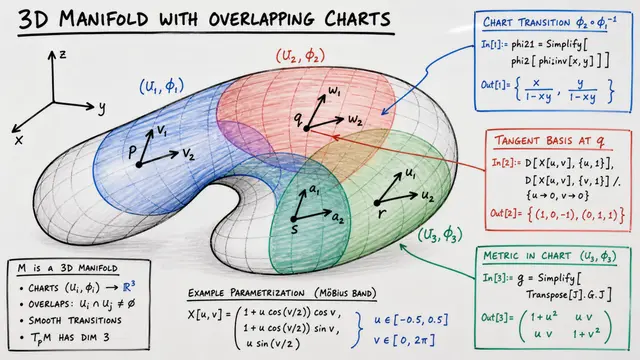
The interpolation procedure works inductively. Lattice gauge transformations first bring link variables close to the identity. Then, within each cell, a Dirichlet problem extends the connection from the boundary links into the interior. Neighboring cells are related by unique transition functions, and compatibility on triple overlaps follows from uniqueness, allowing the local patches to be glued into a global bundle with connection that exactly reproduces the lattice holonomies.
The lattice partition function integrates over admissible gauge configurations with a fermion factor built from the interpolated continuum field. Computing the determinant magnitude reduces to a nonchiral Laplace-type operator, and the eta-invariant can be extracted from the spectrum of a squared operator plus sign information. This avoids reintroducing fermion doubling at the numerical level, establishing that the construction is computable in principle.
The construction applies to any compact gauge group, any anomaly-free fermion representation, and arbitrary compact spin manifolds, but it does not yield a positive measure. The exponentiated eta-invariant remains complex even when anomalies cancel, so standard importance sampling fails. What the paper establishes is formal definability and in-principle computability, not an efficient Monte Carlo algorithm. To explore this and other advances in lattice field theory, visit EmergentMind.com, where you can generate your own videos and dive deeper into the mathematics behind the Standard Model and beyond.