One Text Is All You Need: Frontier Models as Author Detectives
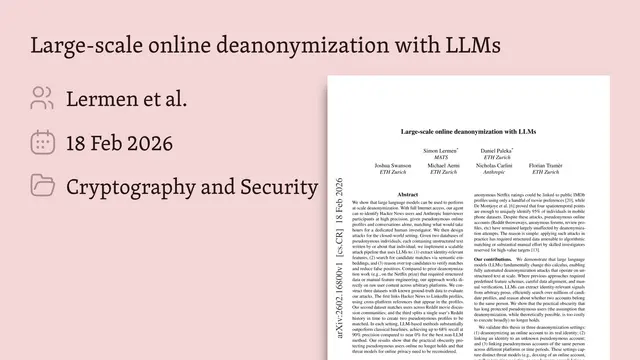
This lightning talk explores a striking capability emerging in frontier language models: the ability to determine authorship from a single document with no candidate list, tools, or reference samples. We examine how models like Claude and GPT can distinguish human from AI writing, identify which lab generated a text, and even name individual human authors—all through parametric familiarity acquired during training. The presentation reveals the mechanics behind this zero-shot attribution, its surprising accuracy on private peer reviews and recent writing, and what it means for anonymity in an age of increasingly capable language models.Script
A single unsigned document lands on your desk. No metadata, no context, no author list to choose from. Can you tell whether a human or an AI wrote it? Which AI lab, if any? And if human, can you name the writer? Frontier language models now say yes to all three.
The key insight is separating prose from ideas. A document might carry human concepts expressed through AI rewriting, or AI suggestions polished by a human hand. Claude Opus 5.5 and GPT 6.1 now reach roughly 90 percent accuracy on idea provenance and 94 percent on prose, approaching trained detectors without any fine-tuning.
All three attribution tasks share one mechanism: parametric familiarity. Models perform best when the writer or generating lab appears frequently in their training data. Claude Fable 5.2 identifies 99.8 percent of texts from Anthropic, OpenAI, and Google, but only 35 percent from eight smaller labs. For human authors, it recognizes 78 percent of Nature reviewers but just 2 percent of inactive Reddit users.
Yet agreement on the verdict does not mean agreement on the reason. When Claude Opus and GPT 6.1 both classify a document correctly, they agree on the decisive evidence only 56 percent of the time for ideas and 63 percent for prose. High accuracy coexists with deep disagreement about which cues actually matter.
AI paraphrasing reduces attribution but does not eliminate it. Rewriting a private peer review drops Opus accuracy from 41 percent to 15 percent, and Reddit comments fall from 17 percent to 10 percent. But highly familiar fiction authors remain recognizable in 81 percent of cases even after two rewrites, and the coupling between recognition and imitation means models can generate text in a target author's style 45 percent of the time when that author is both familiar and successfully identified.
The central unresolved problem is not whether frontier models can sometimes unmask authors, but how to govern a capability where incorrect attribution costs more than silence. Attribution works best for long English texts by visible authors, and confidence filtering can make high-confidence errors operationally rare for models like Claude. But the gap between 27 percent aggregate accuracy and 87 percent confident-answer accuracy shows that one unsigned text may no longer guarantee anonymity, yet knowing when to trust the model remains an open question. Visit EmergentMind.com to explore this research further and create your own video explanations.