Detecting AI in Mathematical Proofs: Beyond the Words
This presentation explores groundbreaking research on identifying AI involvement in mathematical proof development by analyzing the structure of logical reasoning rather than writing style. Using a novel graph-based framework called ProofTrace, the authors examine over 8,000 mathematics papers across five cohorts—including human-written papers, AI-rebuilt proofs, and disclosed human-AI collaborations. The work reveals that AI-assisted proofs exhibit distinctive organizational signatures: they rely less on external citations, use more intermediate reasoning steps, and create more densely interconnected dependency graphs. Remarkably, these structural patterns remain detectable even when the prose is completely rewritten, suggesting that AI leaves traces in how mathematical arguments are organized, not just how they are expressed.Script
When a mathematician writes a proof, they leave behind more than words. They create a map of logical dependencies, a network of how each conclusion supports the next. This paper asks whether AI assistance changes that map in ways we can detect.
The researchers constructed 5 cohorts totaling 8,281 papers. They took 700 human-written math papers, extracted just the research question and target theorem, then had AI regenerate complete proofs from scratch. These matched pairs let them compare how humans and AI organize the same mathematical journey.
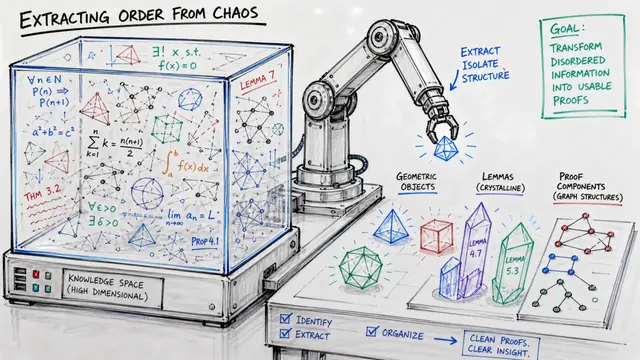
ProofTrace represents each paper as a graph where nodes are mathematical results, theorems, lemmas, and importantly, intermediate conclusions buried inside proofs. Edges show which results directly support others. This captures not what the author wrote, but how the reasoning is organized.
The signatures are striking. AI-rebuilt proofs cite external results at a fraction of 0.002 compared to 0.061 for human papers. They pack more intermediate conclusions into each proof and connect them with 3.57 premises per result versus 2.58 for humans. Human proofs have more separate components, more terminal results, more branching structure.
Here is the key test. When AI rewrites human papers, changing all the prose but preserving the mathematical steps, text-based detectors collapse from 96% accuracy to chance. ProofTrace stays stable, moving from 83% to 84%, because it ignores the words and reads the proof architecture itself.
AI leaves traces not in the words it chooses, but in how it assembles the logical scaffolding of a proof. Visit EmergentMind.com to explore this research further and create your own video explanations of the papers that matter to you.