Frontier models need only one text to unmask its human or AI author
Abstract: Given a single text and a simple zero-shot prompt (no web access, tools, candidate lists, or writing samples), frontier models can answer "who wrote this?" at three increasingly specific levels: (1) whether an AI or human wrote it, (2) if an AI, which lab, and (3) if a human, often exactly who. The latest models (Claude Fable 5.2, GPT-6.1 Sol, Gemini 4 Carbon) match trained detectors like Pangram while also explaining their predictions in natural language, and Opus 5.5 names the correct lab for 98% of texts generated by models from Anthropic, OpenAI, and Google. Most strikingly, Fable 5.2 correctly names the author of 39% of public peer reviews published in Oct-Nov 2026 (78% on a subset of reviews from Nature), and identifies the username behind 69% of comments from active Redditors (with >500 posts over the last year). Accuracy depends on exposure to an author's writing in pretraining data and on reasoning effort, and simply asking a model how familiar it is with someone predicts whether it can identify their writing. For anyone who has published enough writing online, frontier models present a greater threat to anonymity than commonly assumed, and defenses are limited.

Paper Prompts
Sign up for free to create and run prompts on this paper.
Explain it Like I'm 14
1. What is the paper about?
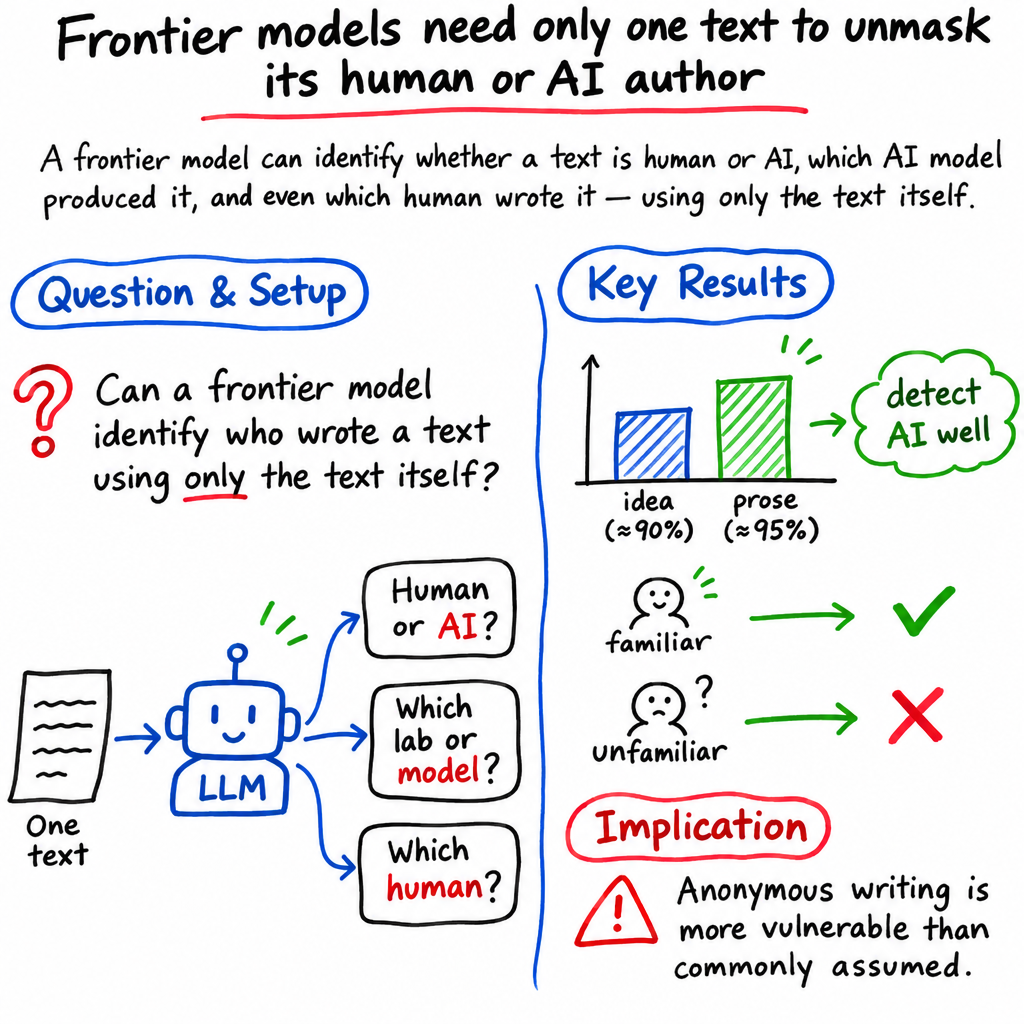
The paper, “Frontier models need only one text to unmask its human or AI author,” studies whether very powerful AI models can figure out who wrote a piece of writing.
The researchers ask whether an AI model can identify:
- Whether a text was written by a human or by AI.
- Which AI company or laboratory created the model that wrote it.
- Which specific human wrote a text, even when that person is trying to remain anonymous.
The surprising main message is that newer AI models may be much better at recognizing writing styles than people expected. They may be able to identify authors using only one piece of writing, without searching the internet or comparing the text with known examples.
2. What questions did the researchers ask?
The paper focuses on several main questions:
- Human or AI? Can an AI tell whether the ideas and the actual wording came from a person or a computer?
- Which AI? If an AI wrote the text, can another AI identify the company or model behind it?
- Which human? If a person wrote the text, can an AI guess the person’s identity?
- Why does the model make its guess? Can it explain which words, ideas, sentence patterns, or punctuation helped it decide?
- What affects accuracy? Are models better at recognizing famous writers whose work they may have seen during training?
- Can anonymous writing still be private? What does this mean for anonymous reviewers, online commenters, and other people who want to hide their identity?
The paper also separates ideas from prose. In this study:
- Ideas mean what the text says—its claims, events, arguments, and organization.
- Prose means how the text says it—the words, sentences, grammar, and style.
This is similar to separating the message of a song from the singer’s voice.
3. How did the researchers investigate these questions?
Testing whether text was written by humans or AI
The researchers collected about 37,575 documents from 24 datasets. These included:
- Student essays
- News articles
- Stories
- Academic writing
- Wikipedia and other web writing
- Peer reviews
Some texts were fully written by humans, while others were written or edited by AI. The researchers included different combinations, such as:
| Ideas | Wording | Meaning |
|---|---|---|
| Human | Human | A person thought of and wrote everything |
| AI | Human | AI created the ideas, but a person wrote them |
| AI | AI | AI created both the ideas and the wording |
| Human | AI | A person created the ideas, but AI wrote or polished the text |
They then gave each document to powerful AI systems, such as Claude, GPT, and Gemini. The models received a zero-shot prompt, meaning they were not specially trained for this particular test. They were simply given instructions and the text, much like asking a smart student to solve a new problem without giving them practice questions first.
The models were not allowed to use:
- Web searches
- Special tools
- A list of possible authors
- Writing samples from possible authors
The models had to decide whether the ideas and wording were human- or AI-produced. They also had to explain their reasoning by quoting parts of the text.
Testing which AI laboratory wrote a text
The researchers created stories, news articles, and opinion pieces using 34 AI models from 11 laboratories.
They then asked five powerful AI systems to identify:
- The laboratory, such as Anthropic, Google, or OpenAI
- The model family, such as Claude or Gemini
- The exact model version
This was harder than simply asking whether a text was AI-generated because many AI systems write in similar ways.
Testing whether a model could identify human authors
The researchers also tested writing whose authors were known or could later be checked. These included:
- Anonymous peer reviews
- Public reviews
- Stories
- Academic papers
- Reddit comments
The AI models were asked to name the human author or online username. They were given only the text, not a list of people to choose from.
Measuring accuracy
The researchers used accuracy, which means the percentage of correct answers.
They also measured the false-positive rate. This is how often a detector wrongly says that a human text was written by AI. This matters because accusing an innocent person of using AI can have serious consequences, such as failing a student or damaging a writer’s reputation.
The researchers also tested newer writing that the AI models were less likely to have seen during training. This was meant to check whether the models were genuinely recognizing writing patterns rather than simply remembering the exact texts.
4. What did the researchers find?
Powerful AI models were very good at detecting AI writing
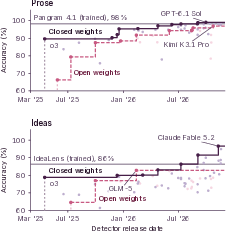
The strongest models achieved about 94–95% accuracy when deciding whether the prose was human- or AI-written.
For identifying whether the ideas came from AI, the best models reached about 90–97% accuracy, depending on the model and test set.
For comparison, the specialized detector IdeaLens achieved about 87% accuracy on the idea-detection task.
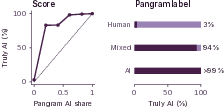
The models also had extremely low false-positive rates on many human-written documents. For example, one model marked only about 0.01% of a large collection of human English texts as AI-written.
This is important because a detector is not very useful if it finds many AI texts but also falsely accuses lots of humans.
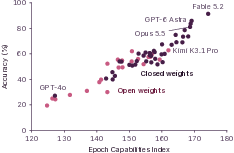
Accuracy improved as AI models became more powerful
Older models performed much worse. The paper reports that accuracy increased from roughly:
- 27% for an earlier model
- 59% for a later model
- About 91% for current frontier models tested in the study
“Frontier models” means the most advanced AI systems available at the time of the research.
The researchers found a strong connection between a model’s general intelligence and its ability to detect authorship. In simple terms, smarter models were usually better at noticing subtle writing patterns.
Models could often identify the AI laboratory
The strongest models were especially good at recognizing text written by the largest laboratories.
For text produced by Anthropic, OpenAI, and Google, some models identified the correct laboratory about 98% of the time.
However, performance was much worse for many other laboratories. Across all laboratories, the best model identified the correct lab for about 60% of texts.
Identifying the exact model was even harder. Models often recognized the general style of a laboratory but could not tell which version created the text.
For example, a newer AI model might be correctly recognized as having an Anthropic-like style, but the detector might name an older Claude model instead of the exact model used.
Some AI models copied the style of other models
The researchers found that some models were often mistaken for models from other companies.
For example, texts from certain open models were frequently labeled as being written by Claude or GPT. The paper suggests that this may happen because some models were trained using outputs from other models, a process sometimes called distillation.
An analogy would be a student who learns to write by copying another author’s essays. Even if the student writes a new essay, it may still sound like the original author.
AI models could sometimes identify human authors
The paper’s most striking claims concern human authorship.
Claude Fable 5.2 reportedly identified:
- The author of 39% of public peer reviews in one collection
- The author of 78% of a particular group of Nature-family reviews
- At least one author for 46% of tested arXiv papers
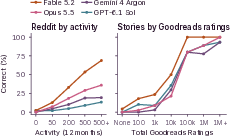
- The username behind 69% of comments from very active Reddit users
- All 15 tested stories from authors with more than one million Goodreads ratings
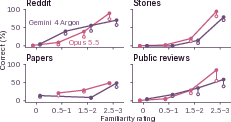
These results were not equally strong for every writer. The models performed best when they said they were already very familiar with the person’s writing.
When the model believed it knew an author well, it correctly identified many texts. When it believed it had little or no knowledge of the author, its accuracy was usually very low.
This suggests that the model may be using information absorbed during training. It may have seen a writer’s articles, books, reviews, or online posts before.
The models could explain their decisions
Unlike many traditional detection tools, the AI models could describe their reasoning in ordinary language.
They might point to features such as:
- Repeated sentence patterns
- Unusual punctuation
- Overly careful or cautious claims
- Common phrases and clichés
- Very polished quotations
- Too much explanation of a theme or moral
- Specific factual details
- The way paragraphs begin and end
Different AI detectors often noticed similar evidence, although they did not always agree about which clue was most important.
For example, the models associated some AI writing with cautious language and obvious explanations of its main message. They associated some human writing with detailed, specific knowledge.
5. Why are these findings important?
The results suggest that AI authorship detection is becoming more powerful and more accessible. A person may no longer need a special detection program. They might simply ask a strong general-purpose AI model, “Who wrote this?”
This could be useful in some situations. For example, it might help:
- Identify fake articles
- Detect AI-generated scams
- Study how different AI models write
- Investigate plagiarism or impersonation
- Understand whether a text has been heavily rewritten by AI
However, the findings also create serious risks.
Anonymous writing may become less anonymous
People often write anonymously to protect themselves. Examples include:
- Peer reviewers judging research papers
- Whistleblowers
- Journalists’ sources
- Students asking for help
- Online users discussing sensitive topics
If an AI can identify someone from only one text, anonymity becomes harder to maintain.
The problem may become even greater if the model is allowed to:
- Search the web
- Compare writing across several websites
- Match usernames across platforms
- Use large collections of a person’s previous writing
The paper argues that deleting online posts may not be enough, because some older AI models may already have learned from those posts. Also, rewriting text with AI does not completely hide the original writer’s style.
Conclusion
In simple terms, this paper says that the newest AI systems are becoming surprisingly good at recognizing writing styles. They can often tell whether a text was written by a human or AI, sometimes identify which AI company created it, and occasionally guess the exact human author.
The research is important because it shows both the power and the danger of advanced AI. These tools could help fight fraud and fake content, but they could also weaken privacy and anonymity. The paper suggests that people who publish a lot of writing online should not assume that one anonymous text will remain anonymous forever.
At the same time, the results should be treated carefully. The tests used particular models, datasets, and prompts, and performance varied greatly between writers and types of text. A model’s guess is not automatically proof of authorship. In real situations, such guesses should be checked with additional evidence before anyone is accused of wrongdoing.
Practical Applications
Immediate Applications
- Academic integrity and assessment screening (education, academia).
- a detector prediction,
- quoted evidence and an explanation,
- a human review,
- and corroborating evidence such as drafts, revision history, citations, or oral defenses.
- Dependencies and assumptions: Results may not generalize to new disciplines, languages, student populations, heavily edited text, or texts produced by unfamiliar models. The system should not be used as an automatic misconduct adjudicator because even low false-positive rates can produce serious harm at institutional scale.
- Peer-review confidentiality audits (publishing, research administration).
- auditing reviewer-anonymity procedures,
- detecting accidental self-identification,
- flagging reviews that contain distinctive or publicly recognizable writing,
- and evaluating whether AI-assisted review has altered authorship expectations.
- Dependencies and assumptions: The model’s success depends strongly on familiarity with the writer and likely exposure to their text during pretraining. Any deployment must respect confidential manuscripts and reviews, avoid sending protected material to third-party APIs, and comply with research-ethics and data-protection rules.
- AI-assisted writing disclosure and provenance review (publishing, journalism, legal services).
- fully human writing,
- AI-generated ideas rewritten by a person,
- human ideas rendered or polished by AI,
- and fully AI-generated text.
- This is more informative than a binary “AI or human” label and could support disclosure statements, editorial risk assessment, and provenance documentation.
- Dependencies and assumptions: The paper’s definitions of “AI ideas” and “AI prose” are task-specific. Organizations would need explicit policies defining what level of editing counts as AI assistance, since light edits may be classified differently by different detectors.
- Newsroom and content-moderation quality control (media, communications, platforms). News organizations and online platforms could use the method to flag likely synthetic articles, fabricated quotations, or model-specific writing patterns for fact-checking. The paper’s model profiles identify recurring stylistic signals, such as hedging, stock phrases, punctuation habits, invented names, and polished but potentially unsupported quotations. Dependencies and assumptions: Attribution to a particular laboratory is substantially more reliable for major providers than for smaller or open-weight models. Model distillation can cause one provider’s text to resemble another’s, making provider attribution unsuitable as definitive evidence of origin.
- AI output monitoring in enterprise workflows (software, customer service, compliance).
- support responses,
- regulatory submissions,
- code documentation,
- procurement documents,
- and internal reports.
- The explanation format—evidence excerpts, reasoning, confidence, and decisive factors—could make review queues more interpretable than conventional opaque detectors.
- Dependencies and assumptions: API cost, latency, data residency, and confidentiality must be addressed. Explanations are not independently validated proof; the paper finds substantial agreement on verdicts but weaker agreement on the exact evidence and decisive factor.
- Anonymity and privacy risk assessment (online communities, whistleblowing, journalism). Forum operators, journalists, and advocacy organizations can use the findings to assess whether pseudonymous writing remains practically anonymous. The reported identification of active Reddit users and well-known writers indicates that a single text may reveal identity when a model has encountered enough of the author’s public work. Dependencies and assumptions: Identification depends on the author’s public exposure, the model’s training data, writing length, and domain familiarity. Such systems should be used defensively—for threat modeling and protection—not for unconsented deanonymization.
- Author-facing privacy guidance (daily life and professional communication).
- avoiding reuse of distinctive phrases across platforms,
- separating topics and accounts,
- limiting publication of large bodies of writing,
- removing biographical and contextual clues,
- and treating AI rewriting as an incomplete privacy defense.
- The paper specifically suggests that deleting online writing may not remove information already encoded in existing model weights, and that rewriting text with AI only partially reduces attribution risk.
- Dependencies and assumptions: These measures reduce—but cannot guarantee—anonymity. They may also reduce writing quality, continuity, or credibility and cannot reliably protect authors whose distinctive style is already widely represented in training data.
- Research and audit tooling for authorship studies (academia, digital humanities).
- authorship,
- AI-assisted scholarship,
- stylistic change,
- model contamination,
- and the evolution of synthetic writing.
- Dependencies and assumptions: Reproducibility depends on model version, system prompt, reasoning setting, sampling parameters, and access conditions. Commercial models may change behavior without notice, so studies require archived prompts, outputs, timestamps, and version metadata.
Long-Term Applications
- Privacy-preserving anonymous peer review systems (publishing, academia).
- estimate whether a review is identifiable,
- automatically remove distinctive stylistic or biographical signals,
- generate privacy-preserving paraphrases,
- and warn reviewers when their text resembles publicly known writing.
- Dependencies and assumptions: Effective anonymization requires validation against multiple frontier models, not merely one detector. Paraphrasing may preserve ideas, introduce errors, or itself create recognizable AI patterns. There are also unresolved questions about whether anonymizing a review changes its evidentiary value or violates publication policies.
- Provenance infrastructure for digital documents (publishing, government, enterprise software).
- who created each version,
- which tools were used,
- what text was generated or transformed,
- and when human approval occurred.
- Dependencies and assumptions: Provenance is more reliable than stylistic inference only if users and software consistently record events. Adoption requires interoperable standards, secure storage, protections against metadata manipulation, and agreement on acceptable disclosure practices.
- Model-family fingerprinting and supply-chain auditing (AI safety, software, cybersecurity).
- investigating unauthorized model use,
- auditing third-party AI services,
- detecting model impersonation,
- monitoring policy violations,
- and studying synthetic-data contamination.
- Dependencies and assumptions: Current exact-model accuracy is low, particularly for newer models and open-weight systems. Distillation, fine-tuning, decoding changes, translation, and human editing can erase or transfer stylistic signals. Reliable deployment would require controlled reference corpora, continual retraining, and calibrated uncertainty estimates.
- Cross-platform identity and deanonymization defense research (privacy, cybersecurity, social platforms). The observed relationship between model familiarity and author-identification accuracy could lead to risk-scoring systems that estimate how vulnerable an account is to authorship matching. A future defensive tool might simulate attacks across a user’s own accounts and recommend safer writing or account-separation practices. Dependencies and assumptions: Cross-platform matching would require access to multiple text collections and could itself become a surveillance capability. Any such system would need strict authorization, local processing where possible, rate limits, audit logs, and prohibitions on identifying uninformed third parties.
- Human–AI authorship certification for high-stakes domains (law, healthcare, finance, government).
- clinical documentation,
- legal filings,
- financial disclosures,
- public-sector decisions,
- and safety-critical engineering reports.
- The system could distinguish human-originated decisions from AI-drafted language and require accountable human sign-off on substantive claims.
- Dependencies and assumptions: The paper does not establish that stylistic attribution is adequate for legal or regulatory evidence. High-stakes use would require validated error bounds, domain-specific testing, explainability standards, appeal mechanisms, and rules specifying whether AI assistance affects responsibility.
- Adaptive AI-detector ensembles (education, publishing, platform governance).
- frontier-model judgments,
- trained detectors such as prose- and idea-level classifiers,
- watermarking where available,
- document metadata,
- revision histories,
- and human examination.
- An ensemble could route uncertain cases to additional review rather than forcing a binary decision. It might also calibrate thresholds by language, domain, document age, and level of AI editing.
- Dependencies and assumptions: Detector agreement does not guarantee correctness, and the paper shows that explanations from different models agree less on decisive evidence than on final verdicts. Continuous benchmark refreshes are necessary because model capabilities, writing styles, and adversarial rewriting techniques will evolve.
- Studies of model distillation and intellectual-property misuse (AI governance, cybersecurity, policy).
- whether a model has copied another provider’s behavioral signatures,
- how much stylistic identity survives fine-tuning,
- and whether attribution can provide evidence in disputes over unauthorized model training.
- Dependencies and assumptions: Stylistic similarity alone cannot prove unlawful copying or training-data use. Legal conclusions would require technical evidence about datasets, model weights, training procedures, and access records.
- Policy frameworks for authorship, anonymity, and AI disclosure.
- AI detection is probabilistic rather than forensic,
- human identity can be inferred without candidate lists or web access,
- public writing can remain embedded in model parameters,
- and AI rewriting does not guarantee anonymity.
- Policies could require human review before sanctions, prohibit sole reliance on detector outputs, establish notification and appeal rights, and distinguish detection of AI assistance from identification of a person.
- Dependencies and assumptions: Effective policy depends on transparent reporting of error rates across languages and populations, independent audits, privacy law, and consensus about acceptable evidence. The paper’s results come primarily from English-language benchmarks and prominent model families, so broader generalization remains uncertain.
Glossary
- Authorship attribution: Determining the individual, organization, or model responsible for producing a text. “authorship attribution”
- Benchmark dataset: A standardized dataset used to compare the performance of systems or models. “24 benchmark datasets”
- Closed-weight model: A model whose learned parameters are not publicly available. “Closed-weight models (solid purple) consistently outperform open-weight models”
- Contamination: The possibility that evaluation data appeared in a model’s training data. “Contamination is an unlikely explanation”
- Corpus: A large, systematically collected body of text used for analysis or training. “Pretraining corpora for frontier models are inaccessible”
- Cross-platform matching: Comparing an individual’s activity or writing across multiple online platforms. “web access and cross-platform matching”
- Distillation: Training one model to imitate the outputs or behavior of another model. “A model trained on another lab's outputs can inherit that lab's style”
- False-positive rate (FPR): The proportion of negative cases incorrectly classified as positive. “Recall is also evaluated at a 1\% false-positive rate (FPR) on English human text.”
- Few-shot prompting: Prompting a model with a small number of examples before requesting a prediction; the paper contrasts this with zero-shot prompting. “Zero-shot prompting has historically been dismissed as a viable method for detecting AI text”
- Frontier model: A highly capable, contemporary AI model representing the leading edge of model performance. “frontier models can answer ``who wrote this?''”
- Harmonic mean: A type of average that emphasizes low values and is commonly used to combine precision and recall. “the harmonic mean of and ”
- Holistic prompt: A prompt that asks a model to assess multiple aspects of a text together rather than evaluating isolated features. “each with the v8 holistic prompt at medium effort”
- Knowledge cutoff: The latest point in time represented in a model’s training data. “texts published after models' knowledge cutoffs”
- LLM: A neural LLM trained on very large text collections to generate or analyze natural language. “Unlike recent work on deanonymization with LLMs”
- Macro-averaging: Computing a metric separately for each class or condition and then giving every class equal weight in the final average. “we follow IdeaLens and report accuracy macro-averaged over the four cases”
- Micro-averaging: Computing a metric by aggregating all individual examples before calculating the overall result. “Unweighted micro-averages are described in \S\ref{app:rq1_results}.”
- Model attribution: Identifying the particular AI model or model family that generated a text. “Which model wrote the text?”
- Model family: A group of related models produced by the same organization or architecture lineage. “We score each answer at three levels: the lab (e.g., Anthropic), the model family (e.g., Claude Opus) and the exact model”
- N-gram matching: Comparing sequences of consecutive tokens or words between texts. “soft n-gram matching”
- Open-weight model: A model whose learned parameters are publicly released or accessible. “Open-weight models: percent of texts by open-weight writers”
- Parametric knowledge: Information encoded in a model’s learned parameters rather than retrieved from external sources. “the model relies solely on its parametric knowledge”
- Pearson correlation coefficient: A statistic measuring the strength and direction of a linear relationship between two variables. “Pearson ”
- Pretraining: The initial process of training a model on a large general-purpose corpus before specialized use or evaluation. “Accuracy depends on how much of a writer's text a model has likely seen during pretraining”
- Provenance: The origin, authorship, or production history of a document or piece of content. “under the provenance rule”
- Recall: The proportion of relevant positive cases that a system successfully identifies. “Recall is defined as the share of AI text flagged as AI”
- Reasoning effort: A model-inference setting that controls how much computational processing the model uses before producing an answer. “Increasing reasoning effort helps most when the model says it is only mildly familiar with a person”
- Stylometric analysis: Quantitative analysis of linguistic and stylistic patterns to identify or compare authors. “we also run a stylometric analysis”
- Temperature: A generation parameter controlling the randomness or diversity of a model’s output. “with the v8 holistic prompt at medium effort”
- Threshold: A cutoff value used to convert a continuous score into a categorical decision. “our default threshold”
- Training cutoff: The latest date of data included in a model’s training process. “accuracy remains high on texts published after models' training cutoffs”
- Zero-shot prompting: Asking a model to perform a task without providing task-specific examples. “Using a minimally modified version of the human vs. AI prompt”
- n-gram: A contiguous sequence of linguistic units, such as words or tokens. “soft n-gram matching”