HarnessMM: Recursive Self-Improvement for Harness Token Efficiency
This presentation examines HarnessMM, a method that dramatically reduces the computational cost of tool-using AI agents without retraining models or changing task interfaces. By treating certain agent actions as persistent executable commitments rather than regenerating them after every tool response, HarnessMM achieves token savings of up to 88% on coding benchmarks while maintaining or even improving task success rates. The talk explores the core mechanism of guarded decision reuse, presents empirical evidence from multiple benchmarks, and examines the careful accounting required to distinguish real efficiency gains from measurement artifacts.Script
Tool-using agents waste tokens by calling their reasoning models over and over, even when a previous call already decided what to do next. HarnessMM cuts that waste by up to 88% without changing a single model weight.
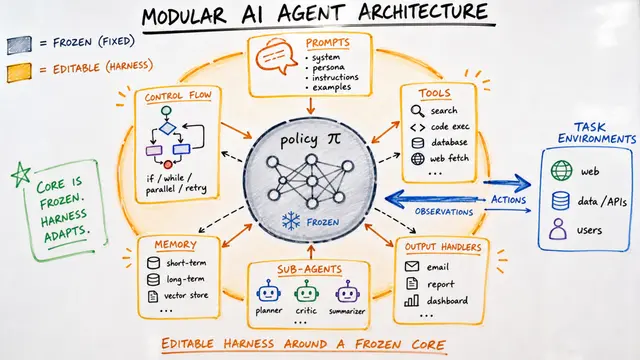
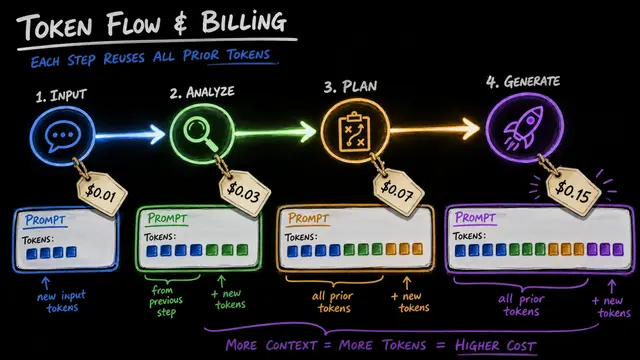
The key insight is separating action semantics from execution readiness. An agent authors a complete decision graph up front, with each action node storing its exact arguments and a public guard. Later tool receipts simply activate ready nodes instead of regenerating decisions.
On HumanEval, the method preserved Codex success at 90.82% while cutting cost by 29.54%. More dramatically, DeepSeek Harness jumped from 71.43% to 85.71% success while reducing tokens by 87.93%, solving 22 more tasks at one eighth the cost.
The MBPP ablation pins down the mechanism. Persistent graph reuse alone saved 26.91% over single-use graphs, executing 407 certified bypasses including 201 graphs reused multiple times. Callback substitution added another 19.52% saving, proving that actual omission matters, not just fast-path availability.
The method has real limits. Guards prove only declared public conditions, not semantic correctness. On AIME, shared authoring overhead exceeded savings, costing more than baselines. The system falls back to slow reasoning for unsupported evidence, but guard design remains task specific and unautomatic.
HarnessMM shows that agent efficiency can improve through harness architecture alone, without touching model weights or task definitions. To explore how guarded decision reuse might reshape agent deployments, visit EmergentMind.com and create your own video breakdown of cutting-edge research.