Rethinking the Evaluation of Harness Evolution for Agents
This lightning talk examines a critical methodological paper that challenges how we evaluate automatic harness evolution for language model agents. The authors expose a fundamental problem: existing evaluation protocols conflate genuine harness improvements with simple test-time exploration, and evolved harnesses fail to generalize beyond their training tasks. Through rigorous comparison against test-time scaling baselines under unified compute budgets, the work reveals that parallel sampling often outperforms sophisticated harness evolution, raising important questions about where the field should invest its optimization efforts.Script
When we optimize language model agents, we can either sample multiple solutions in parallel or evolve the entire scaffolding around the model. This paper reveals a surprising result: the simple approach often wins.
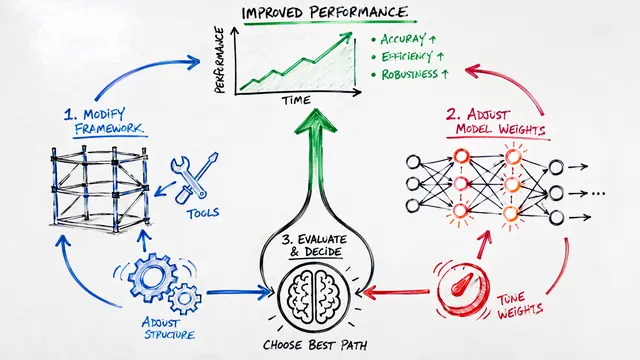
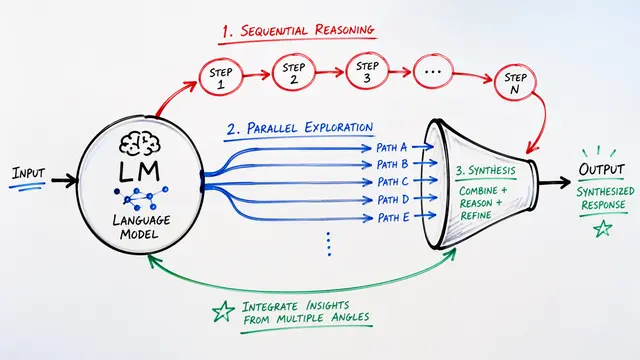
The authors formalize four competing strategies under a unified compute budget: parallel sampling, sequential refinement, batch-level harness evolution, and per-instance harness scaling. This framework exposes whether gains come from genuine harness redesign or just more test-time exploration.
Across three experimental conditions, harness evolution consistently underperforms simpler baselines. Without unit tests, it can even degrade performance. With unit tests, parallel sampling still wins. Most strikingly, evolved harnesses gain only 0.6 percent when transferred to held-out tasks.
Qualitative analysis reveals that meta agents make sophisticated edits: enriching prompts, enforcing runtime constraints, correcting tool parameters. Yet these modifications act more like mnemonic aids than generalizable strategies, and context bloat from accumulated artifacts often cancels out minor gains.
The paper attributes poor generalization to benchmark sensitivity: Terminal-Bench tasks reach near-optimal performance with minimal harnesses, leaving little headroom. Harness evolution may prove more valuable on benchmarks where success depends heavily on specialized scaffolding and domain complexity.
This work recalibrates expectations for harness evolution, showing that rigorous evaluation under unified budgets reveals test-time search as the more productive strategy. To dive deeper into these findings and create your own video summaries of cutting-edge research, visit EmergentMind.com.