FlashAttention-4: Algorithm and Kernel Pipelining Co-Design for Asymmetric Hardware Scaling
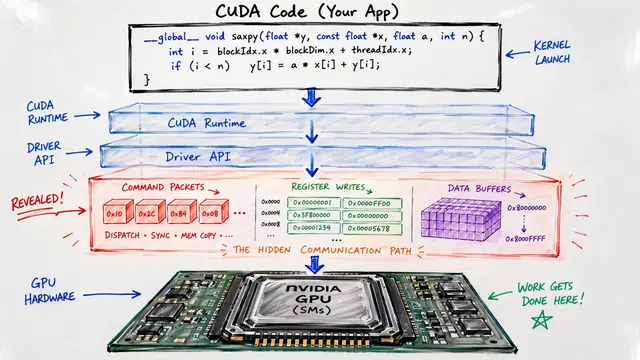
This presentation examines FlashAttention-4, a breakthrough in GPU-accelerated attention mechanisms designed specifically for NVIDIA Blackwell GPUs. As hardware architectures scale asymmetrically—with tensor core throughput doubling while memory bandwidth and other resources lag—FlashAttention-4 introduces a co-designed solution that exploits asynchronous operations, software-emulated exponentials, and intelligent pipelining. Through innovations in scheduling, memory optimization, and a Python-based kernel framework, this work achieves up to 1.3× speedup over cuDNN and reaches 71% of theoretical peak performance, setting a new standard for hardware-aware algorithm design.Script
NVIDIA's latest Blackwell GPUs doubled tensor core throughput but left memory bandwidth and other resources behind. This asymmetry breaks existing attention algorithms, creating new bottlenecks that pure compute power cannot solve.
The disparity is stark. While tensor cores can execute over 8000 operations per clock, the exponential units handling softmax manage only 16. This 500× gap means that even with doubled matrix multiplication speed, attention kernels stall on the very operations that make attention work. FlashAttention-4 was built to exploit what Blackwell offers while circumventing what it withholds.
The authors redesigned the entire attention pipeline from the ground up.
Two breakthroughs work in tandem. First, Blackwell's tensor memory liberates matrix operations from register constraints, enabling aggressive tile sizes and overlapped execution. Second, rather than queuing exponentials at the hardware unit, FlashAttention-4 approximates them using standard floating-point units. A carefully tuned degree-3 polynomial achieves hardware-equivalent precision on nearly all inputs, distributing the exponential workload across 8000 ops per clock instead of 16.
Online softmax traditionally rescales after every tile to maintain numerical stability. The authors observed that rescaling is only necessary when a new maximum appears. By introducing conditional rescaling with bounded slack and a final normalization pass, FlashAttention-4 eliminates redundant operations without sacrificing correctness, cutting register pressure and divergence overhead.
The backward pass is where memory contention typically cripples performance. In 2-CTA mode, cooperative thread arrays share tensor memory and exchange tile data through distributed shared memory. Each pair processes twice the reduction operands, halving the number of expensive atomic operations. This design alleviates shared memory bottlenecks and atomic contention, a critical win when computing gradients for long sequences.
FlashAttention-4 achieves 1613 teraflops per second on Blackwell, capturing 71% of the hardware's theoretical maximum. It outpaces cuDNN by 1.3× and Triton by 2.7×. Equally important, the entire kernel suite is written in a Python-embedded framework, slashing compile times by an order of magnitude and democratizing GPU kernel development. As hardware asymmetry intensifies, this co-design approach will define the next generation of efficient attention mechanisms.
When hardware scales unevenly, algorithms must adapt or become obsolete. FlashAttention-4 proves that the path forward lies in co-design, not brute force. Visit EmergentMind.com to explore this paper further and create your own research videos.