Breaking Circle Packing Records for $28 with LLM-Guided Evolution
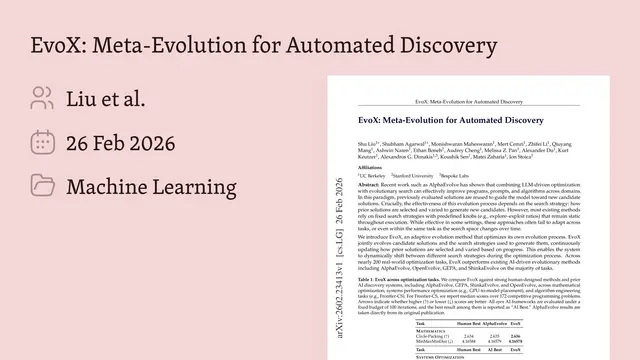
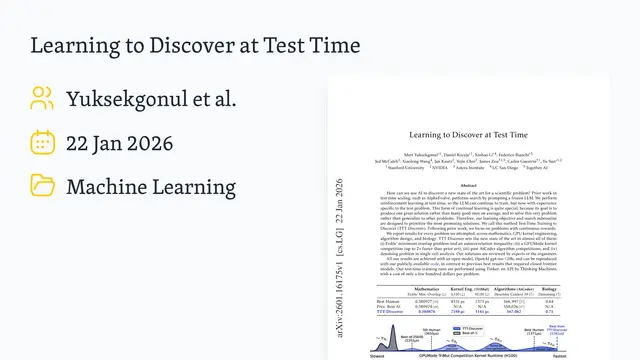
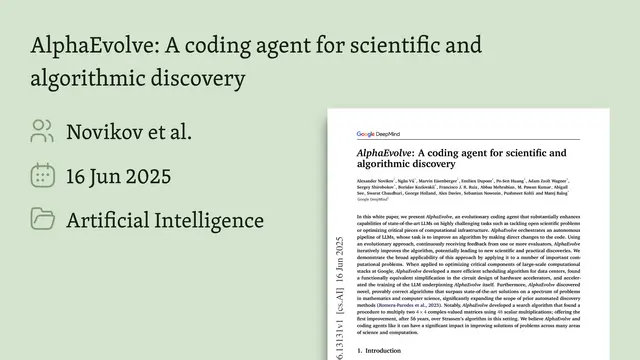
This presentation explores Discovery Loop, a minimal framework that uses large language models to evolve optimization algorithms. Applied to variable-radius circle packing, the system improved 10 Packomania benchmark records with just $28 in API costs, running on a consumer machine. We examine how the system works, what it achieved, the surprising cost dynamics across iterations, and what the results reveal about accessible algorithmic discovery.Script
Ten world records in mathematical optimization fell to an algorithm that cost less than dinner for two. Discovery Loop used a language model to evolve circle-packing solvers, running on a laptop with a total spend of 28 dollars.
The challenge is deceptively simple. Pack circles with variable radii into a unit square, maximize the sum of all radii, and ensure no circle overlaps another or breaches the boundary. The problem is viciously nonconvex, and finding good arrangements requires both continuous optimization of positions and structural changes to the contact graph.
Discovery Loop asks the model to write a complete replacement solver each iteration, not a patch. The candidate runs against all benchmark targets in parallel, and it becomes the new champion only if it beats the current leader's aggregate score. This full-replacement strategy lets the system make architectural leaps, like swapping random initialization for hexagonal lattices or adding specialized polishing stages.
The first five iterations delivered nearly all the value for one sixth of the cost. Continuing to iteration fifteen consumed another 23 dollars but improved scores by only two hundredths of a percent. Cost per unit of improvement deteriorated by a factor of 130, turning productive search into expensive stagnation.
Here is the qualification that matters. The manually designed seed solver already broke all ten records at iteration zero. The model-driven evolution improved the aggregate score further, but it did not discover those initial breakthroughs. This means the experiment validates the complete pipeline, not the language model in isolation.
Discovery Loop shows that meaningful algorithmic progress can happen on accessible hardware without clusters or massive budgets, but the experiment leaves open whether this simplicity scales beyond circle packing. To explore more results like this and create your own research videos, visit EmergentMind.com.