Bidirectional Reasoning Flow
This presentation explores how computational systems leverage information flowing in both forward and backward directions to achieve global consistency and robust reasoning. We examine the mathematical foundations of bidirectional process reward models, compare forward-only versus bidirectional architectures across symbolic reasoning and neural search tasks, and demonstrate why explicitly incorporating future information into past evaluations fundamentally improves stepwise supervision, theorem proving, and program synthesis.Script
Most reasoning systems evaluate each step using only what came before, like reading a proof one line at a time without ever looking ahead. Bidirectional reasoning flow breaks this constraint by propagating information both forward from history and backward from future steps, enabling global consistency checks that catch errors invisible to forward-only methods.
The Bidirectional Process Reward Model scores each step twice: once conditioned on all preceding steps, and again conditioned on all subsequent steps. The final stepwise reward averages these two perspectives, allowing gradients to flow not just from the past but from the future, making back-propagating supervision a first-class signal.
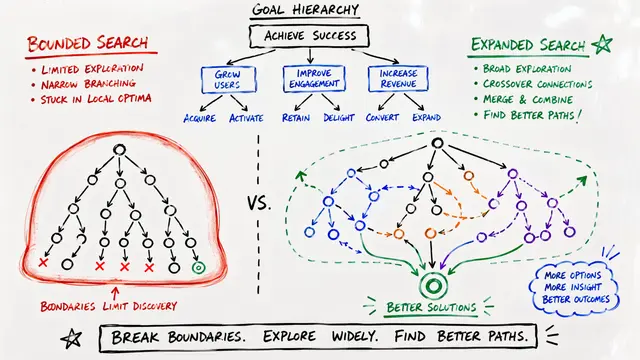
Symbolic systems like Bi-Chainer dynamically switch between forward chaining, which deduces consequences from known facts, and backward chaining, which decomposes goals into subgoals. Intermediate results from one direction resolve ambiguity in the other, reducing the number of inference calls and improving proof accuracy.
Empirically, bidirectional reasoning delivers stepwise reward improvements of up to 31.9 percent over forward-only baselines. In program synthesis, neural-guided bidirectional search drastically outperforms forward-only methods as search depth increases, and theorem provers using bidirectional chaining achieve higher accuracy with fewer calls.
Information-theoretic analysis confirms that bidirectional encodings retain strictly higher mutual information with input compared to unidirectional flows. This means bidirectional architectures preserve more representational capacity and provide richer target prediction signals, as long as the backward stream contributes non-redundant information.
Bidirectional reasoning flow closes the gap between local, myopic stepwise evaluation and holistic verification, bringing computational systems closer to human-like reasoning that constantly updates earlier beliefs with later insights. To explore more about forward and backward supervision or to create your own walkthrough of these frameworks, visit EmergentMind.com.