BDH-CQ: In-Context Learning with Recurrent Latent Reasoning
This presentation explores BDH-CQ, a compact 150-million-parameter system that learns visual transformations from demonstrations at inference time and solves puzzles through repeated computation in a continuous latent workspace. We examine its cost-efficient performance on the ARC-AGI-1 benchmark, reaching 29.5% pass at 2 at $0.00070 per task, and reveal through controlled experiments exactly where latent reasoning excels at propagation and dense mappings versus where it struggles with ordering, nesting depth, and compositional tasks.Script
Most visual reasoning systems decode their thinking step-by-step into tokens. This paper asks whether a compact recurrent model can instead solve puzzles by iterating silently in continuous latent space, learning transformations from just a few examples shown at inference time.
The ARC-AGI-1 benchmark presents exactly this challenge. Each task shows a few demonstrations pairing inputs to outputs, then asks the system to infer the transformation rule and apply it perfectly to a held-out query. There are no labels, no instructions, just visual examples.
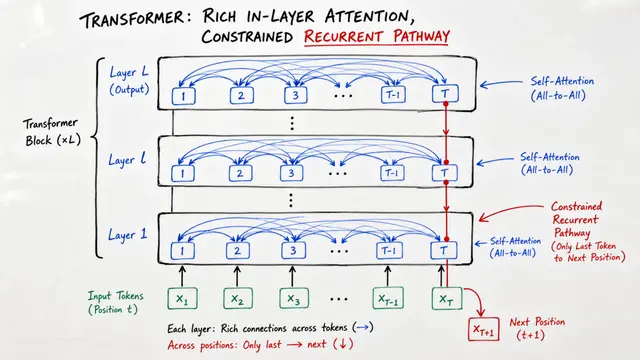
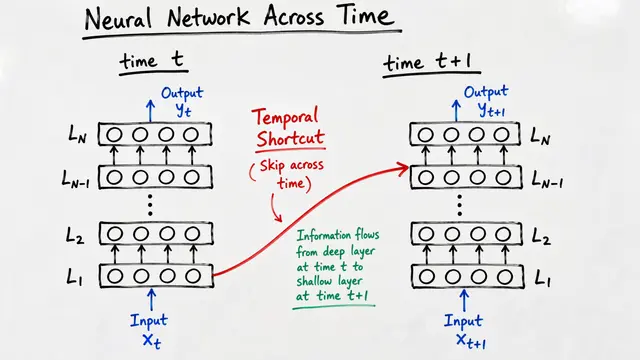
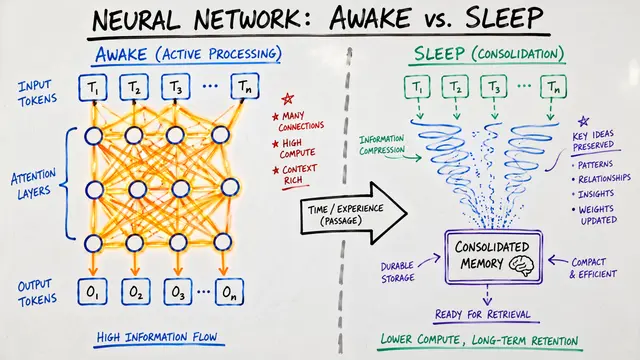
BDH-CQ separates this into two recurrent processes. First, demonstrations update a contextual memory that accumulates task-specific associations. Then, with that memory frozen, the query enters a latent workspace and undergoes repeated computation without ever decoding intermediate steps, until the final grid is produced.
The headline result is both accurate and cheap. At 29.5% pass at 2 on the 400-task public evaluation set, the 150-million-parameter system operates at 0.00070 dollars per task, reportedly moving beyond the previously established Pareto frontier by combining small scale with inference-time adaptation.
Controlled experiments reveal where latent reasoning actually works. Propagation and copying extrapolate perfectly across tested ranges. But ordering collapses sharply beyond length six, and nesting transitions more gracefully at depth five. These are not general reasoning limits; they are operation-specific capacity boundaries, and adding demonstrations at the target complexity often closes the gap.
BDH-CQ shows that compact recurrent models can learn from examples and reason in latent space, but their capabilities are not uniform across transformation types. To explore more research like this and generate your own video summaries, visit EmergentMind.com.