Reading Neural Networks from the Inside Out
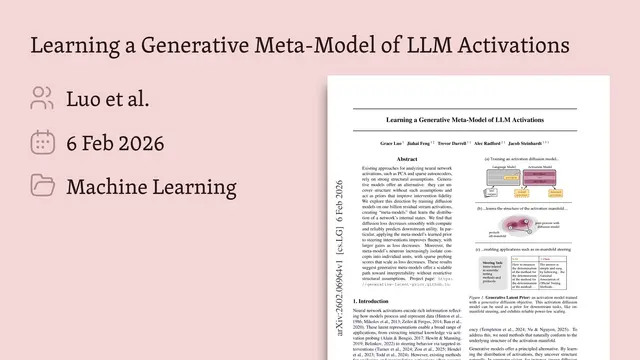
This presentation explores a breakthrough method for interpreting what language models are thinking by generating text that activates specific internal directions. Instead of relying on labels or corpus search, the Maximally-Activating Example Metamodel (MAEM) learns to invert residual stream directions into concrete exemplars that can be verified by running them through the original model. We examine how this approach scales across diverse direction types, from natural activations to steering vectors and hidden backdoors, while maintaining surprising fluency and achieving activation fidelity far beyond traditional methods.Script
Can you generate text that makes a language model think exactly what you want it to think? The authors of this paper demonstrate a model that reads internal neural directions and writes exemplars that activate them with over 75 percent fidelity, verified by the subject model itself.
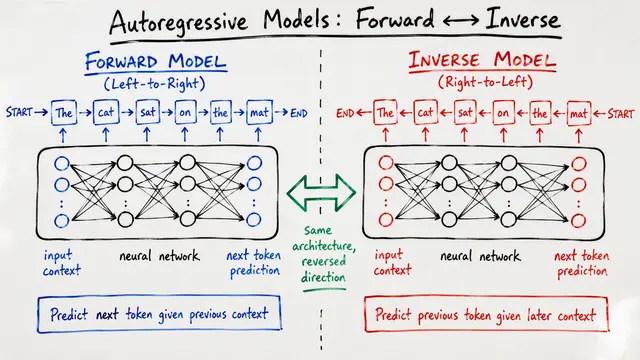
The method treats interpretation as activation inversion. Given a residual stream direction, a fine-tuned metamodel generates text whose forward pass through the frozen subject model strongly activates that direction. The reward is simple: maximize the cosine similarity between the target direction and the activation produced by the generated text.
On held-out natural activations, one MAEM sample reaches a centered cosine of 0.76 compared with 0.57 for 10 million token corpus search. With best-of-eight sampling, that score climbs to 0.82, outperforming the corpus on 92 percent of targets. Even more striking, discrete optimizers like GCG require 274 H200-seconds per target while MAEM needs just 3.4 seconds to generate 64 samples.
The metamodel reads information never seen during training. When the authors construct rank-1 backdoor adapters that hide thematic payloads behind triggers, MAEM recovers the payload from the write direction in 85 percent of samples verbatim. Corpus search, by contrast, recovers only 3 percent. But numeric triggers expose a sharp boundary: the model generates digit-themed text yet fails to produce the exact three-digit code in any sample.
Strong activation does not guarantee complete coverage. MAEM generates specific, internally consistent instances of one facet of a feature, achieving high fidelity but lower diversity than corpus windows. When automated explainers use MAEM examples, their detection recall drops to 38 percent compared with 71 percent for corpus examples. Approximately 11 percent of rare SAE features remain silent even after 64 samples, concentrated among structural features like whitespace position and formatted lists.
Activation inversion replaces unverifiable explanation quality with a grounded test: generate text, run it through the frozen subject model, and measure the alignment directly. The method scales across steering vectors, workspace states, and unseen SAE features without requiring human labels, opening a path toward verifiable neural interpretation. Explore this paper and create your own research videos at EmergentMind.com.