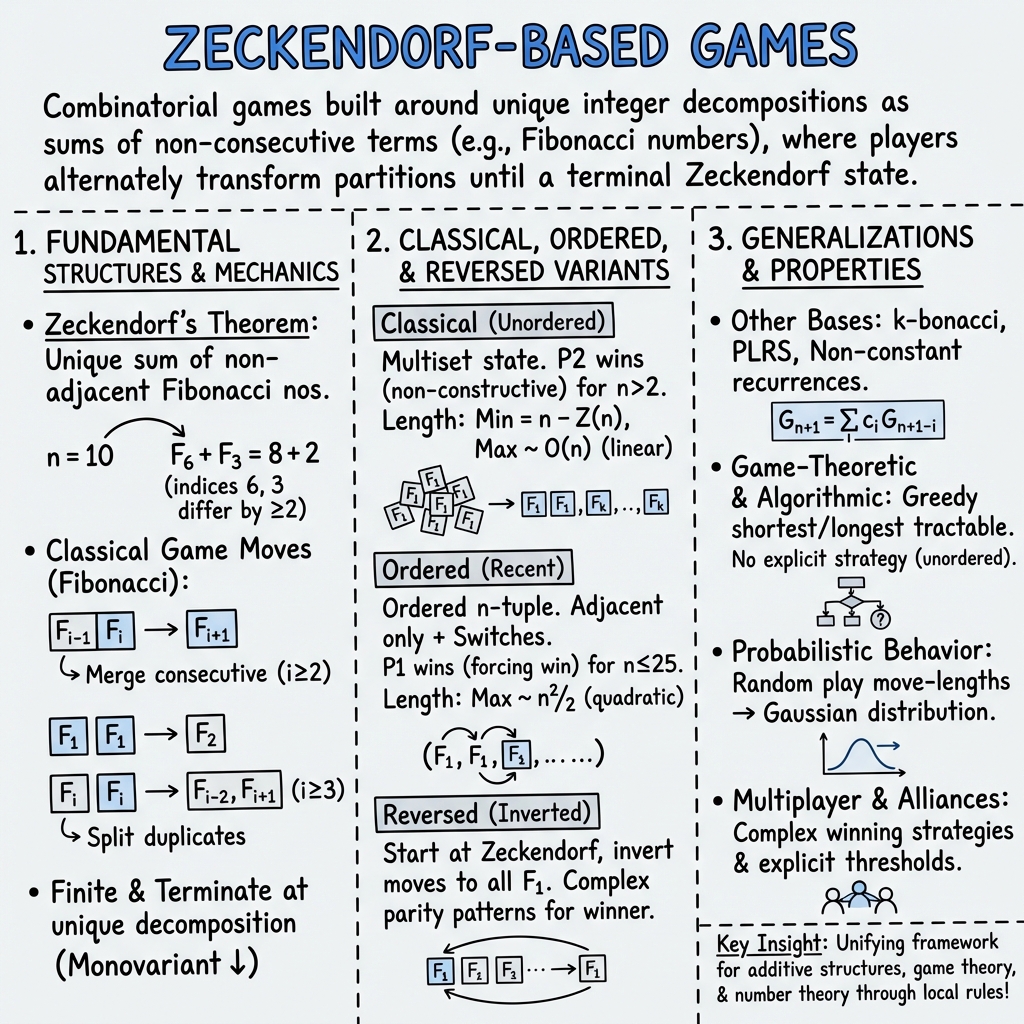
Zeckendorf-Based Games
- Zeckendorf-based games are combinatorial games where players uniquely decompose integers into non-consecutive Fibonacci summands using merging and splitting moves.
- They utilize local move rules that lower invariant measures, ensuring termination at a unique legal decomposition and illuminating links between additive number theory and strategy.
- Variants such as ordered, reversed, and generalized games highlight diverse strategic outcomes and algorithmic properties across different recurrence-based frameworks.
A Zeckendorf-based game is a class of combinatorial games built around unique decompositions of positive integers as sums of non-consecutive terms from certain sequences, most commonly the Fibonacci numbers. Inspired by Zeckendorf’s theorem—which guarantees uniqueness of such decompositions—the canonical format involves two or more players alternately transforming a partition of a fixed integer, following strict local rules that mirror the recurrence relations of the underlying sequence. The game typically terminates at the legal Zeckendorf-type decomposition of the starting integer, with the last player to move declared the winner. Zeckendorf-based games have provided a fertile interface between additive number theory, combinatorial game theory, and the study of probabilistic and algorithmic processes on decompositions.
1. Fundamental Structures and Game Mechanics
Zeckendorf’s theorem asserts that every positive integer can be uniquely written as a sum of non-adjacent Fibonacci numbers , , . The Zeckendorf decomposition of is thus a partition with .
In the classical Zeckendorf game (Baird-Smith et al., 2018), the initial state is an unordered multiset of copies of . Players alternate applying one of the following moves:
- Merge consecutive: Replace by 0 for 1.
- Split duplicates: Replace 2 by 3; 4 by 5; or 6 by 7 for 8.
Each move strictly decreases an appropriate monovariant (e.g., the sum 9 over all pieces), ensuring that the game always terminates at the unique Zeckendorf decomposition (Baird-Smith et al., 2018). The winner is the last player able to make a legal move.
Generalizations of the Zeckendorf game modify the sequence underlying the admissible decompositions—extending to arbitrary positive linear recurrences, non-constant recurrences, or even more complex combinatorial constraints (Baird-Smith et al., 2018, Baily et al., 2021, Bołdyriew et al., 2020).
2. The Classical, Ordered, and Reversed Variants
Classical Zeckendorf Game (Unordered):
- Each state is a multiset.
- Player 2 has a non-constructive winning strategy for all 0 (Baird-Smith et al., 2018, Miller et al., 2022).
- The minimum number of moves is 1, and the maximal length is 2; this bound has been sharpened to linear in 3 in subsequent work (Li et al., 2020, Cusenza et al., 2020).
- The recent Ordered Zeckendorf Game imposes an order: the state is an ordered 4-tuple 5 (Bortnovskyi et al., 27 Aug 2025).
- Only adjacent entries can be acted on; a switch move swaps out-of-order adjacent pairs.
- The introduction of ordered adjacency and switches disrupts mirroring strategies. For 6 (except 7), Player 1 has a forcing win, a sharp reversal from the classical game (Bortnovskyi et al., 27 Aug 2025).
- Termination is proven via the strictly decreasing monovariant 8.
- Shortest-game length equals 9, while longest-game asymptotics are quadratic: 0.
Reversed Zeckendorf Game:
- Initiated at the Zeckendorf decomposition, players invert the moves until all parts are 1 (Batterman et al., 2023).
- Winning regions change radically: Player 1 has a winning strategy for 2; more generally, the distribution of winners exhibits complex parity patterns.
3. Generalizations and Extensions
To Other Linear Recurrences:
- Games have been built on k-nacci numbers, generalized recursions 3, and even nonconstant coefficient recurrences 4 (Baird-Smith et al., 2018, Bołdyriew et al., 2020, Baily et al., 2021, Miller et al., 2022). Decomposition rules, allowed moves, and termination monovariants are adapted to the structure of the underlying recurrence.
- For generalized Zeckendorf games, uniqueness of decomposition and finiteness are guaranteed under suitable conditions (e.g., positivity of coefficients) (Baird-Smith et al., 2018).
To Geometric or Combinatorial Settings:
- The Fibonacci Quilt Game relies on two-dimensional adjacency constraints, resulting in non-uniqueness, more elaborate allowed moves, and qualitative deviations such as multiple legal decompositions and strategic diversity (Miller et al., 2019).
Black Hole Variants:
- The Black Hole Zeckendorf Games restrict play to finite segments: pieces that would enter forbidden bins are removed ('black hole'). These modifications yield intricate modular winners and allow for fully constructive strategies for small 5 (Cashman et al., 2024).
4. Game-Theoretic and Algorithmic Properties
Termination and Monovariants:
- All standard Zeckendorf-based games are finite by construction. Suitable monovariants (sum of indices, weighted sums, quadratic potentials) strictly decrease at each move, covering both unordered and ordered games (Baird-Smith et al., 2018, Bortnovskyi et al., 27 Aug 2025, Baily et al., 2021).
- In the ordered case, the monovariant 6 bounds the maximal length by 7, which is tight up to lower-order terms (Bortnovskyi et al., 27 Aug 2025).
Move-Count Bounds:
- Minimal game length is achieved by greedy merging, always reducing the number of summands by 1: minimal length is 8.
- Maximal game length is realized by maximal splitting; for the unordered game this is now linear in 9 (sharp bound: 0 (Li et al., 2020, Cusenza et al., 2020)), while for the ordered variant it is quadratic (Bortnovskyi et al., 27 Aug 2025).
- For the generalized Bergman game on PLRS, longest plays are 1 (Baily et al., 2021).
Complexity and Algorithmics:
- For ordered/unordered games, finding shortest and longest plays is algorithmically tractable due to greedy characterizations (Bołdyriew et al., 2020, Li et al., 2020).
- However, determining explicit winning strategies is nontrivial: in the classical game, the Player 2 win exists but lacks an explicit protocol for large 2 (Baird-Smith et al., 2018, Miller et al., 2022).
5. Strategic, Probabilistic, and Multiplayer Behavior
Strategic Outcomes:
- Classical Zeckendorf Game: Player 2 has a winning strategy for 3, but this strategy is non-constructive and not explicitly known for large 4 (Baird-Smith et al., 2018, Miller et al., 2022).
- Ordered Zeckendorf Game: Player 1 wins in nearly all small 5 due to adjacency and switching constraints (Bortnovskyi et al., 27 Aug 2025).
- Reversed Zeckendorf: Winner alternates in a nontrivial, parity-governed pattern (Batterman et al., 2023).
- Games built on generalized or non-constant recurrences often admit both parities of game-length, so either player can win for suitable 6 (Bołdyriew et al., 2020, Miller et al., 2022).
Random Play and Probabilistic Phenomena:
- Randomized Zeckendorf games, where moves are chosen uniformly at random, typically exhibit move-length distributions approaching Gaussianity or log-normality as 7 (Cheigh et al., 2022, Bortnovskyi et al., 27 Aug 2025, Miller et al., 2019).
- Under random play, win/loss frequencies converge to 8–9 as 0 grows (Cheigh et al., 2022, Bortnovskyi et al., 27 Aug 2025).
Multiplayer and Alliances:
- For 1 players (classical unordered), no player has a winning strategy for 2. For 3 or sufficiently large 4, coalitions too small cannot force a win; sufficiently large alliances can (Cusenza et al., 2020, Miller et al., 2022, Bołdyriew et al., 2020).
- Existence and classification of winning strategies generalize to more complex alliances, with explicit thresholds depending on recurrence parameters and partition sizes (Cusenza et al., 2020, Miller et al., 2022).
6. Open Problems and Future Directions
- Constructive Winning Strategies: The lack of explicit winning strategies for the unordered Zeckendorf game remains an open problem. Recent work in ordered and modified variants provides analogues with more tractable strategy spaces (Bortnovskyi et al., 27 Aug 2025, Cashman et al., 2024).
- Gaussianity in Move Distributions: The conjecture that move-length in random play approaches a Gaussian law for Zeckendorf and broader recurrence-based games is supported by partition-based analyses but remains unresolved in full generality (Cheigh et al., 2022).
- Extensions to Arbitrary Recurrences: A unified approach to Zeckendorf-type games on arbitrary positive or nonconstant recurrences continues to pose challenges, particularly for explicit move-count bounds, winner classifications, and alliance strategies (Bołdyriew et al., 2020, Baily et al., 2021, Miller et al., 2022).
- Complexity and Algorithmic Questions: Determining worst-case or average-case complexity for arbitrary Zeckendorf-based games, and constructing efficient algorithms for optimal play, remain active areas of study.
7. Comparative Table of Key Zeckendorf-Based Games
| Game Variant | Sequence | State Structure | Key Move Constraint | Player Win (Small 5) | Shortest Length | Longest Length |
|---|---|---|---|---|---|---|
| Classical Zeckendorf | Fibonacci | Unordered multiset | Any occurrence | Player 2 (6), non-constructive | 7 | 8, tight bounds known |
| Ordered Zeckendorf | Fibonacci | Ordered tuple | Adjacent only, switches | Player 1 (9, 0) | 1 | 2 |
| Generalized Zeckendorf | PLRS, 3-bonacci | Unordered multiset | Local, per recurrence | Varies per 4, parity dependent | 5 | 6 or higher |
| Nonconstant Recurrence | 7 | Unordered | Local, per recurrence | Both players can win; parity exists | 8 | Not specified |
| Reversed Zeckendorf | Fibonacci | Partition in bins | Inverted moves | Complex, parity-governed | 9 | 0 |
| Fibonacci Quilt | FQ sequence | Unordered quilt | 2D adjacency, not unique | Either player for 1 | 2 | Variable |
| Black Hole Zeckendorf | Fibonacci | Truncated bins | Disallowed bins, modular | Modular winners (explicit) | — | — |
This comparative table summarizes basis sequence, state representation, move constraints, winner for small 3, and basic move-count bounds for the prominent Zeckendorf-based games (Bortnovskyi et al., 27 Aug 2025, Baird-Smith et al., 2018, Baily et al., 2021, Bołdyriew et al., 2020, Batterman et al., 2023, Miller et al., 2019, Cashman et al., 2024).
Zeckendorf-based games constitute a unifying framework for exploring additive structures through local move rules. They connect combinatorial game theory and number theory, support deep results on unique representations, winning strategies, game complexity, and probabilistic behavior, and catalyze ongoing research across generalizations, alliance settings, and algorithmic aspects (Bortnovskyi et al., 27 Aug 2025, Baird-Smith et al., 2018, Cheigh et al., 2022, Miller et al., 2022, Baily et al., 2021, Bołdyriew et al., 2020, Li et al., 2020, Cusenza et al., 2020, Batterman et al., 2023, Miller et al., 2019, Cashman et al., 2024).