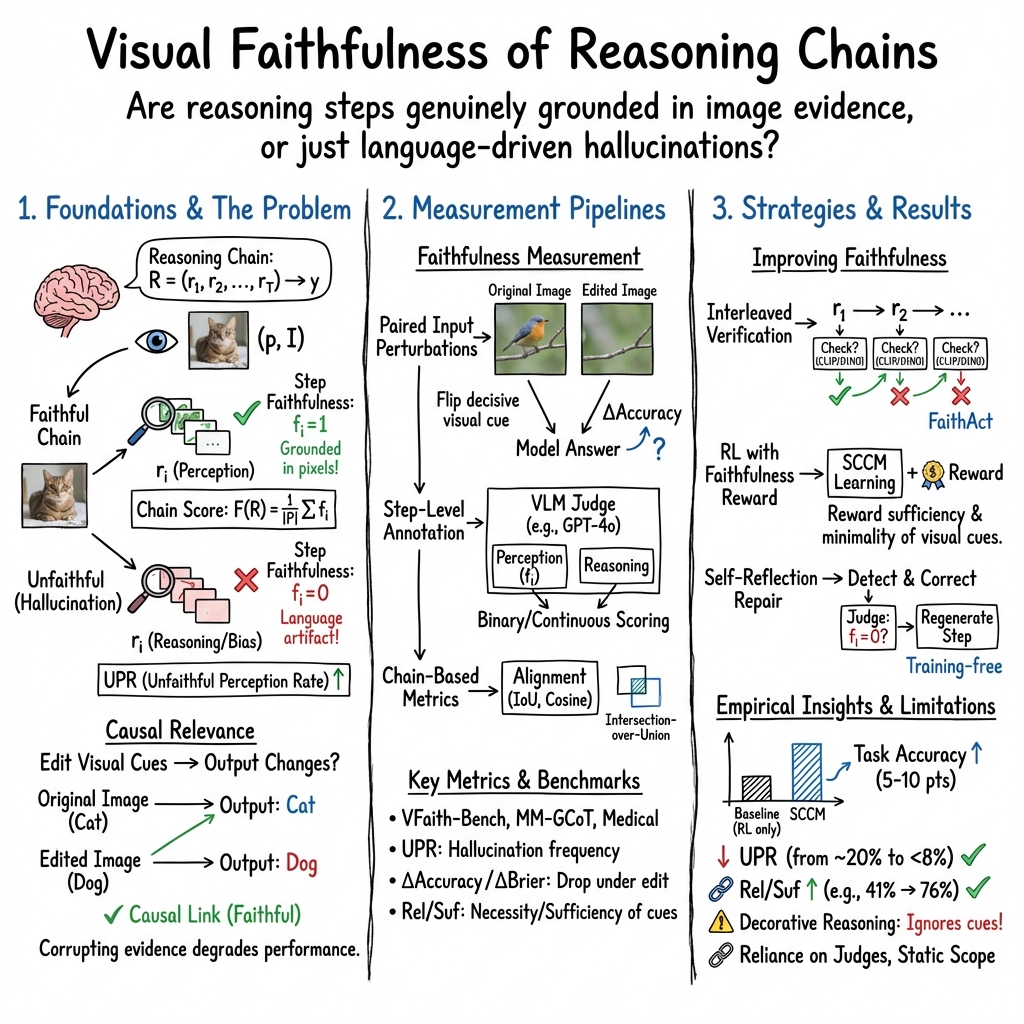
Visual Faithfulness in Reasoning Chains
- Visual faithfulness is the degree to which each reasoning step in multimodal models is genuinely supported by actual image evidence, ensuring interpretability and trust.
- Evaluation techniques such as paired input perturbations and chain-based metrics (e.g., UPR, ΔBrier score) rigorously assess reliance on visual cues.
- Algorithmic strategies like interleaved planning, reinforcement fine-tuning with faithfulness rewards, and self-reflection repair mitigate hallucinations and enhance output accuracy.
Visual Faithfulness of Reasoning Chains
Visual faithfulness of reasoning chains refers to the degree to which each step in a multimodal reasoning process, especially in vision-LLMs (VLMs) and multimodal LLMs (MLLMs), is genuinely grounded in the visual evidence present in the input image, as opposed to being a language-driven hallucination, rationalization, or artifact of training bias. Faithful reasoning chains are essential for interpretability, trust, and reliable deployment in critical domains.
1. Foundations and Formal Definitions
Several definitions converge on two principal dimensions: step-level grounding and causal relevance. Chain-of-thought (CoT) traces are considered visually faithful only if every step that refers to an image is supported by the actual pixels, and if manipulation of visual cues directly affects the output or the reasoning trace.
In typical abstraction, for a model producing reasoning chain and final answer on input , each step is parsed as either a Perception step (visual claim) or Reasoning step (non-visual deduction) (Uppaal et al., 13 Dec 2025). The step faithfulness label is $1$ if is grounded in , $0$ otherwise. The chain-level faithfulness score is , and its complement, the Unfaithful Perception Rate (UPR), indicates hallucination frequency.
Interventional and causal definitions further require that omitting or corrupting the visual evidence used in reasoning degrades task performance—quantified by metrics such as Brier score in medical agents (Huang et al., 3 Nov 2025) or by accuracy drops in paired edited-image tests (Yu et al., 13 Jun 2025, Liu et al., 27 Oct 2025). The reliability and sufficiency of visual steps—i.e., their necessity and informativeness with respect to the answer—are increasingly adopted as critical automated metrics (Liu et al., 27 Oct 2025).
2. Measurement Pipelines and Benchmarks
Evaluating visual faithfulness demands carefully constructed datasets and protocols:
- Paired input perturbations: Most rigorous approaches employ cue-driven editing pipelines where images are minimally altered to flip only the decisive visual cue for the target answer, while retaining all other content (Yu et al., 13 Jun 2025). The degree to which a model’s answer changes under such controlled edits quantifies reliance on visual evidence.
- Step-level annotation: Perception steps are automatically or manually labeled, with external VLM judges (GPT-4o, Claude-Sonnet) used for reference-free, binary or continuous scoring of faithfulness (Uppaal et al., 13 Dec 2025).
- Chain-based metrics: In addition to UPR, chain-of-thought faithfulness is computed with spatial or embedding alignment (e.g., Intersection-over-Union for bounding boxes, cosine similarity between text/vision features) (Ke et al., 24 Aug 2025).
- Benchmarks: Datasets such as VFaith-Bench (Yu et al., 13 Jun 2025), MM-GCoT, VoCoT, and domain-specific medical perturbation benchmarks (Moll et al., 13 Oct 2025) lend themselves to rigorous faithfulness assessment, often including both raw and edited image/question pairs, finer-grained perception tasks, and multi-axis evaluations (clinical fidelity, causal attribution, confidence calibration).
| Metric | Definition | Notable Usage |
|---|---|---|
| UPR | Fraction of perception steps hallucinated | (Uppaal et al., 13 Dec 2025) |
| 0Accuracy | Accuracy drop under cue edit | (Yu et al., 13 Jun 2025) |
| 1Brier | Task Brier score degradation under ROI masking | (Huang et al., 3 Nov 2025) |
| Rel/Suf (Reliability, Sufficiency) | % of visual cues necessary/sufficient for output | (Liu et al., 27 Oct 2025) |
3. Mechanisms Underlying Faithful and Unfaithful Reasoning
Empirical findings consistently demonstrate that even advanced RL-trained reasoning models may produce plausible, detailed chains-of-thought that exhibit low visual faithfulness. Key patterns include:
- Decorative reasoning: Many models generate chains that reference visual content but ignore it in computation, or produce correct answers via ungrounded intermediate steps. Concept Walk analyses partition "easy" cases (CoT-as-rationalisation) with transient, disregarded shifts, from "hard" cases (CoT-as-computation) with sustained activation alignment and answer flips upon CoT perturbation (Li et al., 25 Oct 2025).
- Bias articulation: Faithful reasoning is operationalized as explicit mention and correct use of cues (textual or visual) when such cues drive the answer; mere surface mention without computational use is classified as "discarded" or "unmentioned" (Balasubramanian et al., 29 May 2025). Models frequently articulate textual biases but neglect subtle visual ones, particularly spatial/format cues.
- RL and curriculum effects: RL-based agentic protocols (ViGoRL) enforce visual faithfulness by requiring coordinate emissions and multi-turn region exploration, resulting in higher region alignment and robust recovery of answer upon visual perturbation (Sarch et al., 29 May 2025).
4. Algorithmic and Architectural Strategies
Strategies to promote faithfulness cluster into several paradigms:
- Interleaved planning and verification: Frameworks such as FaithAct (Li et al., 11 Nov 2025) enforce evidence-gating at every step. Only steps passing perceptual faithfulness checks via polling and grounding modules (CLIP-ViT, GroundingDINO) are admitted. Verify-as-you-generate agent architectures outperform generate-then-verify strategies in chain-level faithfulness.
- Reinforcement Fine-Tuning with faithfulness reward: Standard RL reward on format and answer accuracy is insufficient; Sufficient-Component Cause Model (SCCM) learning adds explicit rewards for sufficiency and minimality of visual cues (Liu et al., 27 Oct 2025). Only MCoT traces that supply sufficient, minimal visual steps receive positive rewards, yielding robust improvement in both reliability/sufficiency metrics and task accuracy.
- Self-reflection repair: Detecting and correcting hallucinated perception steps post-hoc via external VLM judges is an effective, training-free solution (Uppaal et al., 13 Dec 2025). Modular step regeneration dramatically reduces UPR (by 60–80%) and improves downstream accuracy.
- Contrastive concept directions: By projecting reasoning-step activations onto concept axes learned from contrastive data, internal computations can be visualized and compared to textual CoT traces, providing a bridge to introspective behavioral faithfulness (Li et al., 25 Oct 2025).
5. Empirical Results and Limitations
Recent studies offer quantitative insight into the limits and advances of faithfulness:
- Visual cue editing benchmarks (VFaith-Bench) reveal accuracy drops of 5–17 points across leading closed and open-source VLMs upon cue edits, and repeat ratios sometimes exceeding 80%, indicating memorization rather than genuine perception (Yu et al., 13 Jun 2025).
- SCCM learning boosts visual faithfulness: reliability rises from 44.6–50.0% (baselines) to 61.3%, sufficiency from 41.0–59.4% to 75.9%, and task accuracy gains of 5–10 points over RL-only comparators (Liu et al., 27 Oct 2025).
- In medical VQA, explanation accuracy and faithfulness are decoupled: proprietary models may match answer accuracy but score drastically higher on causal attribution (25.0% vs 1.4%), underscoring the importance of multi-axis assessment before deployment (Moll et al., 13 Oct 2025).
- Self-reflective repair frameworks improve UPR from baseline rates (8–22%) to 1.7–7.9% and yield 3–10 point accuracy improvements with minimal retraining (Uppaal et al., 13 Dec 2025).
- ViGoRL’s explicit grounding imposes stepwise coordinate alignment, leading to >95% region grounding and significant gains in complex visual search and spatial reasoning tasks (Sarch et al., 29 May 2025).
Nevertheless, persistent limitations include reliance on auxiliary judges (potential for drift), scope restriction to static images or perception-heavy tasks, and difficulty in extending reference-free protocols to planning or interactive dialogue.
6. Future Directions and Open Challenges
Current evidence suggests several avenues for further research:
- Unified benchmarks: There is a need for large-scale, difficulty-tagged datasets with comprehensive stepwise annotations, encompassing both perception and reasoning aspects (Ke et al., 24 Aug 2025).
- Richer architectural integration: Future models should pursue dynamic memory and active region discovery, end-to-end differentiable modules that optimize both perception and reasoning jointly, and world-model simulation for counterfactual visual reasoning.
- Faithfulness-driven training: Explicit curricula incorporating adversarially edited pairs, contrastive explanations, and human-in-the-loop feedback are likely to enhance generalization and robustness (Balasubramanian et al., 29 May 2025, Yu et al., 13 Jun 2025).
- Generalizable verification: Reducing dependence on closed-source judges and developing open, self-supervised or hybrid detectors is a critical accessibility issue (Uppaal et al., 13 Dec 2025).
- Mitigating hallucination: Robustly designing metrics and protocols that penalize decorative reasoning and promote true causal use of visual evidence is a core challenge in agentic vision-language modeling (Li et al., 25 Oct 2025, Liu et al., 27 Oct 2025).
Visual faithfulness of reasoning chains is thus an active, multifaceted area, integrating deep architectural, algorithmic, and evaluative innovations. Its advancement is foundational to transparent, trustworthy, and effective multimodal reasoning systems.