Strongly Invertible Legendrian Knots
- The paper introduces a framework for classifying strongly invertible Legendrian knots via τ-equivariant front diagrams and symmetric Reidemeister moves.
- It defines the equivariant Thurston–Bennequin number and compares its maximal value with the classical invariant for families like torus and twist knots.
- The work establishes equivariant stabilization theorems and poses conjectures on symmetry constraints, paving the way for refined contact-geometric invariants.
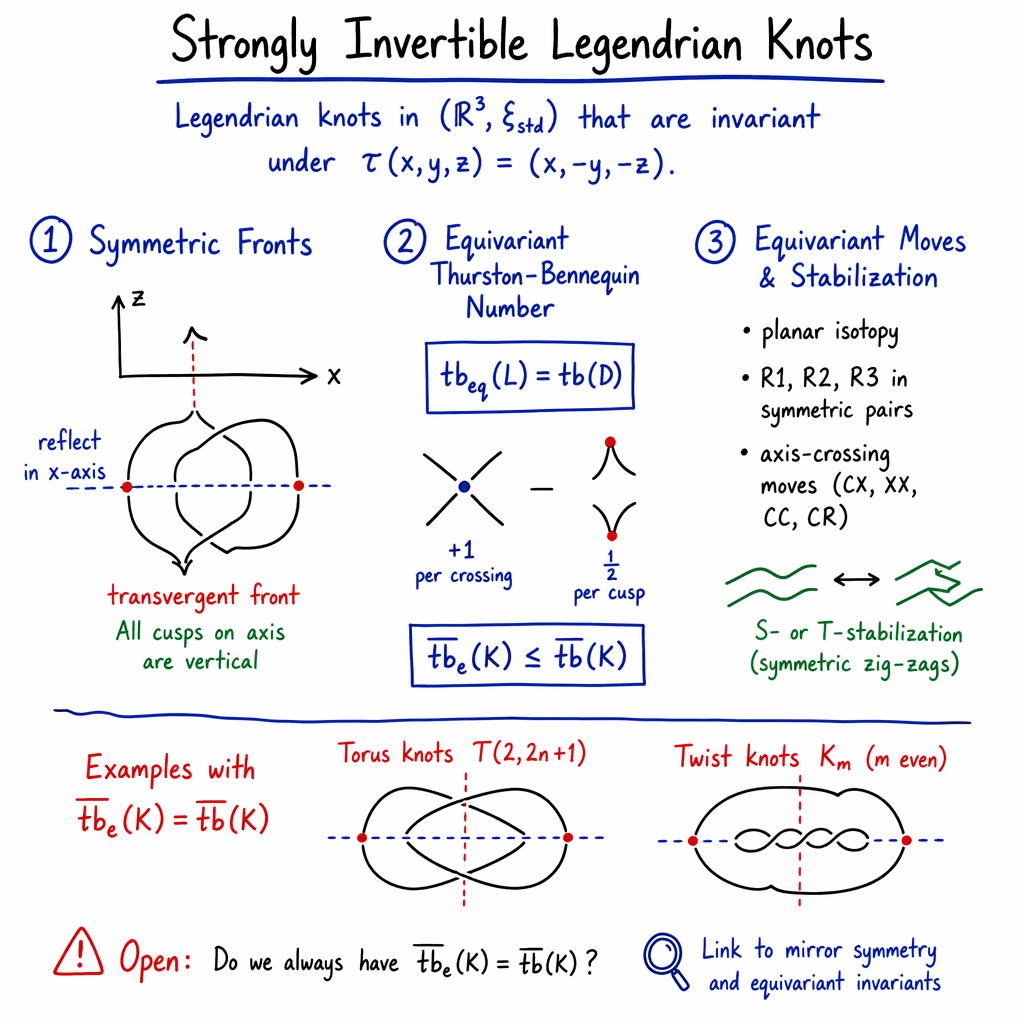
A strongly invertible Legendrian knot is a Legendrian knot in the standard contact three-dimensional space , where , that is invariant under the involution . This involution fixes the -axis pointwise, reverses the coorientation of , and preserves the set of Legendrian curves. A smooth knot is strongly invertible with respect to if , each component is setwise invariant, and fixes exactly two points on each component. A Legendrian knot 0 is strongly invertible if 1 and each component of 2 meets 3 in exactly two fixed points. Equivalence is by 4-equivariant Legendrian isotopy. Strongly invertible Legendrian knots combine topological symmetry constraints with the rigidity of contact geometric invariance, motivating new invariants and symmetries not present in the usual Legendrian or strongly invertible knot setting (Collari et al., 2023).
1. Symmetry and Front Projections
The 5 involution projects to the 6-plane as the reflection 7. The front (or 8-) projection of a Legendrian knot 9 is the image 0. For a generic Legendrian knot, this front projection consists only of cusp singularities and transverse double crossings, with vertical tangencies occurring only at cusps.
A front diagram 1 is defined as transvergent if 2 as a set; equivalently, it is symmetric under reflection across the 3-axis, and all cusps on the 4-axis are vertical. Every strongly invertible Legendrian knot admits a transvergent front diagram, constructed by equivariantly modifying a generic front so that its symmetry is preserved—using an equivariant version of front completion, including adding or removing zig-zags off the axis and resolving crossings in a symmetric fashion (Collari et al., 2023).
2. Equivariant Thurston–Bennequin Number
For a generic front 5 of any Legendrian knot, the Thurston–Bennequin number is
6
and is invariant under Legendrian isotopy. For a strongly invertible topological knot 7, the equivariant Thurston–Bennequin number of a strongly invertible Legendrian representative 8 is defined as 9, where 0 is any transvergent front of 1. The definition follows the same combinatorial rule as for general Legendrian knots.
The maximal equivariant Thurston–Bennequin number for the strongly invertible knot 2 is
3
It follows that always 4, where 5 is the classical maximal Thurston–Bennequin number over all Legendrian representatives. The potential failure of equality motivates the study of when strong invertibility imposes extra constraints on contact-geometric invariants (Collari et al., 2023).
3. Equivariant Reidemeister and Stabilization Theorems
Two transvergent front diagrams 6, 7 represent equivalent strongly invertible Legendrian knots if and only if they are related by a finite sequence of the following moves:
- 8-equivariant planar isotopies in the 9-plane
- Ordinary Legendrian Reidemeister moves (R1, R2, R3) applied simultaneously in symmetric disks above and below the 0-axis
- Special axis-crossing equivariant moves (labelled CX, XX, CC, CR), along with their 1 rotations
This forms the equivariant Legendrian Reidemeister theorem (Theorem 3.1 of (Collari et al., 2023)).
On stabilization, any 2-fixed cusp 3 on a transvergent front admits two inequivalent local stabilizations: S– and T–stabilizations. Off-axis, these are the standard up/down zig–zag insertions done symmetrically. On-axis, two distinct symmetric pairs of zig-zags are possible, yielding inequivalent stabilized diagrams S and T. The equivariant stabilization theorem (Theorem 4.2) establishes that for two strongly invertible Legendrian knots 4, 5 of the same topological type, there exist sufficiently many S–stabilizations such that they become Legendrian isotopic as strongly invertible knots. Thus, classification within each strongly invertible smooth knot type can be completed once S–stabilizations are permitted (Collari et al., 2023).
4. Families Realizing 6
Explicit infinite families of knots are presented for which the equivariant and non-equivariant maximal Thurston–Bennequin numbers coincide.
- Torus Knots 7: For 8, 9; for 0, 1. The construction of transvergent fronts with the requisite symmetry and twist configuration realizes the maximum 2 in both cases. Hence, 3.
- Twist Knots 4 (m even): For each 5, Figure 1 shows a symmetric front diagram achieving the maximal classical Thurston–Bennequin number 6 as the equivariant maximum. In particular, the unknot cases (7) are also realized.
These examples demonstrate that an infinite collection of knot types—including all torus knots 8 and twist knots 9—admits strongly invertible Legendrian representatives with maximal classical 0 (Collari et al., 2023).
5. Conjectures and Open Questions
Unequal Maxima
Conjecture 1: For certain knots, the maximal equivariant Thurston–Bennequin number may be strictly less than the classical maximal value. For the knot 1, computational evidence yields only 2-invariant Legendrian representatives with 3, despite the fact that 4.
Mirror Symmetry and Non-Realizability
Every strongly invertible oriented Legendrian knot 5 satisfies 6, where 7 is the Legendrian mirror (rotation by 8 about the 9-axis) due to commutation of 0 with this rotation.
Conjecture 2: There exist Legendrian knots 1 of some types (e.g., the mirror of 2) with 3 as oriented Legendrians, but no Legendrian representative of that type can be made 4-invariant. In these cases, 5, though the maximal 6 representatives are involutive up to mirror.
Equivariant Jones-type Formula
The classical Jones conjecture relates 7 to the grid number of 8. An equivariant analog would replace the maxima and grid numbers with their equivariant counterparts (the minimal size of a symmetric grid). A counterexample to such an identity is expected if Conjecture 2 holds (Collari et al., 2023).
6. Construction of Transvergent Fronts
Transvergent fronts are constructed from any 9-invariant knot by projection to the 0-plane, perturbing complementary arcs generically, and adjusting vertical tangencies and undesirable crossings in a 1-equivariant manner to ensure the symmetric property 2.
The proof of the equivariant Reidemeister theorem relies on analysis of generic 3-parameter 4-equivariant Legendrian isotopies, where singular events correspond either to standard Legendrian Reidemeister moves off axis (in symmetric pairs) or to axis-crossing events (moves CX, XX, CC, CR).
Equivariant stabilization adapts Fuchs–Tabachnikov zig–zag techniques to the symmetric setting, allowing insertion of symmetric pairs of zig–zags that can transfer across the axis using equivariant moves (Collari et al., 2023).
7. Outlook and Future Research
The foundational framework for strongly invertible Legendrian knots includes precise definitions, existence results for symmetric fronts, equivariant versions of Reidemeister and stabilization theorems, and a new invariant, the maximal equivariant Thurston–Bennequin number. The discovery of infinite families for which 5 resolves certain cases, yet fundamental open questions persist regarding the interplay between maximality, symmetry, and Legendrian isotopy. The distinction between mirror symmetry and strong invertibility as obstructions to invariant realizations of maximal 6 remains an area of active investigation (Collari et al., 2023).