Sparse Mixture-of-Experts (s-MoE)
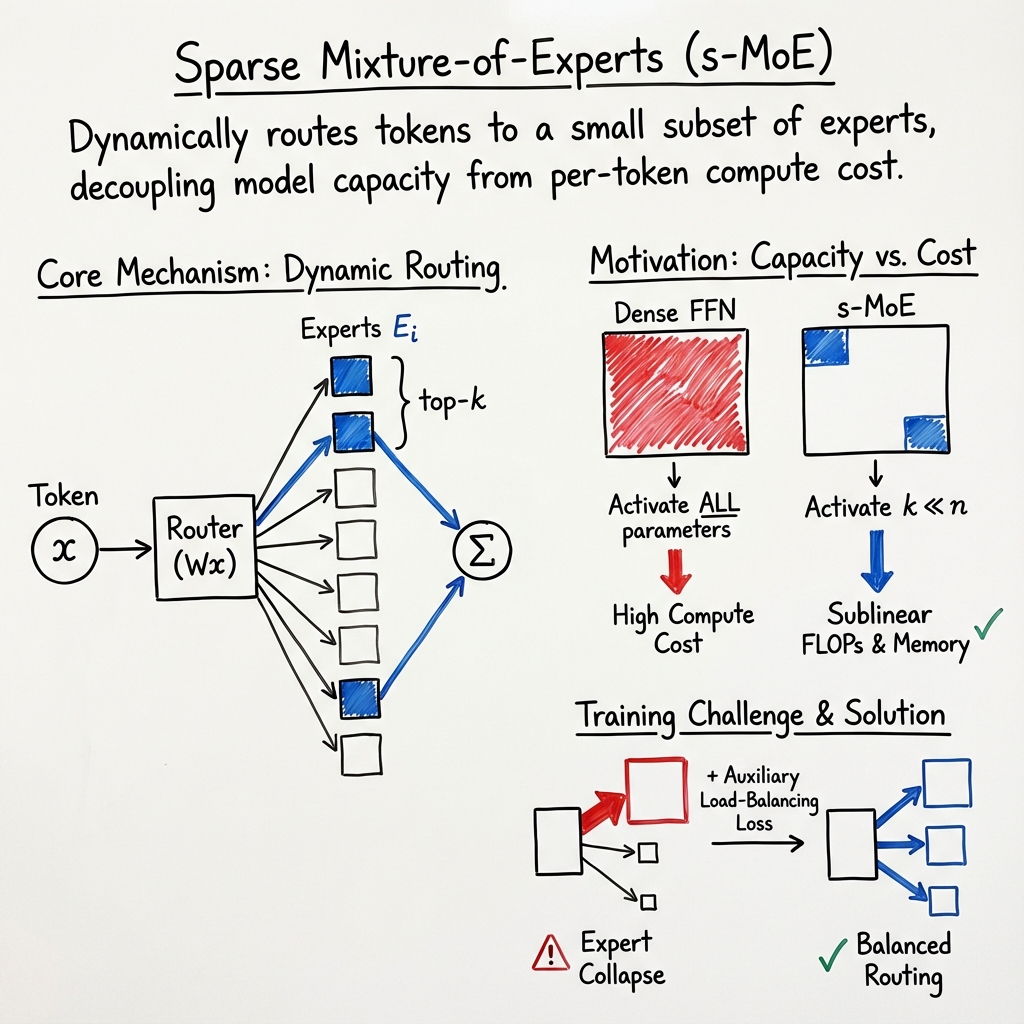
- Sparse Mixture-of-Experts (s-MoE) is a conditional computation architecture that dynamically routes tokens to a select subset of expert sub-networks.
- It employs top-k gating and auxiliary load-balancing to activate only a few experts per token, significantly reducing computational and memory demands.
- s-MoE models are widely adopted in large language, vision-language, and multimodal systems, with research focusing on routing strategies, robustness, and deployment efficiency.
A sparse Mixture-of-Experts (s-MoE) model is a conditional computation architecture in which each token is dynamically routed, via a learned gating mechanism, to a small subset of a large pool of expert sub-networks. This selective activation decouples model capacity from per-token computational and memory cost, making it possible to scale models to trillions of parameters without a proportional increase in computation or inference latency. The s-MoE framework is widely deployed within LLMs, vision-LLMs, and general-purpose deep neural architectures, and has motivated extensive work on routing strategies, regularization, interpretability, and efficient deployment.
1. Core Architecture and Routing Paradigms
An s-MoE layer replaces a standard dense feed-forward sublayer (FFN) in a Transformer block with a bank of expert FFNs, each , and a lightweight router network, typically a per-token softmax over expert indices. At each forward pass, only experts are activated per token, according to the top- gating weights: The output is: Auxiliary load-balancing losses (e.g., importance and load terms) are used at training time to prevent expert collapse and ensure balanced expert utilization (Chen et al., 2024, Lee-Thorp et al., 2022, Chen et al., 2022). This top- gating enables sublinear FLOPs and memory usage per-token: for experts, cost per token is experts. For Switch Transformers and most LLM s-MoEs, 0 or 1 is typical.
Two primary routing paradigms are employed:
- Token Choice: Each token independently selects its top-2 expert(s) via softmax over expert projections, maximizing per-token relevance but potentially overloading some experts.
- Expert Choice: Each expert selects its top-3 tokens (per batch), addressing capacity bottlenecks but risking underutilization (Do et al., 29 Mar 2025).
Hybrid or unified routing (e.g., USMoE) combines both selection axes for improved assignment fidelity and robustness (Do et al., 29 Mar 2025).
2. Training and Regularization Methods
Vanilla s-MoE training with top-4 routing leads to sparse backward signals—only active experts and their gates participate in gradients—introducing instability and representation collapse (where few experts dominate routing or learn redundant functions). Solutions include:
- Auxiliary Regularization: Auxiliary load-balancing (variance/minimum-variance, entropy-based, and importance balancing) is standard to promote both expert diversity and consistent routing (Lee-Thorp et al., 2022, Chen et al., 2024, Qu et al., 2024).
- Dense Backpropagation: Default MoE fills missing gradients for inactive experts using an exponential moving average (EMA) of their outputs, yielding densified router gradients with negligible computational cost and improved convergence (Panda et al., 16 Apr 2025).
- Stochastic Routing Regularization: S2MoE injects controlled noise into router inputs, mixing deterministic and perturbed branches, while contrastive InfoNCE-style objectives align their outputs, increasing diversity and discouraging collapse (Do et al., 29 Mar 2025).
- Task-Specific Pruning and Merging: Progressive expert pruning during downstream fine-tuning reduces the expert pool to one per layer, converting an s-MoE into an efficient dense model with nearly all the original performance (Chen et al., 2022). Post-hoc merging via hierarchical clustering of expert outputs reduces memory footprint in deployment (Chen et al., 2024).
3. Theoretical Foundations and Generalization
Classical generalization theory for s-MoE formalizes the hypothesis class as a family of 5-sparse convex combinations of expert networks 6 (per the selected experts), routed via parameterized sparse mappings 7. The key generalization result is that error bounds scale only as
8
where 9 is the total number of experts, 0 is the sparsity level, 1 is the Natarajan dimension of the router class, and 2 is the dataset size (Zhao et al., 2024). This logarithmic dependence on the pool size 3 (for fixed 4) underpins s-MoE's ability to scale capacity without severe overfitting, provided router complexity and 5 are controlled.
Representation disentanglement and "monosemanticity" metrics quantify how well individual experts specialize in encoding distinct features, as opposed to dense networks where high superposition (polysemanticity) complicates interpretability. Higher network sparsity (low 6) increases monosemantic representation and interpretability, provided that expert pool size is sufficiently large (Chaudhari et al., 26 Oct 2025).
4. Routing Stability, Robustness, and Interpretability
s-MoEs are prone to routing fluctuations—instability in token-to-expert assignments—especially in late-stage training. The token-wise independence of softmax gating yields high entropy of expert selection and sensitivity to minor input or weight perturbations (Nguyen et al., 1 May 2025). This is mitigated by:
- Token Similarity-Aware Routing: Aggregating routing scores across similar tokens or using the attention similarity graph stabilizes assignments and reduces routing entropy, theoretically ensuring more robust performance on clean and adversarial inputs (Nguyen et al., 1 May 2025).
Empirical investigations confirm that with appropriate regularization and hyperparameter tuning (expert dropout, load-balance coefficients), s-MoEs exhibit equal or improved adversarial robustness, safety, and OOD accuracy relative to dense counterparts (Chen et al., 2024). Routing visualization and t-SNE analyses of unsupervised MoE-VAEs reveal that unsupervised expert allocation identifies meaningful, often semantically subclustered regions in latent space—distinct from and sometimes superior to class-label guided routing (Nikolic et al., 12 Sep 2025).
5. Approaches to Expert Pruning, Merging, and Deployment Efficiency
Efficient deployment of s-MoEs in resource-constrained environments demands reduction in active expert count and overall parameter footprint. Several methodologies are prominent:
- Heavy-Hitters/Confidence Pruning: SEER-MoE applies global or layer-wise soft/hard statistical counting over calibration data to remove weakly-activated experts, followed by entropy-penalized fine-tuning to recover accuracy while further reducing active 7 (Muzio et al., 2024).
- Progressive Task-Specific Pruning: Windowed pruning schedules identify the expert contributing most "professional" output per downstream task and reduce to a single expert per layer (Chen et al., 2022).
- Hierarchical Output Clustering and Merging: HC-SMoE merges experts with similar average outputs (measured over a calibration set), reducing both parameters and memory footprint without retraining, and maintaining accuracy within 5–10% of original models for up to 50% reduction in pool size (Chen et al., 2024).
- Sparse Performance Metrics and CAP Trade-Offs: CAP frameworks and sparsity-aware metrics such as S-MBU and S-MFU enable accurate hardware and latency-vs-cost-vs-accuracy benchmarking in deployment, ensuring informed trade-off navigation under real-world constraints (Jiang et al., 2024, Jiang et al., 16 May 2025).
6. Applications, Empirical Outcomes, and Best Practices
s-MoE is now a staple of LLMs (Mixtral, Qwen, Llama-MoE), vision-LLMs (VL-MoE, BEiT-3), and efficiency-driven architectures (Sparse Mixer). When equipped with robust routing, appropriate regularization, and capacity-aware post-training, s-MoEs:
- Achieve state-of-the-art accuracy on language, vision, and multimodal benchmarks with minimal per-token compute increase (Chen et al., 2024, Shen et al., 2023).
- Support rapid inference and high throughput, with empirical training and inference accelerations up to 28 for comparable or better GLUE/SuperGLUE scores (Lee-Thorp et al., 2022).
- Exhibit superior few-shot, OOD, and adversarial robustness compared to dense models (Allingham et al., 2021, Chen et al., 2024).
- Enable model scaling to trillions of parameters deployable on commodity hardware via expert offloading/merging (Jiang et al., 2024, Chen et al., 2024).
- Display greater subnetwork interpretability and emergent specialization, with lower feature superposition and sharper expert semantics as network sparsity increases (Chaudhari et al., 26 Oct 2025, Nikolic et al., 12 Sep 2025).
Key recommendations include judicious tuning of 9, use of robust gating and regularization (especially entropy- and load-based penalization), exploiting expert merging/pruning for deployment, and leveraging sparsity-aware benchmarks for system design.
7. Open Problems and Future Directions
Open challenges for s-MoE research include:
- Unified, end-to-end optimization of expert selection and weight sparsity (e.g., via structured group-Lasso or adaptive regularization) over the full network (Muzio et al., 2024).
- Multimodal and lifelong learning extensions, including dynamic expert population management (creation/deletion) and integration with retrieval or memory modules (Shen et al., 2023).
- Learning richer token similarity graphs or Bayesian inference over expert assignments for further routing stabilization (Nguyen et al., 1 May 2025).
- Scaling interpretability techniques and monosemanticity metrics to production-scale models (Chaudhari et al., 26 Oct 2025).
- Automated CAP trade-off navigation and hardware-aware routing for heterogeneous and distributed deployments (Jiang et al., 2024).
The field continues to advance both in theoretical understanding of generalization and mechanistic interpretability and in practical deployment for large-scale, robust, and efficient conditional computation systems.