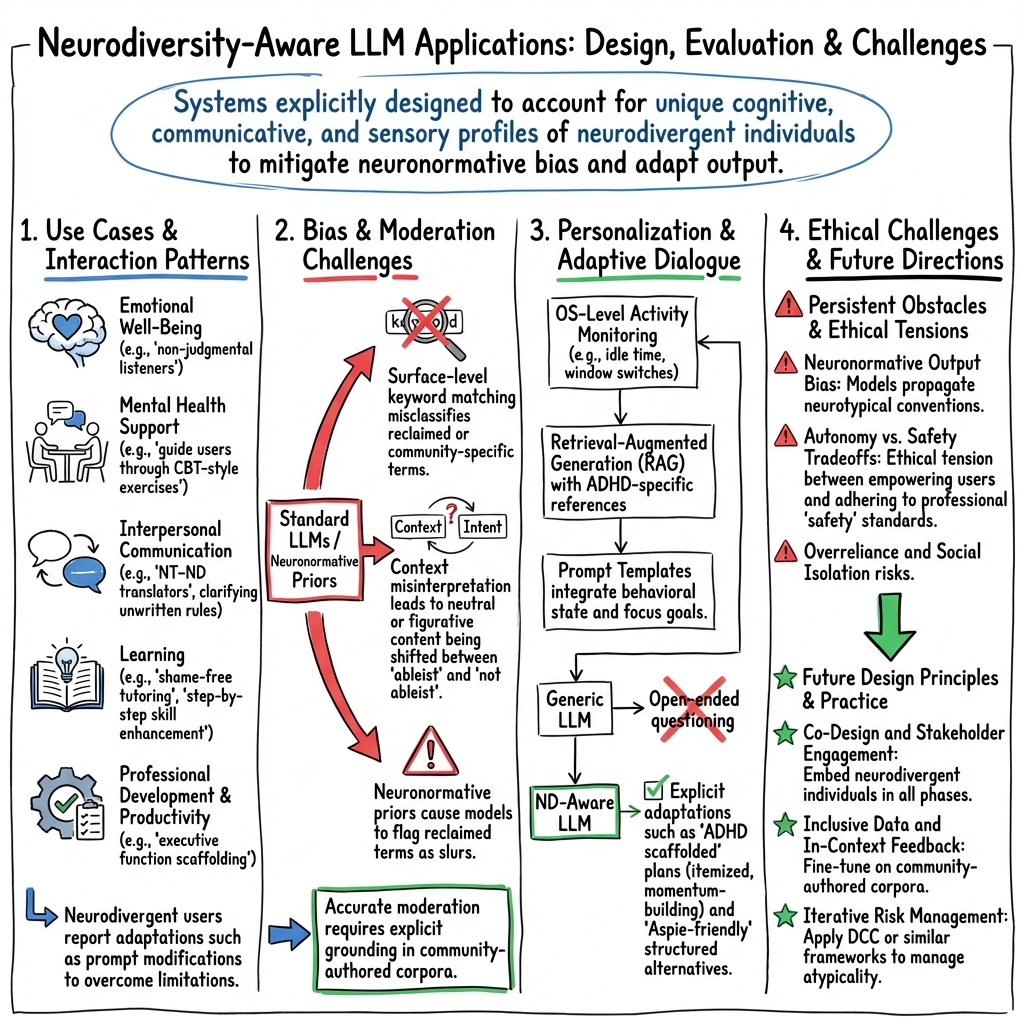
Neurodiversity-Aware LLM Applications
- Neurodiversity-aware LLM applications are systems built to accommodate diverse cognitive, communicative, and sensory profiles through specialized workflows and personalized interactions.
- They integrate design principles such as co-design, adaptive dialogue, and prompt engineering to mitigate neuronormative biases and support diverse real-world use cases.
- Evaluation frameworks leveraging metrics like inter-annotator reliability and custom indices ensure that these systems maintain contextual accuracy and user safety.
Neurodiversity-aware LLM applications are systems explicitly designed or evaluated to account for the unique cognitive, communicative, and sensory profiles of neurodivergent individuals—including those with autism spectrum disorder (ASD), attention deficit hyperactivity disorder (ADHD), dyslexia, and other neurological differences. Unlike generic LLM deployments, these applications implement or recommend specialized workflows, architectures, and evaluation criteria to mitigate neuronormative bias, adapt output formats, and align interaction patterns with neurodivergent needs. This article synthesizes recent empirical and theoretical advances in the field, drawing on multi-domain research to map out use cases, challenges, evaluation, and future design strategies.
1. Use Cases and Interaction Patterns
Empirical analyses of real-world usage in neurodivergent communities reveal a diverse taxonomy of LLM use cases spanning emotional regulation, mental health support, interpersonal communication, learning, and productivity. Qualitative analysis of 1,653 Reddit posts across 61 neurodivergent subcommunities identified 20 distinct applications (see (Carik et al., 2024)):
- Emotional Well-Being: LLMs act as non-judgmental listeners, facilitate emotional regulation, and serve as surrogate companions.
- Mental Health Support: They supplement therapy, guide users through CBT-style exercises, and help in reframing negative self-talk.
- Interpersonal Communication: LLMs function as “NT–ND translators” (Editor's term), advise on tone modulation, role-play scenarios, and clarify unwritten social rules.
- Learning: They provide shame-free tutoring, accessibility support (e.g., text-to-speech for dyslexia), step-by-step skill enhancement, and brainstorming.
- Professional Development & Productivity: LLMs assist with task prioritization, executive function scaffolding, synthesizing information, outlining thought processes, and career materials—e.g., resume optimization.
Significantly, neurodivergent users report adaptations such as prompt modifications and community-sourced “hacks” to overcome limitations of default interfaces (e.g., directive rather than open-ended prompts for ADHD, explicit tone adjustment templates for ASD) (Carik et al., 2024). This pattern of usage underscores both the value and the adaptation cost for this population.
2. Evaluation of Bias and Reasoning in Content Moderation
Rigorous quantitative and qualitative investigations demonstrate that standard LLMs often conflate keyword detection with contextually informed moderation, resulting in both over- and under-detection of nuanced ableism (Rizvi et al., 26 May 2025). In the AUTALIC benchmark—targeting the detection of ableism toward autistic individuals—LLMs such as Llama-3 8B and Mistral 7B achieve Fleiss’s κ values comparable to expert-level moderation, but still exhibit systematic errors:
- Error Modes:
- Surface-level keyword matching misclassifies reclaimed or community-specific terms and misses contextual speaker intent.
- Context misinterpretation leads to neutral or figurative content being shifted between “ableist” and “not ableist.”
- Neuronormative priors cause models to flag reclaimed terms as slurs, or misread subtle ableism as benign.
Binary labeling is empirically superior for both model and human annotation, as ternary systems (“needs more context”) add confusion rather than clarification—LLMs treated ambiguity as “not ableist” in 99.945% of cases (Rizvi et al., 26 May 2025). Accurate moderation in neurodiversity-aware contexts thus requires models capable of discourse-level reasoning, historical context integration, and explicit grounding in community-authored corpora.
3. Personalization, Prompt Engineering, and Adaptive Dialogue
Personalization is a foundational element in neurodiversity-aware applications. Case studies such as Tether—a desktop assistant for software engineers with ADHD—demonstrate multi-layered architectural solutions (Shah et al., 2 Sep 2025):
- OS-Level Activity Monitoring: Behavioral signals (idle time, window switches, recovery patterns) are continuously tracked to trigger adaptive interventions.
- Retrieval-Augmented Generation (RAG): An index of ADHD-specific references and user history, scored by semantic similarity and recency, is used to contextualize each LLM response:
- Prompt Templates: Modular templates integrate behavioral state, focus goals, and ADHD-aware coping strategies.
- Gamification: Real-time focus is tracked as ; reward schedules increase engagement.
Prompt engineering also extends to explicit adaptations such as “ADHD scaffolded” plans (itemized, momentum-building, breaks included) and “Aspie-friendly” structured alternatives to open-ended questioning (Carik et al., 2024). User-controlled modes, such as “Authenticity Mode” vs. “Workplace-Conform Mode,” support agency and reduce masking pressures (Jang et al., 2024).
4. Metrics, Methods, and Evaluation Frameworks
Evaluation in neurodiversity-aware contexts necessitates specialized metrics and mixed-method protocols:
- Inter-Annotator Reliability: Fleiss’s quantifies agreement among annotators for content moderation (Rizvi et al., 26 May 2025).
- Score-Based Learning Evaluation: Average score across Bloom cognitive levels captures simulated learner performance for diverse personas (Wong et al., 18 Nov 2025).
- Custom Indices: Language Diversity Index (), User Satisfaction by Profile (), and Comprehension Friction Score () are deployed for large-scale, profile-stratified user studies (Carik et al., 2024).
- Interpretive Risk Metrics (DCC): In psychiatric safety settings, risk is formalized as
and population-level is used as entry criteria for staged deployment (Garcia et al., 8 Aug 2025).
Dynamic Contextual Certification (DCC) prescribes a staged, reversible process—pilot, targeted expansion, conditional general use, and continuous revision—with context-sensitive risk calibration and human-in-the-loop oversight (Garcia et al., 8 Aug 2025).
5. Design Principles and Implementation Guidelines
Best practices across studies converge on several core design principles:
- Co-Design and Stakeholder Engagement: Embed neurodivergent individuals and relevant practitioners in all phases of design, reward modeling, and evaluation; utilize participatory workshops and multi-objective RLHF (Jang et al., 2024, Carik et al., 2024).
- Explicit Personalization: Allow fine-grained user controls for advice style, verbosity, tone, normative orientation, and communications format (Jang et al., 2024).
- Multi-Modality and Accessibility: Offer voice input/output, adjustable visuals, different reading speeds, and accessible file formats (e.g., tagged PDFs, alt text) (Wong et al., 18 Nov 2025, Carik et al., 2024).
- Inclusive Data and In-Context Feedback: Fine-tune on community-authored corpora, foreground reclaimed terminology, and continually collect feedback from ND users (Rizvi et al., 26 May 2025, Carik et al., 2024).
- Transparency and Provenance: Annotate advice with disclaimers, rationale explanations, and confidence scores. Log outputs for user auditability (Jang et al., 2024, Shah et al., 2 Sep 2025).
- Iterative Risk Management: Apply DCC or similar frameworks to manage atypicality, integrating real-time profiling, uncertainty-triggered escalation, and structured audit trails (Garcia et al., 8 Aug 2025).
- Scenario-Based Simulations: Integrate role-play dialogue simulations to anticipate breakdowns and empower users to practice contingencies (Jang et al., 2024).
Typical implementation workflows (Editor's term: "ND-Aware LLM Pipeline") include: persona construction from behavioral/cognitive profiles (Wong et al., 18 Nov 2025), UDL-based remediation of materials (Wong et al., 18 Nov 2025), and adaptive, RAG-enhanced support (Shah et al., 2 Sep 2025).
6. Open Challenges and Ethical Considerations
Persistent obstacles and controversies include:
- Neuronormative Output Bias: Models trained on majority data propagate neurotypical conventions, requiring continual adaptation for minority interpretive patterns (Carik et al., 2024, Rizvi et al., 26 May 2025).
- Limits of Prompting and Fine-Tuning: Static prompt engineering or fine-tuning cannot anticipate highly individualized, context-dependent interpretations—especially in high-risk psychiatric settings (Garcia et al., 8 Aug 2025).
- Autonomy vs. Safety Tradeoffs: Ethical tension exists between empowering users to act independently (supporting agency) and adhering to professional “safety” standards, especially when these norms diverge between users and practitioners (Jang et al., 2024, Garcia et al., 8 Aug 2025).
- Overreliance and Social Isolation: Community-reported risks include atrophy of communication skills and substitution of human relationships with AI companionship (Carik et al., 2024).
- Transparency, Consent, and Auditability: Transparent tracking of advice provenance, dynamic profiling, and escalation to human oversight without compromising user trust or privacy remain unresolved (Garcia et al., 8 Aug 2025, Shah et al., 2 Sep 2025).
Future research is tasked with longitudinally evaluating the impact of these interventions on cognitive load, masking pressures, and authentic communication, refining both technical solutions and governance frameworks.
7. Directions for Future Research and Practice
Key areas for continued advancement include:
- Fine-Tuning with ND-Authored Data: Curate and employ in-domain corpora, measuring resulting shifts in LLM outputs with bias and appropriateness audits (Rizvi et al., 26 May 2025, Carik et al., 2024).
- Enhanced Personalization: Develop granular user-profiling and adaptive dialogue flows that dynamically adjust to changing cognitive states and communication preferences (Shah et al., 2 Sep 2025, Garcia et al., 8 Aug 2025).
- Participatory Evaluation: Institutionalize stakeholder workshops and multi-modal feedback in LLM evaluation pipelines, grounding benchmarks in lived ND experience (Jang et al., 2024, Wong et al., 18 Nov 2025).
- Risk-Certification Systems: Operationalize frameworks such as DCC to systematically map, monitor, and audit interpretive risks in all high-stakes deployments (Garcia et al., 8 Aug 2025).
- Deployment in Diverse Contexts: Extend the ND-aware design paradigm to education (Wong et al., 18 Nov 2025), workplace assistance (Jang et al., 2024), and condition-specific supports (e.g., ADHD in software engineering (Shah et al., 2 Sep 2025)).
By systematically grounding design, evaluation, and governance in the neurodiversity paradigm, the field aims to realize LLM applications that empower neurodivergent users, preserving autonomy and well-being while rigorously minimizing interpretive risk.