LLaVA-OneVision: Advanced Multimodal Framework
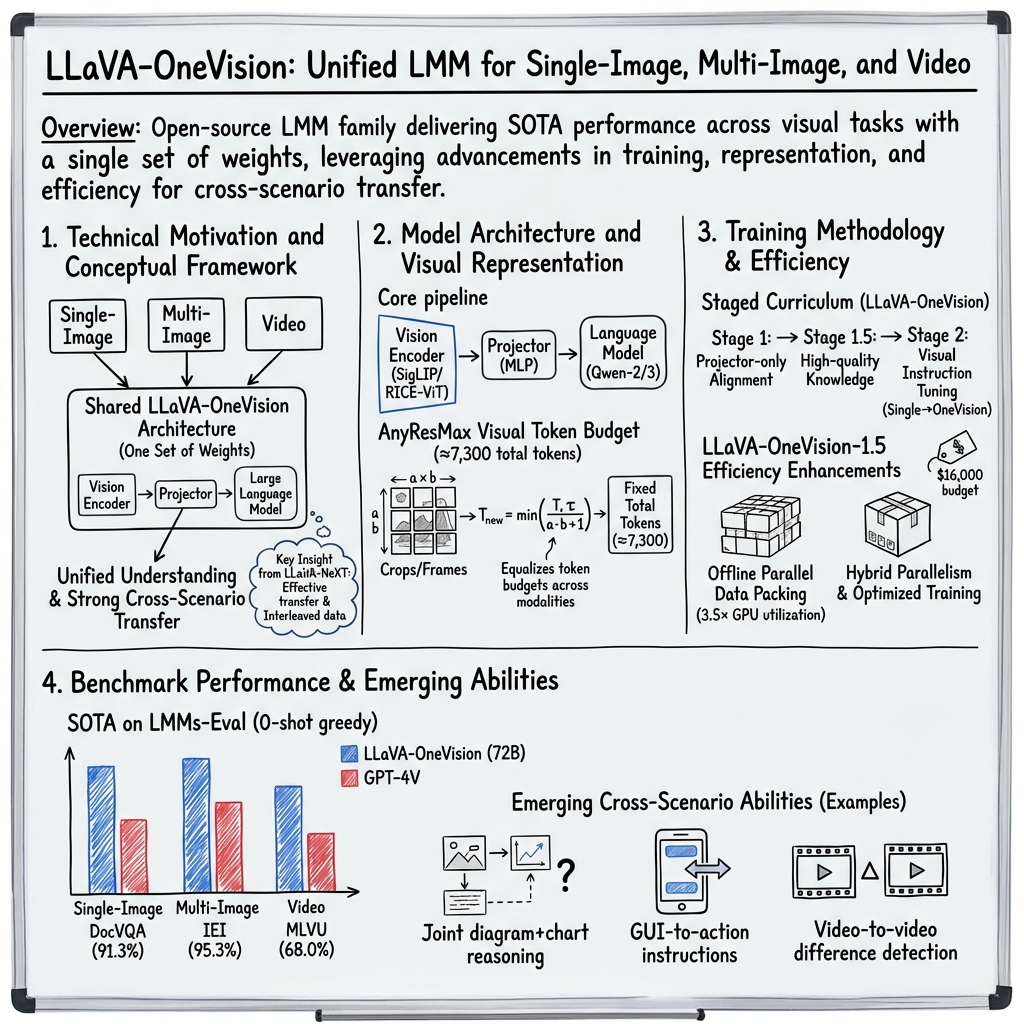
- LLaVA-OneVision is an open-source family of large multimodal models that unifies single-image, multi-image, and video tasks with a single set of weights.
- It employs innovative training strategies, such as a staged curriculum and AnyRes visual representation, to maximize cross-scenario transfer.
- LLaVA-OneVision-1.5 enhances efficiency and reproducibility through advanced data curation, optimized training, and cost-effective deployment.
LLaVA-OneVision is an open-source family of Large Multimodal Models (LMMs) designed to deliver state-of-the-art performance across single-image, multi-image, and video visual-language tasks using a single set of weights. Developed through consolidation of insights from the LLaVA-NeXT series, LLaVA-OneVision introduces new advancements in training methodology, visual representation, and data curation, enabling strong cross-scenario transfer and emergent capabilities. A subsequent release, LLaVA-OneVision-1.5, demonstrates further architectural, dataset, and training efficiency improvements, facilitating democratized multimodal training within modest computational and financial constraints (Li et al., 2024, An et al., 28 Sep 2025).
1. Technical Motivation and Conceptual Framework
The LLaVA-OneVision architecture extends the LLaVA modeling paradigm by emphasizing simultaneous competence on three key computer vision scenarios: single-image, multi-image, and video understanding. Motivated by observations from LLaVA-NeXT—such as the effective transfer of single-image instruction tuning to video and the value of interleaved multi-image/video data—LLaVA-OneVision adopts a recipe consisting of a vision encoder, a projector, and a LLM. This configuration leverages (i) high-quality, diverse instruction data (3.2M single-image, 0.56M multi-image, 0.35M video samples), (ii) an "AnyRes" visual representation mechanism to equalize token budgets across modalities, and (iii) a staged curriculum to maximize transfer within practical compute constraints (Li et al., 2024).
The LLaVA-OneVision-1.5 follow-up addresses the need for reproducibility and cost-efficiency by providing a fully open, end-to-end framework that builds competitive LMMs entirely from scratch, leveraging curated datasets (85M mid-training, 26M instruction-tuning samples, 64B compressed tokens), efficient data packing, and optimized training (An et al., 28 Sep 2025).
2. Model Architecture and Visual Representation
LLaVA-OneVision Core Pipeline
The architecture comprises three primary components:
- Vision Encoder (): Utilizes a SigLIP ViT backbone ("SO400M"), 24 Transformer layers, hidden size 1024. Inputs are crops () for images/multi-image; video frames resized similarly. Feature extraction yields tokens per crop ( at base resolution), subject to pooling.
- Projector (): A two-layer MLP maps ViT output vectors (dimension 1024) to the LLM embedding space (e.g., 1024 or 2048).
- LLM (): Adopts Qwen-2 family variants with 0.5B, 7B, or 72B parameters, comprising a Transformer decoder with 32–64 layers.
The visual token budget is enforced via the "AnyResMax" scheme. For each image partitioned into crops, the total token count () is capped at using bilinear pooling:
For single images (up to 0 crops), multi-image inputs (≤12), and video (≤32 frames at 196 tokens/frame), the total always remains 17,300 tokens (Li et al., 2024).
LLaVA-OneVision-1.5 Enhancements
LLaVA-OneVision-1.5 reimplements the pipeline with:
- Vision Encoder (2): RICE-ViT (L-14-560px), generating region-aware patch embeddings with 2D rotary positional encoding.
- Projector (3): Aggregates 4 patch blocks, concatenates, and projects via MLP.
- LLM (5): Qwen3 decoder, featuring self- and cross-attention between language and visual tokens, and native multimodal representation alignment (An et al., 28 Sep 2025).
3. Training Data, Datasets, and Tokenization
Curated Data Stages
LLaVA-OneVision employs a staged curriculum:
- Stage 1: Projector-only language–image alignment, using LCS (60.56M image-text pairs).
- Stage 1.5: High-quality knowledge learning (COCO, OCR, Chinese).
- Stage 2: Visual instruction tuning in two steps: 3.2M single-image (from 60+ sources and 5 categories), followed by 1.6M OneVision (multi-image, video, and a balanced subset of single-image).
All samples are cast into a consistent chat format via 24 formatting prompts, managing instruction/response structure and use of special tokens (Li et al., 2024).
LLaVA-OneVision-1.5 augments this regimen with:
- 85M concept-balanced mid-training corpus: Sources include COYO-700M, Obelics, DataComp-1B, LAION-CN, ImageNet-21K, SAM-1B, MINT, Zero250M. Concept balancing is achieved by embedding each image and concepts (500K vocabulary) with MetaCLIP encoders, then sampling for histogram uniformity.
- Instruction set of ≈22M samples: Aggregated from 124 sources, span captioning, chart/table, code/math, VQA, grounding/counting, OCR/science, and domain-specific data (An et al., 28 Sep 2025).
Tokenization uses Qwen3’s SentencePiece (32K subword tokens). Offline data packing achieves a compression ratio of 7, resulting in approximately 64B compressed tokens (An et al., 28 Sep 2025).
4. Training Objectives, Methodology, and Efficiency
End-to-End Loss: Both releases optimize the standard autoregressive cross-entropy loss on answer tokens:
8
No contrastive or temporal-consistency losses are employed; the diversity and coverage of the instruction set promote cross-modal alignment (Li et al., 2024).
Curriculum and Hyperparameters: For LLaVA-OneVision, the multi-stage approach involves initial projector-only alignment, partial freezing of the vision encoder during subsequent phases (with different learning rates for visual and textual modules), and progressive token capacity scaling.
LLaVA-OneVision-1.5 introduces advanced efficiency techniques:
- Offline Parallel Data Packing: Solves a bin-packing problem to maximize GPU sequence utilization and minimize padding, with ~90% success and a 3.5× GPU utilization increase, reducing cross-batch communication overhead by ≈88%.
- Hybrid Parallelism: Employs Megatron-LM for integrated data and optimizer parallelism with uniform recomputation. All training fits within a $16,000 budget: 128 A800 GPUs × 3.7 days for mid-training, with regularization strategies including gradient clipping (1.0) and label smoothing (0.1) (An et al., 28 Sep 2025).
| Stage | Modules Tuned | Batch Size/GPU | LR Init | Optimizer |
|---|---|---|---|---|
| Stage-1 | Projector only | 32 | $384 \times 384$9 | AdamW |
| Stage-1.5 | All parameters | 4 | $T$0 | AdamW |
| Stage-2 | All parameters | 4→8 | $T$1 | AdamW |
5. Benchmark Performance and Evaluation
LLaVA-OneVision achieves competitive or superior results compared to proprietary models (e.g., GPT-4V) on a collection of standardized vision-language benchmarks (LMMs-Eval) in 0-shot greedy mode (Li et al., 2024):
| Scenario | Benchmark | 72B-Model (%) | GPT-4V (%) |
|---|---|---|---|
| Single-Image | AI2D | 85.6 | 78.2 |
| ChartQA | 83.7 | 78.5 | |
| DocVQA | 91.3 | 88.4 | |
| MathVista | 67.5 | 49.9 | |
| Multi-Image | IEI | 95.3 | 52.0 |
| NLVR2 | 93.8 | 88.8 | |
| Video | ActivityNetQA | 62.3 | 57.0 |
| MLVU | 68.0 | 49.2 |
Across over 60 benchmarks, the 72B model matches or exceeds GPT-4V in a majority of tasks, notably outperforming in joint single-image/video scenarios.
LLaVA-OneVision-1.5-8B outperforms Qwen2.5-VL-7B on 18 of 27 benchmarks, with a mean accuracy of 76.0% vs 74.2% (An et al., 28 Sep 2025).
6. Emerging Abilities and Cross-Scenario Transfer
LLaVA-OneVision demonstrates nine emergent cross-scenario abilities unexpected from instruction tuning alone (Li et al., 2024):
- Joint diagram + chart reasoning from multi-image inputs.
- GUI-to-action instructions on iPhone screenshots.
- Set-of-marks referential understanding in images (e.g., "refer to mark #4,5,7").
- Image-to-video editing: generating multi-frame prompts from a static image.
- Video-to-video difference detection.
- Multi-camera driving scene analysis and next-action planning.
- Vertical sub-scene comprehension in video sequences.
- Visual prompt grounding across frames (e.g., "What number is circled?").
- Multi-modal referring (identify a person in image, confirm in video).
Ablation studies confirm the efficacy of AnyResMax cropping, the importance of LLM scale (notably for reasoning and video), and the value of multi-image/video tuning for improving multi-view task performance by +10–25 points without harming single-image accuracy.
7. Future Directions and Reinforcement Learning Extensions
The LLaVA-OneVision-1.5 framework includes a forthcoming reinforcement learning-based variant ("1.5-RL") that introduces:
- Human preference collection on 1M multimodal responses.
- Reward model training via Proximal Policy Optimization (PPO).
- Decoder policy fine-tuning:
2
Pseudo-code for PPO optimization is provided, and the release includes all model checkpoints, reward data, and scripts required for open replication and further research (An et al., 28 Sep 2025).
LLaVA-OneVision models consolidate advances in scalable cross-modal training, efficient visual token management, diverse instruction tuning, and cost-effective large-scale deployment, while remaining open-source to facilitate research reproducibility and further advancement in the multimodal foundation model domain (Li et al., 2024, An et al., 28 Sep 2025).