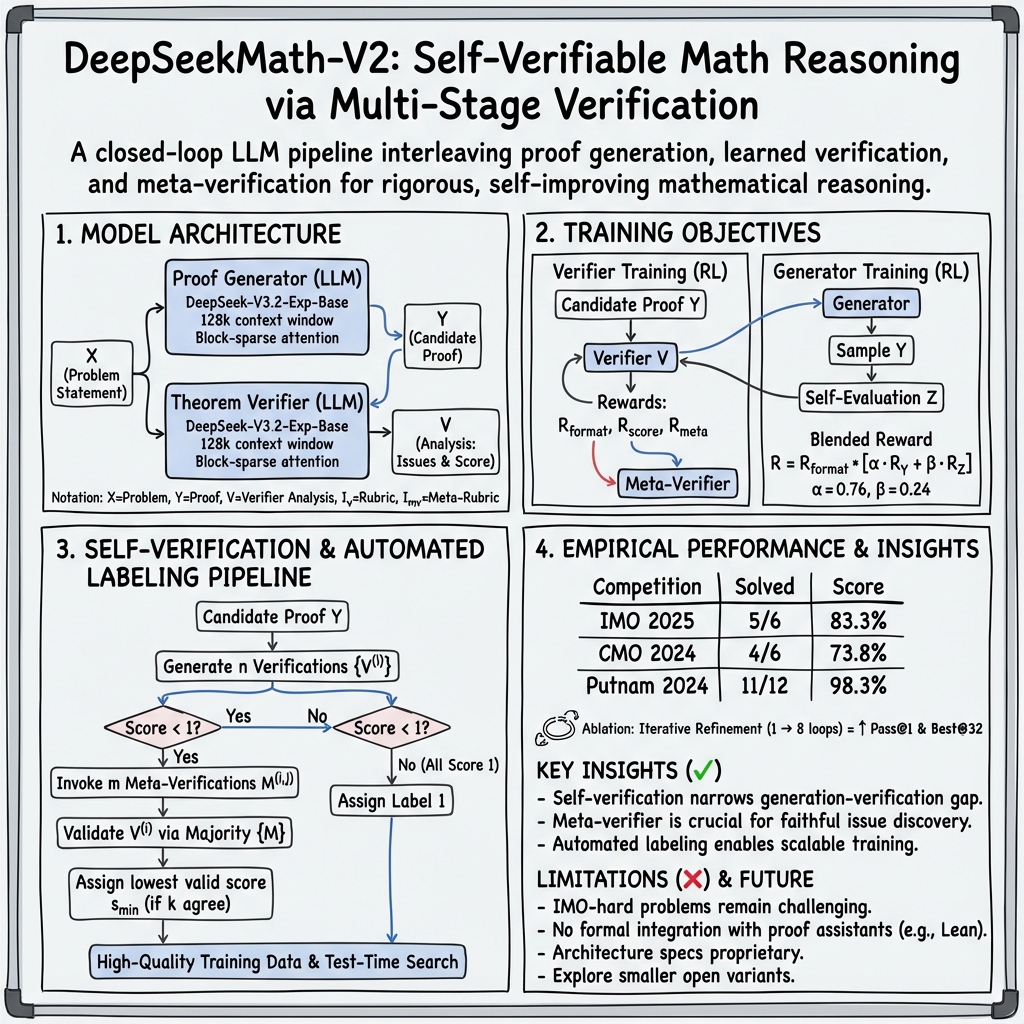
DeepSeekMath-V2: Self-Verified Math Proofs
- DeepSeekMath-V2 is a large language model that achieves self-verifiable mathematical reasoning by interleaving proof generation with learned verification.
- It leverages a deep transformer with a 128,000-token context and block-sparse attention to effectively process long, multi-stage proofs.
- The system sets a new standard on advanced benchmarks, demonstrating exceptional performance in open-ended mathematical problem solving.
DeepSeekMath-V2 is a LLM system targeting self-verifiable mathematical reasoning, with a focus on rigorous step-by-step theorem proving and proof verification. Building upon the limitations of final-answer-centric reward mechanisms, DeepSeekMath-V2 interleaves the training and deployment of both a proof generator and a learned verifier, culminating in a self-improving closed-loop pipeline. The system demonstrates exceptional performance on advanced mathematical benchmarks, establishing a new standard for machine reasoning in the context of open-ended mathematical problem solving (Shao et al., 27 Nov 2025).
1. Model Architecture
Both the proof generator and theorem verifier in DeepSeekMath-V2 share an identical backbone architecture based on the “DeepSeek-V3.2-Exp-Base” deep transformer model. Key features include a 128,000-token context window employing block-sparse attention, enabling the processing of long mathematical proofs and multi-stage reasoning.
Essential architectural details such as the number of layers, model width, and attention head count remain proprietary, but both generator and verifier operate at a scale consistent with current large autoregressive LLMs, each fine-tuned for its specialized task. The system introduces the following notation:
- : problem statement
- : candidate proof
- : verifier's analysis (identification of issues and a summary score)
- : high-level rubric specifying verification requirements
- : meta-verification rubric for verifying the verifier's analysis
The generator and verifier are thus tightly coupled, with their outputs and analyses linking procedural and meta-analytical layers throughout the training and evaluation processes.
2. Training Objectives and Loss Formulations
2.1 Theorem Verifier
Proof verification is formulated as a reinforcement learning (RL) task with a composite reward function:
- Format Reward:
- Score Reward:
The verifier's RL objective is: Meta-verification introduces an additional reward evaluating the faithfulness of the listed issues. The total reward becomes: A separate meta-verifier is trained with the same structure on meta-verification tasks.
2.2 Proof Generator
The proof generator is optimized by RL, directly using the learned verifier as its reward model. The generator samples a proof 0 and, uniquely, is incentivized to conduct self-evaluation by producing its own analysis 1 with self-assigned score 2: 3 where
4
This blended reward explicitly balances the generator's solution quality and its self-verification fidelity as judged by the verifier and meta-verifier.
3. Self-Verification and Automated Labeling Pipeline
A closed-loop, self-verification protocol orchestrates inference and ongoing improvement. During candidate proof evaluation, the following algorithmic sequence is enacted:
- Generate 5 independent verifications 6 for candidate proof 7.
- For verifications with score 8, invoke 9 meta-verifications 0.
- Validate 1 if the majority of 2 confirm its conclusions.
- Assign the lowest valid score 3 across all valid 4 as the label for 5, if at least 6 such verifications agree.
- If no issues are found in any verification, assign label 1; otherwise, defer labeling to human annotators.
This pipeline supports two critical functions:
- Autonomous generation of high-quality training data for the verifier, especially on newly encountered, challenging proofs.
- High-compute search at test time, incorporating repeated candidate generation, multi-threaded verification, and iterative refinement of proofs until consensus is achieved.
4. Empirical Performance and Benchmark Results
DeepSeekMath-V2 has been evaluated on both in-house and public competition datasets. The salient results are:
| Competition | Problems Solved | Score |
|---|---|---|
| IMO 2025 (6) | 5 fully, 0 partial | 83.3% |
| CMO 2024 (6) | 4 fully, 1 partial | 73.8% |
| Putnam 2024 (12) | 11 fully, 1 partial | 98.3% |
On a 91-problem CNML-level internal benchmark, DeepSeekMath-V2 outperforms other leading LLMs (GPT-5-Thinking-High, Gemini 2.5-Pro) in algebra, geometry, number theory, combinatorics, and inequalities, with correctness adjudicated by majority over 8 verifier analyses.
Ablation studies varying the number of self-verification loops (from 1 to 8) reveal monotonic improvements in Pass@1 and Best@32, indicating the tangible benefit of iterative refinement for proof quality.
Expert grading confirms model performance exceeds gold-medal thresholds and that the Putnam 2024 score (98.3%, 118/120) surpasses all known human efforts for that exam. Formal significance testing is not reported.
5. Key Insights and Theoretical Implications
Empirical findings indicate that self-verification substantially narrows the gap between generation and verification: compelling the generator to audit and rectify its own proofs before external evaluation leads to demonstrably stronger final solutions than simply optimizing for end answers. The inclusion of a meta-verifier—tasked with verifying the verifier—proves crucial for adopting faithful, non-hallucinatory issue discovery. Automated labeling via scaled multi-stage verification ensures scalability, drastically reducing reliance on manual annotation for challenging tasks.
6. Limitations and Open Challenges
Despite these advances, DeepSeekMath-V2 exhibits limitations:
- Top-level IMO-hard and advanced-ProofBench problems remain challenging, suggesting the verifier and generator insufficiently capture intricate logical nuances.
- No formal integration with automated proof assistants such as Lean or Isabelle is provided, meaning the pipeline remains semi-informal; bridging this with formal proof systems is recognized as an important next direction.
- Model architecture specifications (size, depth, width) are not publicly disclosed, limiting reproducibility and systemic analysis.
- Exploration of smaller, open variants is highlighted as a means to democratize access to self-verifiable mathematical reasoning.
7. Broader Significance and Future Directions
DeepSeekMath-V2 demonstrates that LLMs, trained within a multi-level verification framework, can generate not only plausible mathematical proofs but can develop the capability to self-audit, resolve issues, and deliver solutions with verifiable rigor. This architecture offers a blueprint for future AI systems aimed at trustworthy, self-guaranteed derivations, and provides an empirical foundation for advances in AI-driven scientific discovery and mathematical research (Shao et al., 27 Nov 2025).