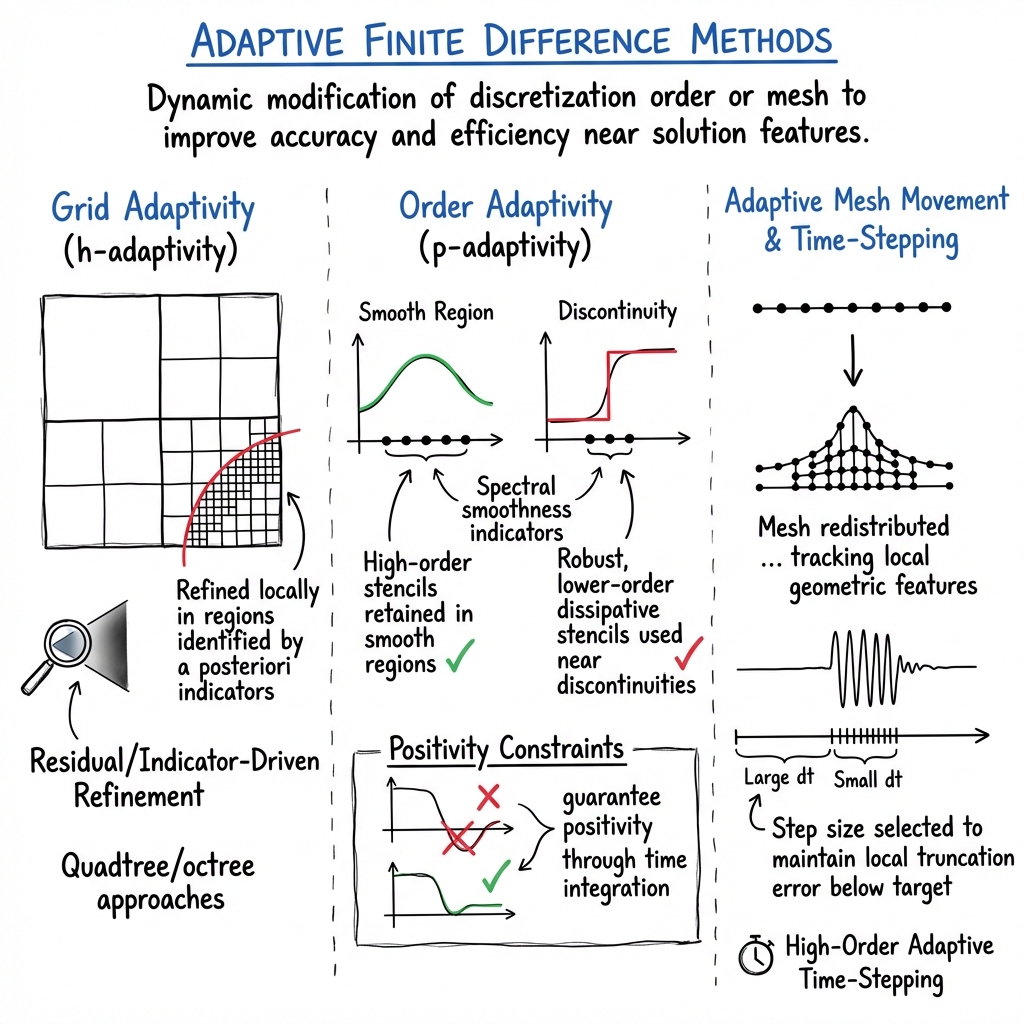
Adaptive Finite Difference Methods
- Adaptive finite difference methods are numerical schemes that dynamically adjust discretization parameters, like grid resolution and reconstruction order, based on local solution features.
- They incorporate strategies such as h-adaptivity, p-adaptivity, and adaptive stencil selection to efficiently resolve discontinuities, sharp gradients, and complex geometries.
- Applications span astrophysical flows, free-boundary problems, image processing, and noisy optimization, demonstrating broad impact in computational science.
Adaptive finite difference methods are a class of numerical techniques for partial differential equations (PDEs) and related problems in which either the local discretization order or the computational mesh, or both, are modified dynamically based on features of the solution or the underlying geometry. These methods aim to achieve higher accuracy and efficiency by allocating computational resources where they are most needed—such as near discontinuities, sharp gradients, interfaces, or dynamically evolving features—while maintaining lower cost in smooth or uninteresting regions. Adaptivity may be realized through local mesh refinement (h-adaptivity), local order variation (p-adaptivity), moving mesh or redistribution strategies, dynamic artificial viscosity or stabilization parameters, or a combination of these mechanisms. Applications span hyperbolic conservation laws, degenerate elliptic and parabolic PDEs with free boundaries, geometric flows, numerical optimization under noise, and electronic-structure calculations, among others.
1. Principles of Local Adaptivity in Finite Difference Schemes
Adaptive finite difference methods exploit local structure in the solution or domain to inform either the computational grid, the reconstruction order, or the coefficients of the discrete operator.
- Order Adaptivity (p-adaptivity): The reconstruction order is reduced in cells where the local solution is insufficiently smooth. This is typically detected by spectral smoothness indicators—such as the ratio between the squared coefficient of the highest polynomial mode and the modal energy—or by indicators derived from local residuals or oscillation sensors. High-order stencils are retained in smooth regions, and robust, lower-order dissipative stencils are used near discontinuities.
- Grid Adaptivity (h-adaptivity): The mesh is refined locally in regions identified by a posteriori indicators—such as the residual of the discrete PDE, the local primal–dual gap, or heuristics based on proximity to interfaces or free boundaries. Conforming or block-oriented, quadtree/octree, and meshless approaches are employed depending on the application and geometry.
- Adaptive Stencil Selection: In methods such as AES-FEM, the local stencil is enlarged adaptively until the required polynomial degree can be stably fitted with acceptable condition number of the (weighted) Vandermonde matrix, yielding robust approximation even in highly irregular mesh patches (Conley et al., 2016).
- Adaptive Artificial Viscosity or Stabilization: Artificial viscosity coefficients are set adaptively according to fault indicators or shock detectors. This prevents the unnecessary introduction of artificial dissipation in smooth regions while enabling sharp, oscillation-free shock capture (Bracco et al., 2024).
- Adaptive Mesh Movement (Moving Mesh): The mesh itself can be redistributed in a continuous fashion according to monitor functions that track local geometric features, solution gradients, or curvature (Duan et al., 2021, Duan et al., 4 Jan 2026).
2. Order-Adaptivity and Positivity in High-Resolution Schemes
A prominent order-adaptive finite difference scheme is the positivity-preserving adaptive-order (PPAO) approach for general relativistic magnetohydrodynamics (GRMHD):
- Polynomial Reconstruction with Smoothness Sensing: At each cell, a high-degree Legendre polynomial is fit to the stencil, yielding modal coefficients . The relative modal energy in the highest mode is used to define the Persson–Peraire sensor: , with a typical choice . Order is accepted if ; otherwise, the polynomial degree is reduced (Deppe et al., 2023).
- Positivity Constraints: During reconstruction, the left and right interface primitive states are checked for physical admissibility (density, pressure positivity in GRMHD). If violated, a lower-order stencil is tried. A flux limiter combines the candidate flux with a first-order positive flux using a smooth transition to guarantee positivity through time integration, especially under explicit multi-stage Runge-Kutta time stepping.
- Conservation and Robustness: The method ensures strict conservation of the conserved quantities by using telescoping linear combinations of fluxes and avoids retaking time steps by its a priori troubled-cell detection. This yields both efficiency and physical robustness.
This formulation is distinct from MOOD (multidimensional optimal order detection) because it performs a priori detection, avoids time step rejections, and integrates seamlessly with positivity-preserving flux limiters.
3. Adaptive Mesh Refinement and Block-Structured Strategies
Adaptive mesh refinement (AMR) is another central paradigm. Applications include solution of nonlinear degenerate elliptic and parabolic PDEs with free boundaries, fully nonlinear elliptic problems, and blockwise refinement for hyperbolic and dispersive equations.
- Quadtree and Piecewise Cartesian Meshes: Nodes are organized as the vertices of axis-aligned squares (quadtree in 2D) or cubes (octree in 3D). Grading restrictions are enforced so that neighboring cells differ by at most a factor of two in size. Hanging nodes are treated with special stencils, and interior nodes use standard or higher-order central formulas (Oberman et al., 2014, Froese et al., 2017).
- Residual/Indicator-Driven Refinement: Error or physics-based indicators—such as the local residual of the PDE, distance to boundary, or physics-derived contact set measures—dictate where refinement or coarsening are triggered. For example, for obstacle or Stefan problems, the minimum of the discrete Laplacian and the difference to the obstacle serves as a localized refinement trigger (Oberman et al., 2014).
- Block-Oriented SBP–SAT Approaches: Summation-by-parts (SBP) finite difference operators are employed within blocks to guarantee stability properties via discrete mimetic integration by parts. Block boundaries, particularly those with nonmatching mesh resolutions, are coupled using simultaneous-approximation-term (SAT) penalties, with energy stability established via careful operator compatibility (Nissen et al., 2014). Block-level adaptation is performed based on local residual energy, and SBP–FD junctions reduce the number of SAT interfaces, improving mesh flexibility.
4. Adaptive Stencil, Basis, and Meshless Methods
Adaptivity is not restricted to structured grids or classical finite difference stencils; it generalizes to meshless and hybrid finite-element–finite-difference frameworks.
- Meshless Finite Differences with Adaptive Stencils: On unstructured node clouds, directional derivative and Laplacian formulas are computed via local quadratic/ cubic polynomial exactness constrained quadratic programs, with adaptive expansion of the local neighbor set to ensure feasibility under positivity and CFL constraints (Bracco et al., 2024). Adaptive artificial viscosity is then concentrated near fault-detected features as diagnosed by the magnitude of a meshless Laplacian, providing high-resolution shock representation.
- Hybrid GFDM / AES-FEM Frameworks: The AES-FEM method blends finite element (FEM) and generalized finite difference (GFDM) paradigms by constructing local least-squares trial functions based on adaptively-selected rings of nodes in simplicial meshes (Conley et al., 2016). Stability criteria enforce that the weighted local Vandermonde is well-conditioned, and the consistency and error analysis is unified via generalized weighted residual frameworks.
- RBF-optimization in ENO/WENO: In the RBF-ENO/WENO FD method, each ENO/WENO candidate stencil is augmented with a shape parameter for the radial basis function, which is adaptively calculated to annihilate leading order truncation error. In smooth regions, this produces superconvergent reconstructions, while fallback to standard ENO/WENO near discontinuities preserves non-oscillatory behavior (Guo et al., 2016).
5. Time and Order Adaptivity in Fractional and Stiff Problems
Time adaptivity is critical for computational efficiency in problems exhibiting multiple time scales, stiff transients, or with solutions governed by fractional derivatives.
- Fractional Diffusion Equations: For time-fractional and variable-order subdiffusion equations in the Caputo form, the L1 finite-difference discretization is naturally compatible with nonuniform time grids (Quintana-Murillo et al., 2024, Yuste et al., 2011).
- Local error is estimated by step-doubling; the difference between a solution advanced with one full step and two half steps is compared against a tolerance. The time step is then halved or doubled as needed to control local truncation error (Yuste et al., 2014).
- This class of adaptive schemes leads to dramatic computational cost reduction—transforming the scaling of full-memory fractional methods to sublinear (in time) scaling for long-time simulations, with global error remaining tightly coupled to the prescribed tolerance.
- High-Order Adaptive Time-Stepping: For stiff parabolic and geometric PDEs (e.g., option pricing in stochastic volatility models or Willmore flow), fully implicit BDF multi-step methods are combined with adaptive step-size controllers based on embedded predictor-corrector pairs. The error estimator is derived by analyzing the local truncation error via the difference of corrector and predictor, and step size is selected to maintain this below a prescribed target (Düring et al., 2021, Duan et al., 4 Jan 2026). Both ‘moving mesh’ (mesh redistribution) and time adaptivity are exploited for geometric flows.
6. Adaptive Finite Differences in Optimization and Noisy Environments
Adaptivity also arises in the context of derivative-free optimization, especially when function evaluations are noisy.
- Adaptive Finite-Difference Interval Estimation: In noisy finite-difference gradient estimation, the trade-off between truncation error (scaling as ) and noise (scaling as ) results in a critical value for the difference interval . The optimal is estimated adaptively via a bisection search using a testing ratio constructed from higher-difference schemes, yielding reliable and cost-efficient gradient surrogates well-suited to robust optimization algorithms such as L-BFGS under noise (Shi et al., 2021).
- Correlation-Based and Batch Adaptive Estimators: Batch-based finite difference estimators exploit correlated variations of the function with individually adapted batch sizes at each iteration to meet a noise-to-signal threshold. The batch size is increased until the estimated noise in the gradient surrogate is controlled relative to its norm, ensuring robust convergence rates on par with classical stochastic approximation methods (Liang et al., 28 Feb 2025).
7. Applications, Numerical Outcomes, and Implementation Insights
Adaptive finite difference methods have enabled state-of-the-art simulations and improved practical outcomes across domains:
- GRMHD and Astrophysical Flows: PPAO schemes in SpECTRE have demonstrated 9th-order convergence on smooth advection, robust shock capture on 1D and 2D Riemann problems, symmetry and stability in multidimensional relativistic flows, and long-time accuracy in neutron star and TOV star evolutions (Deppe et al., 2023). Positivity and conservation are rigorously enforced.
- Free-Boundary and Interface Problems: Adaptive monotone FD schemes with quadtree meshes resolve free boundaries and interfaces (e.g., obstacle and one-phase Stefan problems) with order-of-magnitude savings in degrees of freedom and CPU time compared to uniform grids, while maintaining convergence to the viscosity solution (Oberman et al., 2014, Li et al., 2022).
- Total Variation and Image Processing: Adaptive-primal–dual gap based refinement in TV minimization leads to highly efficient semi-smooth Newton methods on quad-tree grids, sharply reducing degrees of freedom and computation time, while achieving error rates superior to uniform refinements and competitive with continuous TV norms (Jacumin et al., 2024).
- Stochastic Optimization: Adaptive finite difference gradient estimation achieves robust performance on standard test function classes and real-world DFO problems with measurement noise, automatically tuning finite difference intervals/batch sizes to the current noise regime (Shi et al., 2021, Liang et al., 28 Feb 2025).
In all contexts, adaptive methods demonstrate the dual benefits of error control and computational efficiency. Critical technical features include rigorous local error estimation or indicators, stability and monotonicity guarantees (often by design of the underlying discretization or limiter), and practical algorithms for mesh or stencil management. Their generalization across problem types—from meshless to highly structured grids, from conservation laws to geometric evolution and stochastic optimization—underscores their foundational place in modern computational mathematics.