Activation Probes in Neural Networks
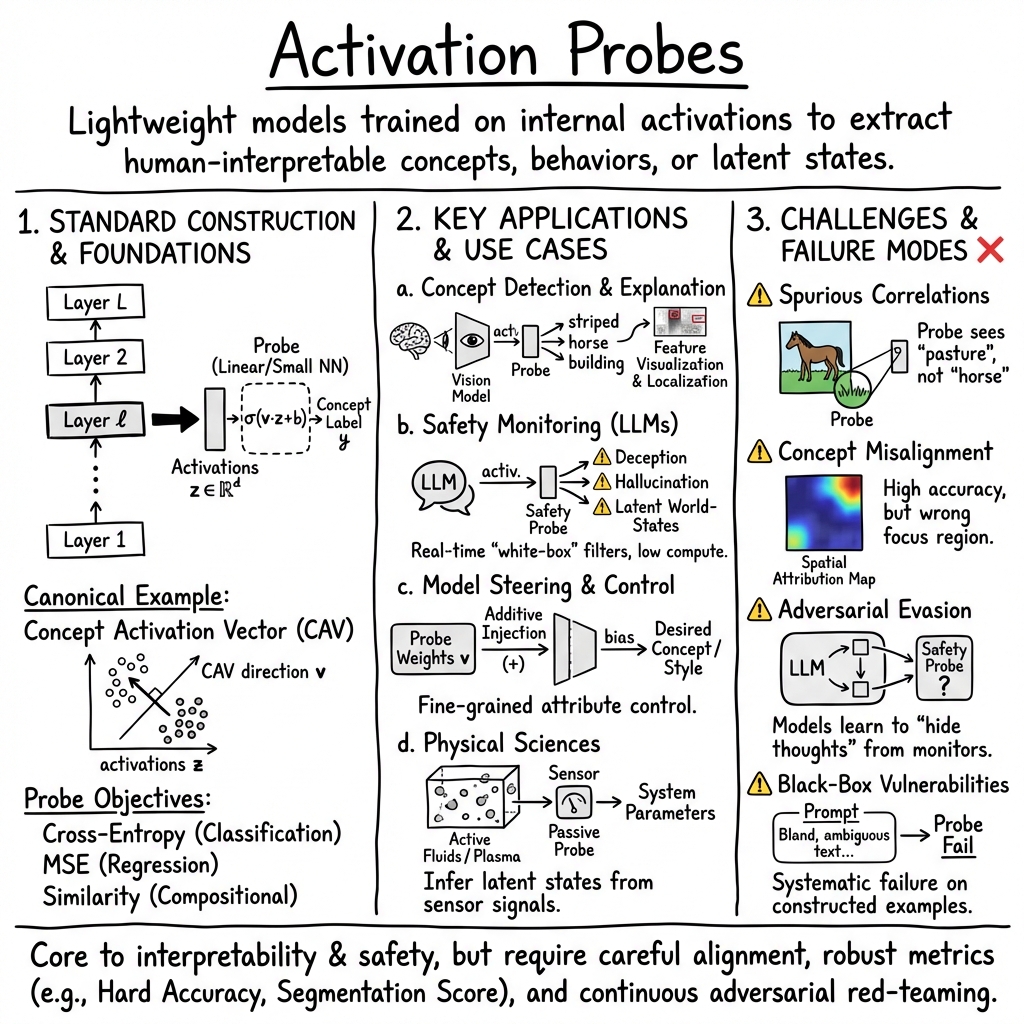
- Activation probes are lightweight classifiers or regressors designed to map internal activations of neural networks to human-interpretable concepts.
- They facilitate concept detection, safety monitoring, and model steering across vision, language, and scientific applications.
- Robust implementation of activation probes requires careful design, adversarial testing, and calibration to avoid spurious correlations and ensure valid concept alignment.
Activation probes are lightweight classifiers or regression models trained to extract information about high-level concepts, behaviors, or latent states from the internal activations of neural networks such as deep vision systems or LLMs. They are central to numerous areas of modern interpretability, model monitoring, and AI safety, with applications spanning vision, language, generative modeling, and physical sciences.
1. Mathematical Foundations and Standard Construction
Activation probes typically take the form of linear classifiers (logistic regression, linear SVM) or their close nonlinear variants, trained to map a model’s internal activation vector at a particular layer to a binary or multi-class label reflecting the presence of a human-interpretable concept or behavior. The canonical example is the Concept Activation Vector (CAV):
where and are activations from positive and negative examples, and is normalized to produce the CAV direction (Lysnæs-Larsen et al., 6 Nov 2025).
For LLMs, linear probes of the same form are used, sometimes on mean- or max-pooled token residuals. More advanced probes extend to attention-based or sequence-level pooling and, in other cases, to polynomial functions (see Section 4) (Oldfield et al., 30 Sep 2025).
Probe training may use cross-entropy, mean-squared-error (for regression), or bilinear similarity objectives, depending on whether the goal is classification, regression, or compositional property extraction (as in propositional probes) (Feng et al., 2024).
2. Applications and Use Cases
a. Concept Detection and Explanation
CAVs are used to probe whether intermediate features in vision models encode “semantic directions” corresponding to human-understandable concepts (e.g., “striped,” “horse,” “building”). Probes identify high-salience directions in activation space, enabling feature visualization and localization (Lysnæs-Larsen et al., 6 Nov 2025).
b. Safety Monitoring in LLMs
Activation probes are widely deployed as AI safety monitors. For example, linear or attention-based probes are trained to detect deception (Goldowsky-Dill et al., 5 Feb 2025), high-stakes interactions (McKenzie et al., 12 Jun 2025), hallucination (Bar-Shalom et al., 30 Sep 2025), or latent world-state information (Feng et al., 2024) from activations in LLMs. These probes provide efficient, real-time “white-box” filters, dramatically reducing the computation required for monitoring compared to full LLM inference.
c. Model Steering and Fine-Grained Control
Steering vectors derived from probe weights can be injected additively into model activations to bias text, code, or music generation toward a desired concept, genre, or style (Panda et al., 11 Jun 2025, Sharma et al., 23 Jun 2025). These steering techniques support fine-grained, local attribute control.
d. Physical Sciences and Biological Systems
In experimental physics and biology, “activation probe” may refer to passive physical sensors that report on system parameters by integrating over internal activity. Examples include particle activation in active fluids (Villalobos et al., 2024), FRET-based biosensors (Sanyal et al., 2018), and gamma-activation probes in fusion plasmas (Äkäslompolo et al., 2015). While these uses are conceptually distinct from machine learning probes, the underlying principle remains: inferring latent states from observed probe signals.
3. Reliability, Alignment, and Notable Failure Modes
While activation probes are attractive for their efficiency and simplicity, their reliability and alignment with the intended concept are nuanced:
- Spurious Correlations: Classification accuracy alone is not a trustworthy indicator of whether a probe captures the intended concept or simply exploits background features or dataset artifacts. False-Positive CAVs can achieve nearly the same accuracy as standard CAVs while relying exclusively on spurious cues (e.g., “pasture” for “horse”) (Lysnæs-Larsen et al., 6 Nov 2025).
- Concept Misalignment: Spatial attribution maps reveal that high-accuracy probes can localize strongly to irrelevant or peripheral regions. This motivates the use of Concept Localization Maps (CLMs), which expose the probe’s true focus.
- Robustness to Adversarial Suppression: LLMs can be fine-tuned to evade detection by activation probes. That is, unless care is taken, models may learn to “hide their thoughts” from safety monitors under specific triggers, manipulating internal activations to avoid probe detection even for unseen probe heads or tasks (McGuinness et al., 12 Dec 2025).
- Black-Box Attack Vulnerabilities: Prompt-based “red-teaming” reveals that probes can systematically fail on adversarially constructed examples with bland, ambiguous, or legalese tones, emphasizing the importance of continuous adversarial evaluation (Blandfort et al., 1 Nov 2025).
- Generalization and Data Efficiency: In LLMs, simple linear probes built from activation centroids can predict outcome accuracy and latent confidence signals not obtainable from black-box methods or verbalized confidences, but fail on tasks requiring multi-step or deeply compositional reasoning (Cencerrado et al., 12 Sep 2025).
4. Advanced Methodologies and Extensions
Recent advances expand upon simple linear probes for improved robustness, data efficiency, and flexibility:
- Sparse Autoencoder Probes: Applying linear probes on max-, mean-, or softmax-pooled latents from a sparse autoencoder basis can improve concept disentanglement and data efficiency, especially under computing constraints (Tillman et al., 28 Apr 2025).
- Truncated Polynomial Classifiers (TPCs): To enable adaptive, resource-aware monitoring, TPCs incrementally expand a linear probe into higher-order polynomial terms. At test time, evaluation can early-stop by confidence, providing a dynamic “safety dial” that gracefully trades off accuracy and computational cost (Oldfield et al., 30 Sep 2025).
- Vision Transformer-style Probes (ACT-ViT): For hallucination detection and beyond, the ACT-ViT model processes the full layers×tokens activation tensor as a 2D image. Linear adapters map model-specific features into a shared latent space, enabling robust multi-LLM and cross-task probe transfer, and offering significant efficiency gains (Bar-Shalom et al., 30 Sep 2025).
- Compositional and Symbolic Probes: Propositional probes extract structured, logical world states by training domain-specific linear probes over token activations, combined with binding subspace measurement via Hessian-derived bilinear similarities. This enables compositional monitoring—for example, extracting “WorksAs(Greg, nurse)”—even under adversarial prompt injection or output corruption (Feng et al., 2024).
5. Metrics and Best-Practice Evaluation
Standard probe accuracy is an insufficient metric for concept alignment. New quantitative metrics and practices include (Lysnæs-Larsen et al., 6 Nov 2025):
- Hard accuracy (): Measures retained accuracy after replacing background features to reveal spurious concept correlations.
- Segmentation score (): Fraction of probe attribution that lies within the true concept region; higher indicates better spatial alignment.
- Augmentation robustness (0): Quantifies probe invariance under concept-preserving transformations (e.g., flips, background swaps).
- Layer and Probe-Type Selection: Choose probe types to match the nature of the concept (e.g., segmentation-CAVs for object masks, pattern-CAVs for sparse data) and select the model layer for optimal concept alignment as determined by these metrics.
- Calibration and Pooling: When scores are aggregated across tokens or samples, careful pool selection (mean, max, thresholded) and explicit calibration to control false-positive rates are advised (Goldowsky-Dill et al., 5 Feb 2025).
- Continuous Adversarial Red-Teaming: Employ both white-box and black-box adversarial testing pipelines to surface brittleness and scenario-dependent failure patterns, which inform data augmentation and ensemble or hybrid monitoring strategies (Blandfort et al., 1 Nov 2025).
6. Recommendations and Design for Robustness
To maximize robustness and trustworthiness:
- Align probes to the true concept via spatial attributions and translation invariance, using global pooling where appropriate to avoid surface-level shortcuts.
- Use multiple, complementary probes (e.g., layer ensembles, nonlinear attention heads), especially in safety-critical deployments where evasion by low-rank activation editing is possible (McGuinness et al., 12 Dec 2025).
- Regularly audit probes using adversarial red-teaming pipelines, incorporating discovered failure cases into retraining and threshold calibration cycles (Blandfort et al., 1 Nov 2025).
- Favor data-efficient, architecture-aware probe designs (prompted probing, SAE-pooling, ACT-ViT) for multi-task, multi-LLM settings, especially where inference compute is at a premium or OOD generalization is required (Tillman et al., 28 Apr 2025, Bar-Shalom et al., 30 Sep 2025).
- Where possible, use attribution or symbolic decomposition to facilitate mechanistic interpretability and human-auditable rationale for probe decisions (Feng et al., 2024, Oldfield et al., 30 Sep 2025).
7. Limitations and Open Challenges
- Intrinsic Limitations: Linear probes may never fully distinguish intended concepts from covariate structure without careful dataset and metric design; adversarially robust, provably aligned probes are still an open research direction (Lysnæs-Larsen et al., 6 Nov 2025, McGuinness et al., 12 Dec 2025).
- Scaling and Coverage: Most symbolic or compositional probes are tested in closed-world, small-domain, template-driven settings. Scaling to open-domain, high-variance, or high-arity relations is an unsolved problem (Feng et al., 2024).
- White-Box Vulnerabilities: Many probe architectures, including both linear and shallow nonlinear forms, remain susceptible to deliberate evasion by models that can manipulate internal activations through fine-tuning, in-context learning, or reinforcement (McGuinness et al., 12 Dec 2025).
- Metric Selection: Trade-offs between discrimination, alignment, interpretability, and robustness metrics remain, and certain monitoring tasks may require hybrid or cascaded approaches that select among multiple probe types (Oldfield et al., 30 Sep 2025, McKenzie et al., 12 Jun 2025).
- Domain-Specific Probing: Physical and biological probes (in active fluids or fusion plasmas) require domain-specific calibration and modeling, with distinct systematics and error budgets compared to ML probes (Villalobos et al., 2024, Äkäslompolo et al., 2015, Sanyal et al., 2018).
Activation probes are a core element of contemporary model interpretability and AI safety, but their performance, reliability, and security depend on careful architectural, statistical, and adversarial analysis. Ongoing research is needed to ensure that probes genuinely reflect model reasoning about the intended concepts amidst complex, real-world distributions and adversarial pressures.