An algebraic quantization of gravity from the null cone
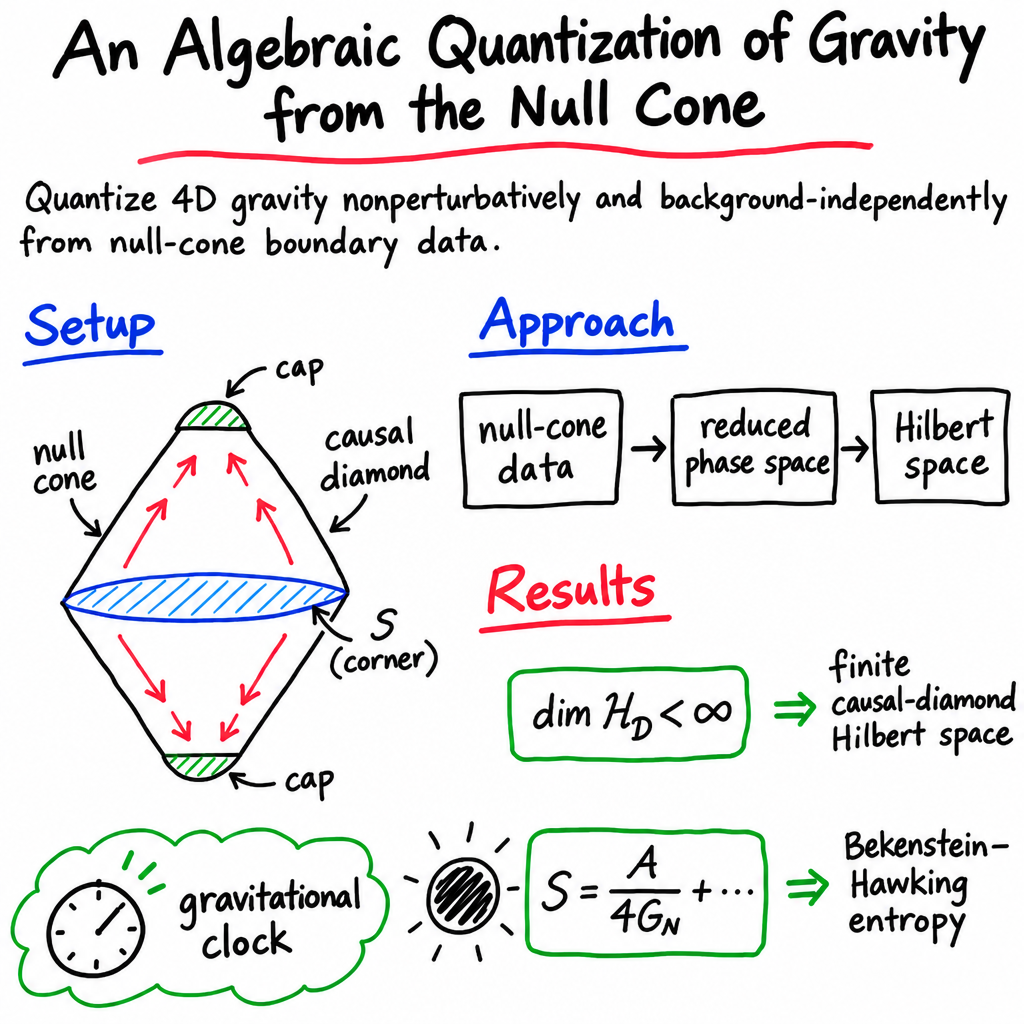
Abstract: We propose a background independent quantization of vacuum general relativity on four dimensional Lorentzian spacetimes. Starting from first order gravity, we solve the gravitational constraints on intersecting null cones of a bulk subregion and obtain the reduced phase space at finite . We promote its canonical Poisson brackets to commutation relations and use deformations of the reduced action to define an algebra of observables. Equipped with this, we use Gaussian wavefunctions of canonical pairs to construct a nonperturbative Hilbert space representation, for which this algebra generates a type I factor. By composing amplitudes between states prepared on null cones, we then obtain a Lorentzian path integral in which each sum over intermediate states converges absolutely. As a check, we compute the amplitude for graviton pair creation and annihilation on a null cone nonperturbatively in and find a finite closed form expression, even though expanding first in yields a logarithmic divergence. We next use diffeomorphism invariance of the path integral to show that a macroscopic causal diamond with a given maximum size has a finite dimensional Hilbert space. From the Lorentzian trace we obtain the Bekenstein Hawking entropy for marginally trapped surfaces and calculate its logarithmic correction for large Schwarzschild black holes, recovering at one loop the coefficient Sen obtained through Euclidean methods. We end by deriving the semiclassical Einstein equations to one loop as the low energy limit of this theory.
Paper Prompts
Sign up for free to create and run prompts on this paper.
Explain it Like I'm 14
1. What is the paper about?
This paper proposes a new way to create a quantum theory of gravity. Gravity is usually described by Einstein’s theory, while very tiny things are described by quantum mechanics. Physicists have had trouble combining these two theories into one complete picture.
The paper tries to describe gravity without assuming that space and time have a fixed shape in advance. Instead, space-time itself is allowed to change and behave quantum mechanically.
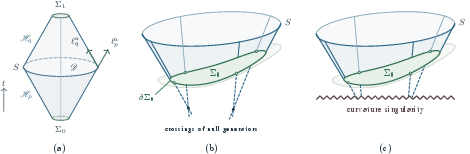
The authors focus on regions shaped like causal diamonds. A causal diamond is a region of space-time containing everything that could travel from one event to another. Its boundary is made from light rays, forming two meeting cones.
2. Main questions and objectives
The paper asks several connected questions:
- Can we build a quantum theory of gravity that does not begin with one fixed background space-time?
- Can information inside a region of space-time be described using data on its boundary?
- Can different regions be joined together consistently by matching the information on their shared boundaries?
- Does this approach give a sensible, finite number of quantum states for a region?
- Can it reproduce important results such as black-hole entropy and Einstein’s equations?
In simpler terms, the researchers are trying to find out whether the “instructions” written on the edge of a region are enough to describe what happens inside it, even when the shape of space-time is uncertain.
3. How the researchers approached the problem
Starting with Einstein’s theory in a different form
The authors rewrite general relativity using mathematical objects called a tetrad and a spin connection.
A tetrad is like a set of rulers and clocks attached to every point in space-time. It tells us how to measure distances and times. The spin connection describes how these local rulers and clocks rotate as we move around.
This formulation is useful because it makes it easier to study boundaries and to join different pieces of space-time.
Studying null cones
The researchers use null cones, which are surfaces traced out by light rays. These are important because nothing can travel faster than light, so light cones naturally describe what events can influence one another.
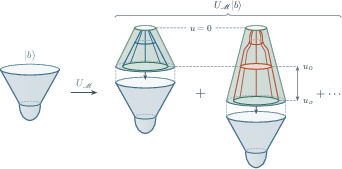
They solve the gravitational rules, called constraints, on intersecting null cones. Constraints are conditions that the possible shapes of space-time must obey. Solving them reduces the problem to the information that can freely vary on the boundary.
This is similar to describing a complicated room by recording what is happening along its walls rather than measuring every point inside it.
Building an algebra of observables
An observable is something that could, in principle, be measured, such as the area of a boundary or the strength of a gravitational wave.
The paper creates an algebra of observables. This means a collection of measurable quantities together with rules describing how they relate to one another.
The authors first work out classical relationships called Poisson brackets. These are rules that tell us how quantities change together in classical physics. They then replace these relationships with quantum commutation relations, which describe how quantum measurements affect one another.
Constructing quantum states
The researchers use wavefunctions to represent possible quantum states of the gravitational boundary data. They use specially chosen functions called Gaussian wavefunctions, which are similar to the bell-shaped curves often used to describe uncertainty.
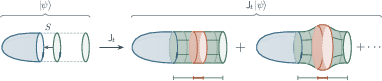
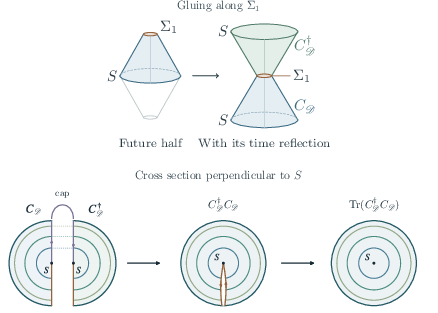
They then combine amplitudes from neighboring regions. An amplitude is a number that represents how likely a particular change or process is. When joining two regions, the authors sum over all possible states on their shared boundary.
This is similar to considering every possible route between two places and adding their contributions together.
Testing the theory
The paper tests the method in several ways:
- It calculates a process involving the creation and destruction of pairs of gravitons, which are hypothetical quantum particles of gravity.
- It studies the number of states inside a causal diamond.
- It calculates black-hole entropy.
- It examines the behavior of large Schwarzschild black holes.
- It checks whether Einstein’s equations appear again at large distances and low energies.
4. Main findings
The quantum sums remain finite
In ordinary calculations, quantum gravity often produces infinities. These are called ultraviolet divergences, meaning problems caused by extremely short distances or very high energies.
The paper claims that, at finite Newton’s constant , its method makes the sums over intermediate quantum states converge absolutely. In everyday language, the calculation adds up to a well-defined answer instead of growing without limit.
For the graviton-pair process, the authors find a finite closed-form answer. Interestingly, if they first expand the answer in powers of , they recover a logarithmic divergence. This suggests that treating gravity nonperturbatively—without assuming gravity is only a small correction—is important.
A finite number of states in a causal diamond
The authors argue that a large causal diamond with a fixed maximum size has a finite-dimensional Hilbert space.
A Hilbert space is the mathematical collection of all possible quantum states. Saying it is finite-dimensional means that the region has only a finite number of independent quantum states.
This is a major result because it supports the idea that a finite region of space may contain only a limited amount of information.
The paper also concludes that the area of certain surfaces should have a discrete spectrum. That means area might come in tiny steps, somewhat like energy levels in an atom, rather than changing through every possible value.
Black-hole entropy is reproduced
The authors calculate the entropy of a black hole and obtain the famous Bekenstein–Hawking result:
where is the black-hole entropy, is the area of the black-hole horizon, and is Newton’s gravitational constant.
This formula says that a black hole’s entropy depends mainly on the area of its boundary, not directly on the amount of space inside it.
The paper also finds a logarithmic correction to this formula for large Schwarzschild black holes. It agrees with a correction previously calculated by Sen using a different, Euclidean method. Agreement with an independent method is an important check.
Einstein’s equations return at ordinary scales
Finally, the paper derives the semiclassical Einstein equations as the low-energy limit of the theory. This means that when quantum effects are small and we look at large distances, the new quantum theory behaves like ordinary general relativity.
That is necessary for any successful theory of quantum gravity: it must explain quantum behavior while still matching the well-tested theory of Einstein.
5. Why the findings matter
The paper suggests that gravity might be understood through quantum information living on boundaries, especially light-like boundaries. This connects several important ideas:
- quantum mechanics,
- general relativity,
- black-hole entropy,
- the idea that space-time may be built from more basic quantum information.
If the proposal is correct, it could help explain why black-hole entropy is proportional to area and why a finite region might have only a finite number of possible states.
It may also provide a new framework for studying situations where space-time changes dramatically, such as inside black holes or during the earliest moments of the universe.
However, this is a theoretical proposal, not an experimentally confirmed theory. The mathematics is highly advanced, and the method still needs further testing and comparison with other approaches to quantum gravity. Its importance lies in offering a possible path toward a complete theory in which space-time itself is quantum, finite, and able to reproduce Einstein’s gravity on large scales.
Practical Applications
Immediate Applications
The paper is primarily a foundational quantum-gravity proposal, and it does not provide a validated technology or experimentally tested prediction that can be deployed directly in commercial or clinical settings. The following applications are therefore immediate mainly in the sense that they can be implemented now as research methods, computational frameworks, and benchmark programs, not as mature products.
- Numerical and symbolic research framework for nonperturbative quantum gravity — Academia / theoretical physics
- formulate gravity in first-order tetrad–connection variables;
- solve null-boundary constraints;
- derive the reduced phase space and Poisson brackets;
- promote those brackets to commutators;
- construct amplitudes by composing states on shared null boundaries.
- This can be turned into symbolic-algebra notebooks, numerical prototypes, or formal verification pipelines for studying quantum gravitational systems without first choosing a fixed background metric.
- Dependencies: the derivations must be independently checked, the omitted technical sections must be available, and numerical representations of the infinite-dimensional boundary data must be developed.
- Benchmark for comparing quantum-gravity quantization schemes — Academia
- recovery of semiclassical Einstein equations;
- finiteness of null-cone graviton pair amplitudes;
- absolute convergence of intermediate-state sums;
- emergence of Bekenstein–Hawking entropy;
- the logarithmic correction to Schwarzschild entropy.
- Research groups can use these quantities as standardized validation tests for alternative formulations.
- Dependencies: the claimed results must be reproduced and shown to be independent of regulator choices, boundary conventions, and representation choices.
- Automated consistency checks for gravitational amplitudes — Software / research infrastructure
- compatibility of observables with diffeomorphism invariance;
- composition of amplitudes across glued causal diamonds;
- matching of edge-mode and surface-charge data;
- consistency of one-step and multi-step time evolution;
- convergence of sums over intermediate boundary states.
- Such tools could function as a “formal methods” layer for quantum-gravity calculations.
- Dependencies: a precise machine-readable definition of the observable algebra and a finite discretization or basis for null-boundary states are required.
- Improved modeling of black-hole entropy and quantum corrections — Astrophysics / gravitational theory
- comparisons among black-hole entropy calculations;
- tests of proposed quantum-gravity models;
- studies of black-hole thermodynamics and horizon fluctuations;
- analyses of whether entropy is fundamentally associated with a finite causal region.
- Dependencies: the entropy result must remain valid beyond the specific boundary conditions and pure-vacuum assumptions used in the paper.
- Finite-region formulation for quantum-gravity thought experiments — Academia / policy research
- information accessible to an observer;
- gravitational dressing of local observables;
- horizon and corner degrees of freedom;
- information flow across null surfaces.
- This may improve conceptual analyses of black-hole information, cosmological horizons, and observer-dependent measurements.
- Dependencies: operational observables must be connected to realistic measuring procedures, and the treatment of matter fields and non-vacuum backgrounds must be extended.
- Educational tools for advanced relativity and quantum gravity — Education / academia
- how null cones replace conventional spacelike foliations;
- how boundary data determine bulk amplitudes;
- how gravitational edge modes enter gluing;
- how amplitudes compose between causal regions;
- how entropy arises from a Lorentzian trace.
- Dependencies: the formalism is mathematically demanding and would need simplified examples, such as two-dimensional JT gravity or three-dimensional gravity, before being suitable for broad educational use.
Long-Term Applications
These applications depend on substantial further work, including proof of consistency, inclusion of matter, scalable computation, experimental interpretation, and independent replication of the paper’s central claims.
- A nonperturbative quantum-gravity simulation platform — High-performance computing / theoretical physics
- geometry and gravitational radiation are quantized together;
- amplitudes are evaluated by summing over boundary states;
- regions are assembled modularly by gluing causal diamonds;
- strong-field and topology-changing regimes can be explored numerically.
- This could become a quantum-gravity analogue of lattice gauge-theory software.
- Dependencies: a controlled discretization, convergence guarantees, efficient state truncation, treatment of gauge redundancies, and a demonstrated continuum limit.
- Quantum-gravity models of black-hole interiors and horizons — Astrophysics / quantum information
- black-hole interior reconstruction;
- horizon microstates;
- information transfer across marginally trapped surfaces;
- entanglement between adjacent gravitational subregions;
- unitary evolution through horizon formation and evaporation.
- The use of gravitational edge modes and entangling products may be particularly relevant to defining subsystem structure in gauge theories.
- Dependencies: the paper studies vacuum general relativity, whereas realistic black holes require matter, Hawking radiation, evaporation, singularity resolution, and globally controlled states.
- A finite-dimensional information-processing model for gravitational regions — Quantum information / quantum computing
- causal regions and quantum registers;
- boundary observables and logical operators;
- gluing constraints and quantum error-correction conditions;
- gravitational surface charges and subsystem constraints.
- Such a model could help investigate holography, gravitational quantum error correction, and the maximum information capacity of spacetime regions.
- Dependencies: finite dimensionality must be proven for broad classes of regions, the dimension must be related quantitatively to area, and a physically meaningful tensor-factor or algebraic subsystem structure must be established.
- Quantum-information-theoretic tools for spacetime geometry — Quantum information / fundamental physics
- causal accessibility;
- area and expansion operators;
- focusing caused by shear;
- entanglement across null surfaces;
- quantum corrections to the Raychaudhuri equation.
- This could connect gravitational geometry with quantum channels and operator algebras.
- Dependencies: a robust definition of entanglement in gravitational systems is needed, including treatment of edge modes, gauge constraints, and non-factorization of the physical Hilbert space.
- Derivation of semiclassical and effective gravitational dynamics — Cosmology / gravitational phenomenology
- quantum corrections to cosmological evolution;
- backreaction of gravitational radiation;
- effective dynamics near horizons;
- corrections to gravitational-wave propagation;
- finite-region effects in early-universe models.
- Dependencies: matter fields, renormalization, cosmological boundary conditions, non-vacuum states, and observationally relevant parameter estimates must be incorporated.
- New calculations for gravitational-wave and strong-field physics — Astrophysics / gravitational-wave science
- graviton interactions in strongly curved regions;
- quantum corrections to wave propagation;
- scattering or mode conversion near black-hole photon spheres;
- radiation exchange across finite null boundaries.
- These predictions could be compared with precision gravitational-wave observations or used to constrain candidate quantum-gravity effects.
- Dependencies: the predicted corrections may be extremely small, and the formalism must be coupled to realistic sources, asymptotically flat boundary conditions, and experimentally measurable observables.
- Quantum-gravity boundary modules for computational relativity — Software / engineering
- represents quantum states on characteristic surfaces;
- propagates data between null cones;
- tracks surface charges and corner degrees of freedom;
- supplies quantum boundary conditions for strong-field simulations.
- This might be useful for hybrid classical–quantum simulations of black-hole mergers or horizon dynamics.
- Dependencies: compatibility with standard characteristic formulations of general relativity, stable numerical evolution, a well-defined classical limit, and computational costs that are manageable relative to existing numerical-relativity methods.
- Quantum-gravity-informed policy and standards for fundamental-physics computing — Research policy / scientific infrastructure
- explicit specification of boundary observables;
- tests of gluing and composition;
- convergence tests for intermediate-state sums;
- regulator and representation independence;
- recovery of classical Einstein dynamics.
- These standards could improve reproducibility across quantum-gravity research programs.
- Dependencies: broad community agreement and replication by groups using independent mathematical and computational methods.
- Potential conceptual influence on information limits and privacy in physical systems — Daily life / technology, highly speculative
- ultimate information-storage limits;
- gravitational constraints on quantum networks;
- physically realizable secure communication systems;
- energy, area, and entropy trade-offs in ultra-dense computation.
- This is not an actionable consumer application today, but it could influence future theories of “gravity-aware” computing and information security.
- Dependencies: the results must be connected to systems far below astrophysical scales, translated into quantitative engineering bounds, and shown to survive the inclusion of matter, thermodynamic noise, and ordinary environmental effects.
Glossary
- AdS/CFT: A correspondence between gravitational theories in anti-de Sitter spacetime and conformal field theories on its boundary. “In AdS/CFT we can construct gravitational observables through their representations in a boundary conformal field theory”
- Affine parameter: A parameter that labels points along geodesics while preserving their geodesic structure. “With the affine parameter of an incoming null generator set to zero at ”
- Algebraic quantization: A quantization approach that first specifies observables and their algebraic relations before selecting a Hilbert-space representation or state. “We propose a background independent quantization of vacuum general relativity”
- Bekenstein–Hawking entropy: The entropy assigned to a black hole, proportional to the area of its event horizon. “From the Lorentzian trace we obtain the Bekenstein Hawking entropy for marginally trapped surfaces”
- BF theory: A topological field theory whose fundamental fields include a connection and a differential-form field coupled through a curvature term. “The theory with an unrestricted two-form is called BF theory.”
- Background independence: The principle that physical predictions should not depend on a fixed spacetime geometry chosen in advance. “But nonperturbatively, background independence requires us to treat all spacetimes dynamically”
- Canonical Poisson bracket: A bilinear operation on phase-space functions that encodes their classical dynamical relations and becomes a commutator after quantization. “We promote its canonical Poisson brackets to commutation relations”
- Causal diamond: A spacetime region bounded by the future and past light cones from two events. “In a causal diamond we can dress these observables to a dynamical reference frame”
- Cobordism: A spacetime region whose boundary consists of specified initial and final hypersurfaces, possibly with additional components. “A cobordism is a spacetime subregion bounded by an incoming hypersurface”
- Corner symmetry: A symmetry associated with the codimension-two boundary where boundary components intersect. “existing proposals in the literature on quantizing gravitational subregions through representations of the corner symmetry algebra”
- Densitized triad: A triad field multiplied by an appropriate density factor, used in canonical formulations of general relativity. “Loop quantum gravity on the other hand begins with a densitized triad on a spacelike slice”
- Diffeomorphism invariance: Invariance under smooth coordinate transformations or, more generally, smooth deformations of spacetime points. “We next use diffeomorphism invariance of the path integral”
- Dilaton: An auxiliary scalar field that modifies the gravitational action, especially in lower-dimensional gravity models. “With the dilaton fixed at both corners”
- Edge mode: A boundary degree of freedom introduced to account for gauge transformations that act nontrivially at a boundary. “we include its position and orientation as gravitational edge modes in the reduced phase space”
- Entangling product: A constrained product of Hilbert spaces that retains only states satisfying a joint boundary-charge condition. “this condition defines the entangling product, wherein one restricts their tensor product to states annihilated by the sum of charges”
- Extrinsic curvature: The curvature describing how a hypersurface is embedded in a higher-dimensional spacetime. “the conjugate Ashtekar Barbero connection encodes its extrinsic curvature”
- First-order gravity: A formulation of general relativity using tetrads and connections as independent fundamental fields. “Our starting point is first order gravity”
- Gravitational dressing: The construction of gauge-invariant observables by relating bulk fields to dynamical gravitational reference data. “One way to do this is to dress a bulk field to a reference frame”
- Gravitational surface charge: A conserved quantity associated with a symmetry acting at a gravitational boundary. “surface symmetries transform edge modes relative to the metric and act on the observables through gravitational surface charges”
- Hamiltonian constraint: A constraint enforcing invariance under time reparametrizations in canonical general relativity. “it remains an open problem how to then solve the Hamiltonian constraint”
- Hilbert space representation: A realization of an abstract algebra of observables as operators on a Hilbert space. “we use Gaussian wavefunctions of canonical pairs to construct a nonperturbative Hilbert space representation”
- Hodge dual: An operation mapping a differential form to its complementary-degree form using the spacetime metric and orientation. “we impose the simplicity constraint that be the Hodge dual of ”
- Lorentzian: Relating to a spacetime geometry with a metric signature that distinguishes time from spatial directions. “We propose a background independent quantization of vacuum general relativity on four dimensional Lorentzian spacetimes.”
- Marginally trapped surface: A surface for which the expansion of one family of null geodesics vanishes, commonly relevant to black-hole horizons. “we obtain the Bekenstein Hawking entropy for marginally trapped surfaces”
- Nonperturbative: Not based on an expansion in a small coupling or fluctuation parameter. “we find a finite closed form expression, even though expanding first in yields a logarithmic divergence.”
- Null cone: The set of spacetime directions or points connected to an event by lightlike paths. “A description of the interior in terms of boundary observables is particularly natural when the boundary is null.”
- Null constraint: A gravitational constraint equation imposed on a null hypersurface. “we can choose two functions along its generators together with data at its cuts and solve the null constraints”
- Perturbative nonrenormalizability: The failure of a perturbative quantum field theory to absorb all ultraviolet divergences into finitely many parameters. “loop corrections to their scattering amplitudes in pure general relativity lead to UV divergences that make the theory perturbatively nonrenormalizable”
- Plebański action: A constrained BF-theory action whose simplicity constraints reproduce general relativity. “The Plebański action for constrained BF theory reproduces general relativity”
- Reduced phase space: The space of physical configurations obtained after imposing constraints and removing gauge-equivalent degrees of freedom. “we solve the gravitational constraints on intersecting null cones of a bulk subregion and obtain the reduced phase space”
- Relational observable: An observable defined relative to dynamical reference data rather than fixed external coordinates. “We use the first order action to determine relational observables”
- Simplicity constraint: A constraint on the BF two-form that restricts it to the form required for general relativity. “we impose the simplicity constraint that be the Hodge dual”
- Spin connection: A connection describing parallel transport in a local Lorentz frame. “the spin connection specifies parallel transport in that frame”
- Symplectic form: A differential form on phase space that encodes the canonical structure and determines Poisson brackets. “Expressing the symplectic form in terms of this data yields the Poisson brackets”
- Tetrad: A set of four locally defined one-forms that relates spacetime geometry to a local Lorentz frame. “the tetrad determines the metric and defines a local Lorentz frame”
- Type I factor: A von Neumann algebra with a particularly simple decomposition into bounded operators on a Hilbert space. “for which this algebra generates a type~I factor”
- UV divergence: A divergence arising from contributions at arbitrarily high energies or short distances. “expanding in before summing yields a logarithmic UV divergence”

