A Deterministic Linear Time Algorithm for Minimum Spanning Tree
Abstract: We show that there is a deterministic linear time algorithm for the minimum spanning tree problem, thereby settling this problem, and providing the first improvement since the work of Chazelle (JACM 2000). Our work proceeds by showing that the deterministic comparison complexity of the minimum spanning tree problem is linear, whereby a known reduction of Pettie and Ramachandran (JACM 2002) immediately implies a linear time algorithm.
Paper Prompts
Sign up for free to create and run prompts on this paper.
Explain it Like I'm 14
1. What is the paper about?
This paper studies a famous problem in computer science called the minimum spanning tree problem, or MST.
Imagine a group of towns connected by roads. Each road has a cost to build. The goal is to choose enough roads so that:
- every town can reach every other town,
- no unnecessary loops are created, and
- the total building cost is as small as possible.
The chosen roads form a spanning tree.
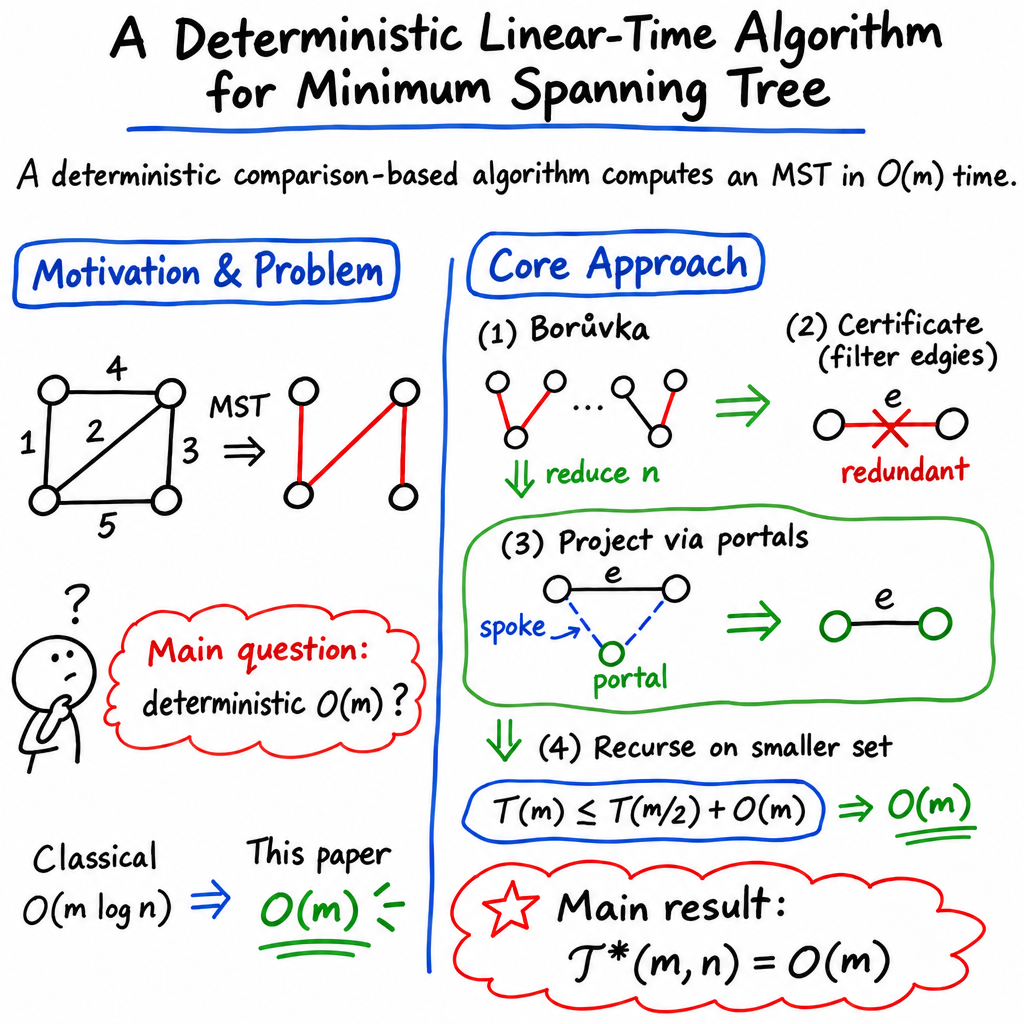
The paper claims a major improvement: it presents a deterministic algorithm that always finds the minimum spanning tree in time proportional to the number of roads. If there are roads, the running time is .
In simple terms, the algorithm needs to examine the roads only about a constant number of times, rather than repeatedly sorting them or spending extra time organizing them.
2. What questions does the paper ask?
The main question is:
Can we always find a minimum spanning tree in linear time using a deterministic algorithm?
Here, deterministic means that the algorithm does not use luck or random choices. Given the same input, it always makes the same decisions.
The paper also asks a more specific question:
Can the MST be found using only comparisons between pairs of edge weights?
For example, the algorithm may ask:
“Is road A cheaper than road B?”
However, it is not allowed to inspect the actual numerical values of the costs. This is important because it means the algorithm works even when the edge weights are complicated objects that can only be compared.
Before this paper, researchers had already found:
- randomized algorithms that were linear-time on average,
- deterministic linear-time algorithms for special kinds of weights, such as machine-sized integers,
- and deterministic algorithms for certain special graph families.
But for completely general edge weights, the best known deterministic method was slightly slower than linear time. The paper claims to close this gap.
3. How does the research work?
Comparing possible edge weights
The researchers focus on the number of comparisons the algorithm makes. A comparison is a question such as:
1 |
Is the weight of edge A smaller than the weight of edge B? |
The paper relies on earlier work showing that if the number of necessary comparisons can be made linear, then the whole algorithm can also be implemented in linear time.
Useful facts about minimum spanning trees
The algorithm uses two important rules.
Cut rule: If a cut divides the graph into two parts, the cheapest edge crossing that cut must belong to the MST.
Cycle rule: If an edge is the most expensive edge in a cycle, it cannot belong to the MST. Removing it would still leave the cycle's other edges connecting the same vertices, but at a lower cost.
The second rule is especially important. The algorithm tries to discover many expensive, unnecessary edges and remove them.
Borůvka phases
The paper also uses a classic technique called a Borůvka phase.
During one phase, every vertex chooses its cheapest neighboring edge. These selected edges are known to belong to the MST. The algorithm then treats each connected group of selected edges as a single larger vertex.
This quickly reduces the number of vertices. It is similar to combining nearby groups until the graph becomes much smaller.
Each phase takes time proportional to the number of edges, but it reduces the number of vertices by about half.
The certificate procedure
The central new idea is called the certificate procedure.
Its job is to build a smaller collection of edges that gives enough information to prove which edges can be ignored. The procedure produces:
- a forest , which is a collection of edges with no cycles,
- a set of edges that are still uncertain,
- and smaller subproblems that must be solved recursively.
An edge is called supported if the forest already contains a path between its endpoints using edges no heavier than that edge. If such a path exists, adding the edge would create a cycle in which the edge is the heaviest. Therefore, the edge cannot be part of the MST.
This is like checking whether a new road is unnecessary because the towns it connects already have a cheaper route between them.
Portals, spokes, and projections
To find these unnecessary edges efficiently, the algorithm uses a complicated but useful idea:
- Some vertices are chosen as portals.
- Other vertices are connected to portals by edges called spokes.
- An edge between two ordinary vertices can then be “projected” to an edge between their portals.
This is like replacing a detailed map with a smaller map. If the smaller map shows that two places are already connected by cheaper roads, the original edge can be rejected.
The algorithm performs these projections in several rounds. It carefully records which edges were used during the projections so that it can verify whether the conclusions are correct.
Deterministic scheduling
A major difficulty is deciding when each edge should be processed. A random algorithm could choose schedules randomly and argue that bad choices are unlikely. This paper must avoid randomness.
The researchers study all the possible “histories” of the algorithm: the possible states of the forest, spokes, and edge decisions. They then prove that there are not too many such histories. This allows them to choose a fixed schedule that avoids causing too many problems.
In other words, the algorithm carefully plans when edges will act so that only a small number are placed in inefficient situations.
Recursive reduction
The certificate procedure reduces a problem with edges to smaller problems whose total size is at most about . The work done outside the recursive calls is .
This creates a recurrence like
The first recursive problem costs about half as much as the original one, while the current level costs . Adding the work over all levels gives
Thus, the total running time is linear.
4. What are the main findings?
The paper's main theorem is:
There is a deterministic algorithm that finds a minimum spanning tree of a weighted undirected graph in worst-case time, using only pairwise comparisons of edge weights.
This result has several important parts:
- The algorithm is deterministic. It does not depend on random sampling or luck.
- It works for general real-valued edge weights. The algorithm does not need the weights to be small integers or to fit into computer words.
- It works for multigraphs. Multiple edges can connect the same pair of vertices.
- It uses only linear time. The amount of work is proportional to the number of edges.
- It resolves a long-standing open problem. Earlier deterministic algorithms were almost linear but included very slowly growing extra factors, such as the inverse-Ackermann function.
The paper also proves that the number of comparisons needed is linear. Earlier work showed that this comparison result is enough to obtain a full linear-time algorithm.
5. Why is this important?
Finding a minimum spanning tree is useful in many real-world situations, such as:
- designing inexpensive telephone or internet networks,
- connecting electrical power stations,
- building road or transportation systems,
- linking computers or data centers,
- and reducing the cost of communication networks.
The result is also important theoretically. It shows that sorting all edges is not necessary. Traditional methods often sort the roads or repeatedly organize them by cost, which creates extra work. This paper shows that the MST can be found without fully sorting the edges.
The main impact is that a problem studied for about a century now has the strongest possible general running-time guarantee: the algorithm must at least look at the input edges, so time is essentially the fastest possible.
Simple conclusion
The paper presents a breakthrough algorithm for connecting all the vertices of a graph as cheaply as possible. Its clever strategy repeatedly identifies roads that are definitely unnecessary, keeps roads that are useful, and shrinks the problem into smaller pieces.
Although the technical details are very advanced, the central idea is simple:
Keep the edges that might belong to the cheapest network, remove edges that are proven to be wasteful, and do this efficiently enough that the total work grows only linearly with the size of the graph.
Practical Applications
Immediate Applications
- Network and infrastructure design — utility grids, telecommunications, roads, and pipelines. The algorithm can be used to compute a minimum-cost connected backbone from a weighted network: electric distribution links, fiber-optic routes, road segments, water pipes, or pipeline corridors. Its claimed worst-case running time removes the previous deterministic comparison-model overhead, which is particularly relevant when edge weights are opaque costs rather than integers. Assumptions/dependencies: The graph must accurately represent feasible connections, edge costs must be comparable, and the implementation of the claimed certificate, filtering, and recursive MSF procedures must be complete and independently validated.
- Large-scale network preprocessing and clustering. An MST can serve as a sparse backbone for connectivity analysis, hierarchical clustering, image segmentation, geographic information systems, and topology simplification. The algorithm can replace repeated uses of Kruskal’s or Prim’s algorithm in preprocessing pipelines where the input graph is very large. Assumptions/dependencies: The MST must be appropriate for the downstream objective; an MST minimizes total edge weight but does not necessarily optimize latency, reliability, congestion, or fault tolerance.
- Real-time or deterministic software systems. The worst-case linear bound can support predictable resource planning in routing engines, embedded systems, graph databases, and safety-critical software. Unlike randomized linear-time MST algorithms, the proposed method does not rely on probabilistic guarantees. Assumptions/dependencies: “Linear time” in the theoretical comparison model does not automatically imply low wall-clock latency. Engineering performance depends on memory access, recursion overhead, graph representation, parallelism, and the constants hidden in the certificate procedure.
- Graphs with arbitrary or nonnumeric edge labels. Since the method only requires pairwise comparisons, it can operate on costs represented as opaque objects—for example, lexicographic priorities, vendor quotations, manually ranked preferences, or custom application-specific orderings. Assumptions/dependencies: The comparison relation must be consistent, transitive, and deterministic. Ties require a stable tie-breaking rule, such as edge identifiers, as assumed in the paper.
- Minimum spanning forests for disconnected data. The same techniques can be applied to disconnected graphs to produce a minimum spanning forest, yielding a minimum-cost backbone within every connected component. This is useful for fragmented transportation networks, disconnected communication graphs, and batch processing of multiple network components. Assumptions/dependencies: Components and isolated vertices must be handled correctly by the implementation; the paper’s main theorem is stated for connected multigraphs, while the broader discussion uses MSFs.
- Academic instruction and algorithm benchmarking. The result provides a new reference point for courses and research on greedy algorithms, comparison complexity, soft heaps, Borůvka contraction, cycle-property filtering, and deterministic versus randomized algorithms. It also supplies a benchmark against which practical MST implementations can be evaluated. Assumptions/dependencies: The paper’s technical proof and source implementation should be checked before being used as a finalized pedagogical or software reference, particularly because the supplied text contains incomplete sections, formatting artifacts, and references to procedures whose full implementation is not shown in the excerpt.
- Verification and auditing of proposed network designs. Existing linear-time MST verification techniques discussed in the paper can be used immediately to check whether a supplied spanning tree is optimal. Organizations can use this as an independent audit step after network planning, procurement, or optimization software generates a proposed design. Assumptions/dependencies: Verification requires access to the complete graph, edge weights, and the proposed tree. It confirms MST optimality, not whether the model’s costs or engineering constraints are correct.
- Policy analysis for cost-efficient connectivity projects. Public agencies can use MST computation as a baseline for comparing infrastructure proposals, such as rural broadband expansion, emergency communication networks, or municipal utility extensions. The MST can identify the cheapest unconstrained connectivity plan before adding resilience, equity, environmental, or capacity requirements. Assumptions/dependencies: Policy decisions should not use the MST alone where redundancy, service quality, geographic equity, environmental impact, or disaster resilience matters.
Long-Term Applications
- National-scale infrastructure optimization. A mature implementation could support deterministic linear-time preprocessing for very large electricity, transportation, sensor, and telecommunications networks. This could make it practical to recompute connectivity backbones after failures, construction changes, or fluctuating costs. Assumptions/dependencies: The algorithm must be implemented and empirically tested at scale, including parallel and distributed settings. Real infrastructure usually requires survivable or capacitated network designs rather than a single tree.
- Dynamic and streaming network systems. The certificate and edge-filtering ideas could inspire incremental or decremental MST algorithms that update a solution after edges are added, removed, or repriced. Potential applications include changing road traffic networks, cloud infrastructure, wireless systems, and financial correlation graphs. Assumptions/dependencies: The paper addresses static graphs. Dynamic updates, adversarial changes, synchronization, and maintaining worst-case guarantees require additional research.
- Distributed and parallel MST computation. The reduction in total comparison work may provide a foundation for distributed implementations across clusters or edge devices. Borůvka-style contraction is especially compatible with distributed processing because each vertex can initially identify a minimum incident edge. Assumptions/dependencies: The paper proves a sequential pointer-machine-style result, not a communication-complexity or parallel-time bound. Communication costs, duplicate edges, synchronization, and fault tolerance may dominate practical performance.
- Robotics and multi-agent systems. Robots, drones, or sensor nodes could use MSTs to construct low-cost communication or coordination backbones, reduce wireless links, and support exploration or mapping. The deterministic guarantee could be useful when all agents must make reproducible decisions. Assumptions/dependencies: Wireless links are often dynamic and directed, and practical systems may require bounded degree, redundancy, energy constraints, or latency guarantees. These requirements lead to variants beyond ordinary MST.
- Energy-aware sensor and IoT deployments. If edge weights encode installation cost, transmission energy, or maintenance burden, the algorithm could produce an initial low-cost connectivity structure for sensor networks. It might also be used as a preprocessing stage before adding backup links. Assumptions/dependencies: A tree has no redundancy: one failed link can disconnect the network. Real deployments therefore need fault-tolerant augmentation, which is not solved by the paper.
- Machine learning, image analysis, and hierarchical clustering. MSTs are used to construct single-linkage clustering hierarchies, segment images, and identify structure in similarity graphs. A deterministic linear-time MST routine could improve preprocessing for large sparse similarity graphs. Assumptions/dependencies: Building the graph and computing pairwise similarities may cost much more than computing the MST. The benefit is greatest when the graph is already available and sparse.
- Finance and risk-network analysis. Financial institutions and researchers could use MSTs to summarize correlation or dependency networks, identify sector connectivity, and visualize changing market structure. A deterministic implementation could make repeated analyses reproducible. Assumptions/dependencies: Correlation-derived edge weights may contain ties, noise, missing data, and temporal instability. An MST is descriptive and should not be interpreted as a causal or risk-minimizing portfolio.
- Formal verification and certified optimization software. The paper’s emphasis on certificates, supported edges, and cycle-property filtering could lead to software that outputs not only an MST but also a compact verifiable certificate explaining why discarded edges cannot belong to the solution. Such certificates could support reproducible science, procurement audits, and safety-critical optimization. Assumptions/dependencies: The certificate format, verifier, and proof-carrying implementation would need to be specified and tested. The supplied paper describes the conceptual certificate procedure but does not provide enough of the full implementation to establish an off-the-shelf certification tool.
- Advances in deterministic graph-algorithm theory. The central theoretical application is methodological: the combination of deterministic scheduling, recursive vertex projection, Borůvka contraction, and edge filtering may transfer to other problems involving redundant constraints or cycle elimination. Possible targets include connectivity certificates, graph sparsification, and selected matroid optimization problems. Assumptions/dependencies: The MST proof relies heavily on cut and cycle properties and may not generalize directly. Any transfer to other optimization problems requires new correctness proofs and complexity analyses.
- Policy-grade reproducible network planning. In the long term, agencies could integrate deterministic MST computation into transparent planning workflows: ingest a public graph, apply a documented tie-breaking policy, produce the tree and certificate, and publish an independently verifiable result. This could improve auditability when infrastructure decisions are contested. Assumptions/dependencies: Reproducibility depends on standardized data, transparent cost models, versioned implementations, and independent verification. The mathematical optimum remains only as valid as the assumptions encoded in the graph and weights.
Glossary
- Ackermann function: A rapidly growing recursive function whose inverse grows extraordinarily slowly. “In this context, is a parameterization of the extremely slowly-growing inverse-Ackermann function.”
- Admissible edge: An edge whose projection history contains only projections valid with respect to edge weights. “We say that w(e)e$ at preceding recursion levels are valid.”
- Amortized time: Average cost per operation over a sequence of operations, allowing some operations to be more expensive than others. “Every operation takes constant amortized time except insertion, which takes amortized time.”
- Atomic heap: A priority-queue structure exploiting machine-word operations to achieve constant-time operations under restricted key representations. “Its atomic heaps exploit word-level operations on the keys.”
- Comparison complexity: The number of pairwise comparisons required by an algorithm in the worst case. “Our analysis focuses on the number of edge weight comparisons rather than the running time.”
- Comparison model: A computational model in which keys can be manipulated only through comparisons. “We study the most general version of the problem, where the algorithm may only compare edge weights in pairs.”
- Comparison tree: A decision tree whose internal nodes perform key comparisons and whose leaves specify the algorithm’s output. “A comparison tree for is a decision tree where each internal node compares two edge weights and whose leaves are labeled with spanning forests of .”
- Contraction: The operation of merging the endpoints of selected edges into a single vertex. “The algorithm then commits to keeping these edges in the MST, and effectively contracts on these committed edges, treating the created components as their own vertices.”
- Decision-tree complexity: The minimum worst-case depth of a decision tree solving a computational problem. “Let be the deterministic decision-tree complexity of the problem on graphs with edges and vertices.”
- Dense graph: A graph whose number of edges is large relative to the square of its number of vertices. “Indeed, on dense simple graphs with , an array implementation of Prim's algorithm already runs in linear time.”
- Fibonacci heap: A meldable priority queue with exceptionally efficient amortized decrease-key operations. “In the 1980's, the seminal work of Fredman and Tarjan~\cite{FredmanTarjan1987} introduced Fibonacci heaps.”
- Filtering: Removing edges that cannot belong to a minimum spanning tree. “This idea of using Bor\r{u}vka phases to reduce vertices, and ``filtering'' to reduce edges, will also re-appear in the algorithm we present below.”
- Forest: An acyclic graph, possibly containing several disconnected trees. “For any forest , let us call an edge -heavy if it is heavier than every edge on the -path between its endpoints.”
- High probability: A probability guarantee that typically means probability at least for a fixed positive constant . “Klein and Tarjan~\cite{KleinTarjan1994}, and later Karger, Klein, and Tarjan~\cite{KargerKleinTarjan1995}, gave a randomized algorithm that always returns an MST and runs in linear time both in expectation and with high probability.”
- Inverse-Ackermann function: The inverse of a very rapidly growing function, yielding values that increase extremely slowly. “Here is a two-parameter inverse-Ackermann function as in Tarjan's analysis of union--find~\cite{Tarjan1975}.”
- Linear comparison complexity: A bound requiring a number of comparisons proportional to the input size. “In this work, we show that it does: .”
- Meldable priority queue: A priority queue supporting efficient merging of two heaps. “Its main tool is the so-called soft heap~\cite{ChazelleSoftHeap2000}, a meldable priority queue that can corrupt a key by increasing its value.”
- Minor-closed class: A graph class closed under vertex deletion, edge deletion, and edge contraction. “Within the comparison model, deterministic linear-time algorithms were known for planar graphs~\cite{CheritonTarjan1976}, for each fixed proper minor-closed class of simple graphs~\cite{Mares2004}.”
- Multigraph: A graph that may contain multiple edges between the same pair of vertices. “There is a uniform deterministic algorithm that, on every connected undirected multigraph with vertices and edges with real weights, finds an MST in worst-case time.”
- Opaque key: A key whose internal representation cannot be inspected and whose value can be accessed only through comparisons. “The algorithm works for even the most unstructured weighted settings.”
- Path compression: A technique that shortens parent-pointer paths in a disjoint-set or tree data structure. “Tarjan showed how to solve this path-maximum problem in time using path compression on balanced trees.”
- Pointer machine: A computational model permitting pointer-based data structures but excluding direct word-level arithmetic and array addressing assumptions. “The ultimate algorithm is comparison-based, runs on a pointer machine, and makes no numerical assumptions about the weights.”
- Portal: A selected vertex through which other vertices are projected in the certificate procedure. “It is also possible that may not have a spoke, in this case we write .”
- Projection record: Data attached to an edge that stores the spokes used to project it at previous recursion levels. “Each edge has a weight and a projection record, which stores, for each preceding recursion level, the pair of spokes used to project at that level.”
- Random sampling: Selecting elements probabilistically to obtain a smaller representative instance. “Despite this barrier proved by \cite{Pettie2006}, it is nevertheless the case that combining this filtering step with random sampling is the key idea needed to get an time randomized MST algorithm.”
- Spanning forest: A forest containing a spanning tree of every connected component of a graph. “In general, for a disconnected graph, one asks for a minimum spanning forest (MSF), which simply contains an MST of each connected component.”
- Soft heap: An approximate priority queue that permits controlled corruption of stored keys for improved performance. “For an error parameter , after insertions, the guarantee is simply that at most items currently in the heap have corrupted keys.”
- Spoke: An incident edge connecting a vertex to a portal in the certificate procedure. “For each vertex , the goal is to maintain an incident edge connecting to a portal, called the spoke of .”
- Threshold connectivity: Connectivity restricted to edges whose weights do not exceed a specified threshold. “They preserve connectivity at every weight threshold.”
- Uniform algorithm: An algorithm generated independently of the particular input graph’s topology or size parameters. “There is a uniform deterministic algorithm that, on every connected undirected multigraph with vertices and edges with real weights, finds an MST in worst-case time.”
- Unit-cost RAM: A computational model in which basic operations on machine-word values take constant time. “Dixon, Rauch, and Tarjan \cite{DixonRauchTarjan1992} ... obtained a linear-time implementation on a unit-cost RAM.”
- Union–find: A disjoint-set data structure supporting operations for maintaining and querying connected components. “Here is a two-parameter inverse-Ackermann function as in Tarjan's analysis of union--find~\cite{Tarjan1975}.”
- Word RAM: A machine model in which arithmetic and logical operations on fixed-size machine words take constant time. “Fredman and Willard~\cite{FredmanWillard1994} gave a deterministic linear-time algorithm for MST with word-sized integer weights on a word RAM.”
- Worst-case running time: A guaranteed upper bound on execution time for every valid input of a given size. “Does the MST problem admit a deterministic algorithm \with worst-case running time?”