Symmetry-resolved spectroscopy of truncation-induced perturbations in loop tensor network renormalization of the six-vertex model
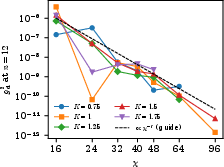
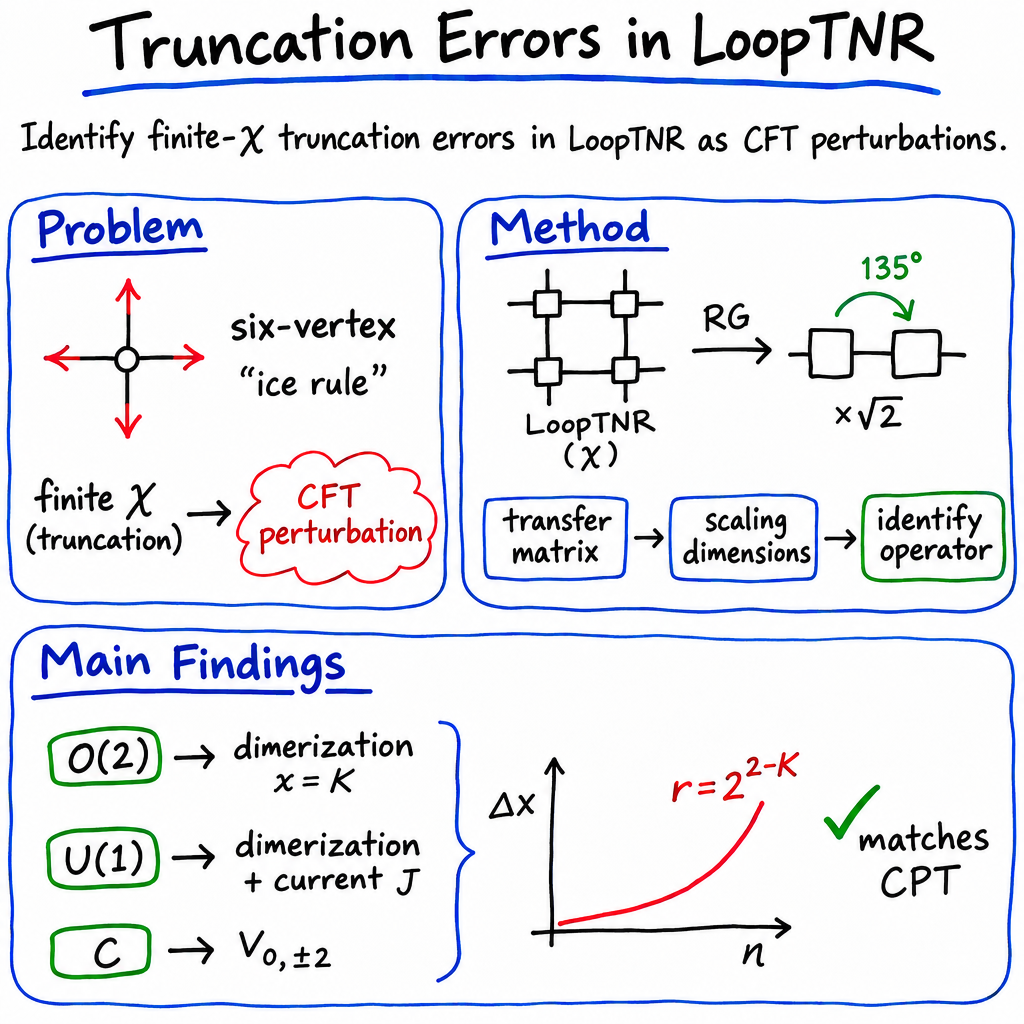
Abstract: Tensor network renormalization at finite bond dimension introduces truncation errors that are amplified by the renormalization-group (RG) flow. For loop tensor network renormalization (LoopTNR) on the critical line of the six-vertex model, with Luttinger parameter , we identify these errors operator by operator from symmetry-resolved transfer-matrix spectra and conformal perturbation theory. With symmetry imposed, the dominant error is the dimerization operator, which is allowed because LoopTNR breaks one-site translation. With less symmetry it is the current or a charge-two vertex operator. The growth of the dimerization per RG step and a parameter-free ratio of its amplitudes agree with conformal perturbation theory to within a few percent. The parameter drifts slowly, owing to a weak marginal error and to the running induced by the dimerization. A larger lowers the initial amplitude of the error for but changes neither the operator nor its growth rate.
Paper Prompts
Sign up for free to create and run prompts on this paper.
Explain it Like I'm 14
1. What is this paper about?
This paper studies what goes wrong when scientists use a computer method called loop tensor network renormalization, or LoopTNR, to simplify a difficult physics problem.
The problem studied is the six-vertex model, a mathematical model made of arrows arranged on a grid. It is useful for understanding things such as magnets, fluids, and chains of atoms.
LoopTNR repeatedly replaces a complicated large grid with a smaller, simpler one. This is similar to zooming out from a picture while trying to keep the important details. However, the computer cannot keep every detail, so it throws some information away. This creates small errors.
The main purpose of the paper is to find out:
- Which kinds of errors appear?
- How quickly do these errors grow?
- How are the errors affected by the symmetries built into the calculation?
- Can the errors be predicted using mathematical physics?
2. What questions did the researchers ask?
The researchers focused on several main questions:
- What is the most important error caused by LoopTNR? The calculation can make the system behave as though its bonds are alternately strong and weak. This is called dimerization.
- Does the answer depend on which symmetries are preserved? A symmetry is a rule that says the system should look the same after a certain change, such as reversing arrows or rotating the grid.
- How fast does each error grow as the calculation continues?
- Can the errors be recognized from changes in the system’s energy-like levels?
- Does using a larger bond dimension, written as , solve the problem? The bond dimension is roughly the amount of information the computer is allowed to keep at each step.
3. How did they investigate the problem?
The six-vertex model
In the six-vertex model, arrows point along the links of a square grid. At every crossing, exactly two arrows point in and two point out. This is called the ice rule, because it resembles the rules for the directions of bonds in ice.
The researchers changed a parameter called . This parameter controls the behavior of the model, much like changing the temperature or strength of an interaction.
LoopTNR
LoopTNR is a type of renormalization-group method. The basic idea is:
- Start with a detailed grid.
- Combine nearby parts into larger blocks.
- Replace each block with a simpler object.
- Repeat.
Each step makes the length scale larger by a factor of . In other words, the researchers repeatedly zoomed out.
At each step, some information had to be removed. The number describes how much information could be retained. A larger usually means a more accurate calculation.
Measuring the errors
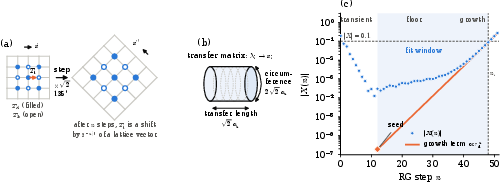
The researchers built a mathematical object called a transfer matrix. One can think of this as a machine that describes how information moves from one row of the grid to the next.
The important numbers produced by this matrix are called eigenvalues. By examining these numbers, the researchers estimated the system’s scaling dimensions. Scaling dimensions describe how strongly different patterns change when the system is viewed at larger and larger distances.
If the calculation were perfect, these values would remain close to the predictions of the underlying theory. Changes in them reveal the errors introduced by LoopTNR.
Comparing with theory
The researchers used conformal perturbation theory. Despite its complicated name, the idea is simple: start with a perfectly understood system, add a small disturbance, and calculate how the disturbance changes the system.
They compared the observed changes with predictions for different possible disturbances, including:
- Dimerization, which makes neighboring bonds alternate between stronger and weaker.
- Currents, which are related to a flow or imbalance in the system.
- Vertex operators, which represent other possible wave-like disturbances.
- Marginal errors, which do not quickly grow or shrink but can slowly change the value of .
They also tested several choices of symmetry:
- Full symmetry.
- Only symmetry.
- Only charge-conjugation symmetry, written as .
4. What did they find?
The main error with symmetry is dimerization
When the calculation preserved symmetry, the dominant error was dimerization.
Imagine a row of connected springs. If every other spring becomes slightly stronger, the pattern is:
strong, weak, strong, weak, ...
That is similar to what dimerization does to the model.
This error appears because LoopTNR does not preserve the original one-site translation symmetry. The original model looks the same if shifted by one grid position, but the coarse-grained model uses a two-part repeating cell. As a result, the computer calculation can accidentally favor alternating bonds.
The error grows at a predictable rate
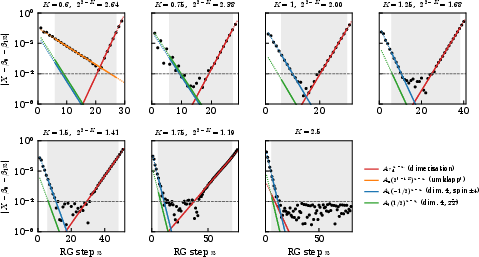
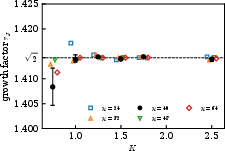
For most of the tested values of , the dimerization error grew by a factor close to
at each renormalization step.
The measured growth agreed with this prediction to within a few percent. This is important because it shows that the error is not random numerical noise. It behaves like a specific physical disturbance predicted by theory.
For example, if , the predicted factor is
So the effect of dimerization roughly doubles at each step.
When was larger than about $2$, the dimerization became irrelevant. This means that it did not grow strongly, and the researchers saw no clear breakdown even after many steps.
Other symmetries allow different errors
The leading error changed when fewer symmetries were imposed.
| Symmetry kept in the calculation | Main error observed |
|---|---|
| Dimerization | |
| only | Dimerization plus a current-like error |
| only | A charge-two vertex disturbance |
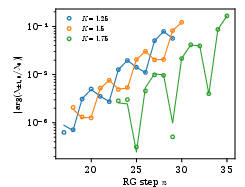
With only symmetry, a current-like error appeared. It changed the energies of states with opposite charges in opposite directions. Its size grew by about per step, and its direction rotated by about each step, exactly as expected from the geometry of the LoopTNR procedure.
With only charge-conjugation symmetry, a different disturbance called became important. Its growth also matched the theoretical prediction very well.
A second test confirmed the identity of the error
A growth rate alone does not always prove which operator caused an error. Different disturbances can sometimes grow at similar speeds.
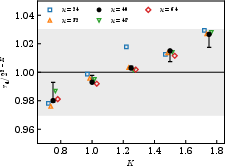
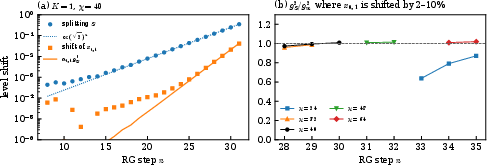
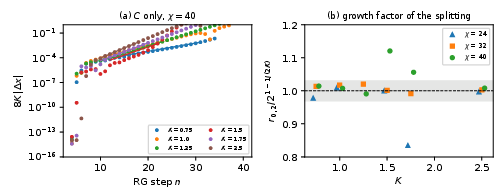
To solve this problem, the researchers compared the error’s effect on two different energy levels. Theory predicted a particular ratio between these changes if dimerization were responsible.
The measured ratio agreed with the prediction to about 1% over a wide range of . This gave strong evidence that dimerization really was the main error.
The parameter slowly drifts
The researchers also found that did not stay perfectly constant. It slowly changed as the calculation continued.
This happened for two reasons:
- There was a weak marginal error, which can slowly move the system along the line of critical states.
- The growing dimerization itself caused to decrease.
This drift is slower than the main dimerization error, but it matters when very accurate results are needed.
Larger bond dimension reduces the starting error
Increasing reduced the initial size, or seed, of the error. This is what one would hope: allowing the computer to keep more information makes the first approximation better.
However, increasing did not change:
- Which operator caused the main error.
- How quickly that error grew.
So a larger bond dimension delays the problem but does not remove the basic mechanism causing it.
Behavior near the BKT point
At the special point , the model is near a Berezinskii–Kosterlitz–Thouless, or BKT, transition. Near this point, the system changes unusually slowly, following a logarithmic pattern.
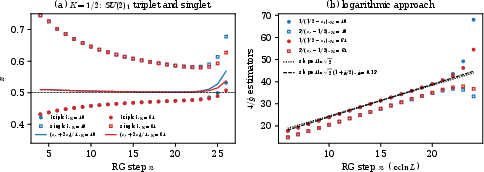
The researchers observed this expected slow behavior for about 15 renormalization steps. After that, dimerization again became the dominant error.
5. Why are these results important?
The paper shows that finite-bond-dimension errors in LoopTNR are structured and understandable. They are not simply unpredictable computer mistakes.
The important lessons are:
- Symmetry controls which errors are allowed. Preserving more symmetry can prevent some unwanted disturbances.
- The main error can be identified by its growth rate and its effects on different energy levels.
- Theoretical predictions work very well, often within a few percent.
- Increasing makes the calculation last longer before breaking down, but does not change the type of error.
- The loss of one-site translation symmetry is especially important, because it allows dimerization to appear.
6. Possible impact of the research
This work can help physicists use tensor-network calculations more safely.
Instead of simply running LoopTNR until the results look unreliable, researchers can:
- Monitor the energy levels at every step.
- Recognize which error is growing.
- Predict when the calculation will stop being trustworthy.
- Choose symmetries that block the most dangerous errors.
- Increase to reduce the initial error and extend the useful calculation range.
- Potentially design improved algorithms that cancel or avoid the unwanted disturbance.
In short, the paper provides a detailed “diagnostic guide” for LoopTNR. It explains not only that errors occur, but also what they are, why they appear, and how they grow. This could lead to more accurate studies of critical physical systems and better computer methods for studying them.
Practical Applications
Immediate Applications
The paper’s main practical contribution is a diagnostic framework for identifying and controlling finite-bond-dimension errors in tensor-network renormalization. The findings are primarily applicable to computational physics and numerical-method development rather than to direct consumer or clinical deployment.
- Automated quality control for LoopTNR and related tensor-network calculations — Computational physics/software
- Implement transfer-matrix spectroscopy after each RG step and monitor:
- scaling dimensions in symmetry-resolved sectors;
- the central charge and drift of the Luttinger parameter ;
- charged-level splittings;
- first-order level repulsion;
- phase rotations associated with spinful perturbations.
- Use the predicted growth factors to detect the onset of truncation-induced breakdown. For example, with symmetry, a dimerization contribution should grow approximately as per RG step when it enters at second order.
- This could become a diagnostic module in packages such as
TNRKit.jl, reporting a recommended stopping step , error type, and confidence interval. - Dependencies: reliable transfer-matrix eigenvalues, correct assignment of CFT states to symmetry sectors, sufficiently large weak-coupling windows, and an appropriate estimate of the tube’s modular parameter.
- Evidence-based selection of the RG stopping point — Numerical simulation and scientific computing
- Replace fixed rules such as “stop after a predetermined number of iterations” with an adaptive stopping criterion:
- 1. discard the initial transient regime;
- 2. identify the numerical error floor;
- 3. fit the growing perturbation;
- 4. stop before deviations exceed a chosen threshold, such as .
- This is especially useful near criticality, where truncation errors are amplified slowly at first and then rapidly dominate the spectrum.
- Dependencies: the perturbative regime must be identifiable; near the BKT point, logarithmic physical running and truncation-induced growth must be separated.
- Symmetry-aware algorithm design — Tensor-network software and algorithm engineering
- Use the paper’s symmetry classification to predict which errors are allowed by a chosen tensor ansatz:
- imposing suppresses current and charge-breaking perturbations, but does not prevent the translation-breaking dimerization operator;
- imposing only permits the current, producing charge splittings and a phase rotation per RG step;
- imposing only charge conjugation permits charge-two vertex perturbations and, in some cases, more relevant charge-breaking operators.
- Before running a calculation, software could generate an “allowed perturbation report” based on the imposed internal symmetries, unit-cell structure, and lattice rotations.
- Dependencies: the symmetry classification applies to the six-vertex/compact-boson setting and must be re-derived for other models or tensor-network geometries.
- Benchmarking and regression testing of tensor-network implementations — Academic software development
- Treat the measured quantities as reproducible benchmarks:
- dimerization growth close to ;
- parameter-free amplitude ratios between charged and current levels;
- current growth close to ;
- current-coupling phase rotation close to ;
- absence of dimerization growth for within the tested window.
- These tests can detect changes in truncation routines, symmetry handling, tensor normalization, or coarse-graining geometry across software versions.
- Dependencies: benchmark values depend on the LoopTNR implementation, lattice rotation, readout tube, and fit protocol.
- Improved extraction of critical spectra and CFT data — Statistical mechanics and conformal field theory
- Fit finite- spectra using conformal perturbation theory rather than treating deviations as unstructured numerical noise.
- Separate:
- common level-scale errors;
- drift along the critical line through ;
- relevant dimerization effects;
- marginal and dimension-four corrections;
- umklapp contributions.
- This can improve estimates of scaling dimensions, operator content, and critical parameters from tensor-network calculations.
- Dependencies: the operator content must be known or hypothesized, and the data must remain within the weak-coupling regime.
- Improved numerical studies of the six-vertex and XXZ models — Condensed-matter theory and statistical mechanics
- Use the observed correspondence between dimerization in LoopTNR and bond alternation in the XXZ chain to quantify how a tensor-network truncation effectively perturbs the underlying lattice model.
- Researchers can compare LoopTNR data with exact diagonalization or DMRG for a deliberately dimerized XXZ chain, providing an independent calibration of truncation errors.
- Dependencies: the mapping between tensor-network perturbations and lattice operators is model- and normalization-dependent.
- Teaching and training workflows for numerical RG — Education and academia
- The six-vertex model provides a compact training example for demonstrating:
- symmetry-resolved transfer matrices;
- finite-size scaling;
- conformal perturbation theory;
- relevant versus marginal perturbations;
- BKT logarithmic corrections;
- adaptive numerical stopping criteria.
- A practical laboratory exercise could vary , , and the imposed symmetry, then reproduce the transition from a stable critical spectrum to truncation-induced breakdown.
- Dependencies: access to tensor-network software and sufficient computational resources for multiple bond dimensions and RG histories.
- Practical bond-dimension allocation — High-performance scientific computing
- The results indicate that increasing reduces the initial truncation-error seed but generally does not change the dominant operator or its RG growth rate.
- This supports a more efficient workflow: estimate the seed at moderate , extrapolate its impact, and increase only when the required correlation-length or RG-step window demands it.
- Dependencies: the reported behavior was tested mainly for and selected values outside that interval; extrapolation to other models or parameter regimes requires validation.
Long-Term Applications
The following applications would require additional research, algorithmic development, or validation beyond the results established in the paper.
- Error-compensated or error-canceling LoopTNR — Tensor-network algorithm development
- Use the fitted dimerization seed, including its sign where measurable, to modify tensors or local weights so that the leading truncation-induced perturbation is canceled.
- A future algorithm could:
- 1. estimate the seed after early truncations;
- 2. add a counterterm with the opposite dimerization coupling;
- 3. continue the RG flow;
- 4. iteratively retune the counterterm as new truncation sources appear.
- This could extend the usable critical window and delay breakdown without simply increasing .
- Dependencies: requires a robust signed-seed measurement and a method for distinguishing an initial seed from perturbations injected at every RG step, as proposed by branching runs at intermediate steps.
- Symmetry-preserving coarse-graining that retains one-site translation — Tensor-network architecture
- Since the dominant -symmetric error is caused by loss of the original one-site translation symmetry, a future coarse-graining scheme could seek a local representation of translation on the coarse network.
- Possible designs include:
- translation-aware unit cells;
- enlarged or structured tensor unit cells;
- explicit projective representations of fractional coarse-lattice translations;
- optimization constraints coupling the two tensors and .
- If successful, this could remove or strongly suppress the relevant dimerization perturbation.
- Dependencies: the paper emphasizes that simply making the tensors equal or imposing symmetry is not known to restore ; a genuinely translation-compatible coarse-graining construction is required.
- Adaptive symmetry selection for critical simulations — Scientific software and automated modeling
- Build an optimizer that chooses the least restrictive symmetry set compatible with the desired observables while minimizing dangerous perturbations.
- For example, the system could compare , , and charge-conjugation-only runs and select the scheme with the smallest predicted error growth for a target range of .
- This would turn symmetry choice into an adaptive numerical control parameter rather than a fixed user decision.
- Dependencies: stronger symmetry can reduce computational cost and suppress some errors, but may also exclude observables or physical perturbations of interest.
- Generalization to other critical systems — Statistical mechanics and condensed matter
- Apply the operator-resolved methodology to:
- the XY model;
- quantum rotor models;
- compactified boson lattice models;
- critical XXZ chains;
- Coulomb-gas systems;
- other tensor-network representations with continuously varying critical exponents.
- The key transferable idea is to infer the effective truncation perturbation from its symmetry quantum numbers, scaling rate, level dependence, and conformal spin.
- Dependencies: operator identifications, lattice symmetry actions, normalization conventions, and coarse-graining rotations differ between models.
- Finite- renormalization-group flow equations with source terms — Theory and simulation control
- Incorporate truncation as an explicit source in effective RG equations, such as
- A calibrated source model could predict: - the eventual finite- correlation length; - the RG step at which a run leaves the critical regime; - the dependence on , , and symmetry; - whether an error is a one-time seed or a continuously injected source. - Dependencies: source functions and must be measured independently and may depend on implementation details.
Automated inference of effective lattice perturbations from spectra — Machine learning and scientific AI
- Train or construct an interpretable inference pipeline that maps spectral histories to effective perturbations:
- growth rate scaling dimension and perturbative order;
- sector selection symmetry quantum numbers;
- relative amplitudes operator identification;
- eigenvalue phase conformal spin and lattice rotation.
- Such a tool could flag whether a numerical calculation is being driven by dimerization, currents, umklapp, charge-two vertices, or marginal drift.
- Dependencies: training data must cover different models, tensor-network geometries, bond dimensions, and symmetry conventions; black-box classification should be supplemented by conformal-perturbation-theory checks.
- Higher-precision BKT transition detection — Phase-diagram computation
- Combine the paper’s treatment of logarithmic flow with truncation diagnostics to distinguish physical BKT behavior from finite- artifacts.
- The triplet/singlet combination
suppresses the leading logarithmic correction and could serve as a more stable estimator near the transition. - A future workflow could jointly fit logarithmic physical flow, dimerization growth, and bond-dimension dependence to locate BKT points more accurately. - Dependencies: the fitting window must be long enough to observe logarithmic flow but short enough to avoid relevant truncation errors.
Transfer-matrix spectroscopy as a general diagnostic for numerical renormalization methods — Computational physics
- Adapt the approach to tensor-network algorithms beyond LoopTNR, including TNR, TRG variants, graph-independent local truncations, and potentially tensor-network simulations of quantum circuits.
- Comparing the operator fingerprints generated by different algorithms could reveal which truncation procedures preserve translation, rotation, charge, or reflection symmetries most effectively.
- Dependencies: each method may have a different effective geometry, transfer matrix, unit cell, and scaling of truncation errors.
- Design of critical fixed-point tensors with controlled irrelevant directions — Tensor-network fixed-point construction
- The identified perturbations can be used as control coordinates when optimizing approximate fixed-point tensors on the line.
- Instead of optimizing only tensor reconstruction error, one could penalize:
- dimerization amplitude;
- current coupling;
- charge-two vertex amplitude;
- unwanted drift in ;
- spin-dependent anisotropy.
- This may enable more stable approximate fixed points and improve extraction of CFT data.
- Dependencies: optimization landscapes may contain competing truncation and symmetry errors; controlling one operator may increase another unless the full perturbation spectrum is monitored.
Glossary
- Antiferroelectric order: A state in which neighboring arrows or dipoles preferentially align in an alternating, oppositely oriented pattern. “Antiferroelectric order sets in only for ”
- Berezinskii–Kosterlitz–Thouless (BKT) transition: A topological phase transition characterized by the binding or unbinding of vortex-like excitations and logarithmic scaling behavior. “ () is the BKT point of the F model.”
- Bosonization: A correspondence that represents certain one-dimensional fermionic or spin systems in terms of bosonic fields. “These rules are those of the bosonization of the XXZ chain and of the Coulomb gas”
- Bond dimension: The dimension of the contracted virtual indices in a tensor network, controlling its representational capacity. “The bond dimension changes the initial amplitude of the error”
- Compact boson: A conformal field theory describing a periodic scalar field whose target space is a circle. “In the continuum the model becomes a compact boson with ”
- Conformal defect: A localized structure or interface that preserves conformal symmetry in a conformal field theory. “conformal defects”
- Conformal field theory (CFT): A quantum or statistical field theory invariant under conformal transformations. “the six-vertex model on its critical line as a lattice realization of the compact boson”
- Conformal perturbation theory: A method for calculating the effects of perturbing a conformal field theory by additional operators. “We describe the finite-size spectrum by conformal perturbation theory”
- Conformal spin: The difference between the holomorphic and antiholomorphic scaling dimensions of an operator. “the vertex operator has scaling dimension and conformal spin”
- Coulomb gas: A field-theoretic representation of statistical models in terms of interacting charges or vertex operators. “These rules are those of the bosonization of the XXZ chain and of the Coulomb gas”
- Critical line: A continuous set of parameter values at which a system remains critical and exhibits scale-invariant behavior. “The compact boson has an exactly marginal operator”
- Critical phase: A parameter region characterized by scale-invariant correlations rather than a single critical point. “the whole range $0<c<2$ forms a single critical phase”
- Descendant: A conformal-field-theory state or operator generated from a primary by applying symmetry-algebra modes. “Descendants, with ”
- Dimerization operator: An operator representing alternating bond strength or bond order in a lattice system. “With imposed, the dominant error is the dimerization operator of dimension .”
- Exactly marginal operator: An operator whose perturbation changes a parameter of a fixed-point theory without generating an RG flow away from the fixed-point manifold. “The compact boson has an exactly marginal operator”
- Finite-entanglement scaling: The scaling behavior induced by representing an entangled state with finite tensor-network resources. “the length scale set by finite entanglement”
- Fixed-point tensor: A tensor that is invariant, up to prescribed transformations, under an RG coarse-graining procedure. “At criticality these algorithms approximately realize a fixed-point tensor”
- Free-fermion point: A parameter value at which an interacting model becomes equivalent to noninteracting fermions. “The free-fermion point is ”
- Holomorphic: Depending only on the complex coordinate in a two-dimensional conformal field theory. “ are the holomorphic and antiholomorphic stress tensors”
- Ice rule: The six-vertex constraint requiring two arrows to enter and two arrows to leave every vertex. “subject to the ice rule that two arrows point into and two out of each vertex”
- Level repulsion: The phenomenon in which coupled energy or scaling levels avoid crossing and split apart. “At the spin-one states ... are degenerate, and connects them at first order.”
- Luttinger parameter: A parameter characterizing the interactions and critical exponents of a one-dimensional gapless system. “with Luttinger parameter ”
- Marginally irrelevant: Describing a perturbation that is marginal at leading order but decreases under RG flow and becomes less influential at long distances. “the marginally irrelevant current--current coupling of the theory”
- Modular parameter: A complex parameter specifying the geometry and boundary conditions of a torus or cylindrical conformal geometry. “where is the modular parameter of the tube”
- Operator product expansion (OPE): An expansion expressing the product of nearby local operators as a sum of local operators with position-dependent coefficients. “operator product expansion coefficients”
- Primary state: A conformal-field-theory state annihilated by the positive modes of the relevant symmetry generators. “the primary state of ”
- Relevant perturbation: A perturbation whose scaling dimension is below the spatial dimension and whose influence grows under RG flow. “the finite- error acting as a relevant perturbation”
- Renormalization-group (RG) flow: The evolution of effective parameters as the length scale changes under coarse-graining. “the RG flow amplifies”
- Scaling dimension: An exponent determining how an operator or correlation function changes under scale transformations. “the scaling dimensions of the underlying conformal field theory”
- Six-vertex model: A lattice model in which each vertex permits one of six arrow configurations satisfying the ice rule. “The six-vertex model assigns an arrow to each bond of the square lattice”
- Staggered field: A field or operator whose sign alternates between neighboring lattice sites or sublattices. “the dimerization, staggered, and umklapp fields”
- Tensor network renormalization (TNR): A real-space RG method that coarse-grains tensor networks while attempting to remove short-range entanglement. “tensor network renormalization (TNR)”
- Transfer matrix: An operator that propagates a lattice system in one direction and whose eigenvalues encode finite-size spectral information. “We then compute the leading eigenvalues of its transfer matrix”
- Truncation error: The error introduced when retaining only a finite number of degrees of freedom during tensor-network coarse-graining. “each truncation introduces a small error”
- Umklapp field: A periodic interaction in a bosonized theory that transfers momentum by a reciprocal-lattice vector. “the dimerization, staggered, and umklapp fields”
- Vertex operator: An exponential operator of a bosonic field carrying momentum and winding charges. “the vertex operator has scaling dimension and conformal spin”
- Winding number: An integer counting how many times a compact bosonic field wraps around its target-space circle. “ and are the momentum and winding numbers of ”
- XXZ chain: A one-dimensional anisotropic quantum spin chain related to the six-vertex model. “These rules are those of the bosonization of the XXZ chain”
- Zero mode: The spatially uniform mode of a field, often associated with a conserved global quantity. “their zero modes are and ”