Ambient LLMs: Data-Efficient Supervised Fine-tuning via Temperature Matching
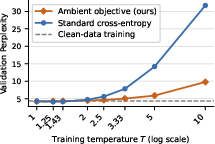
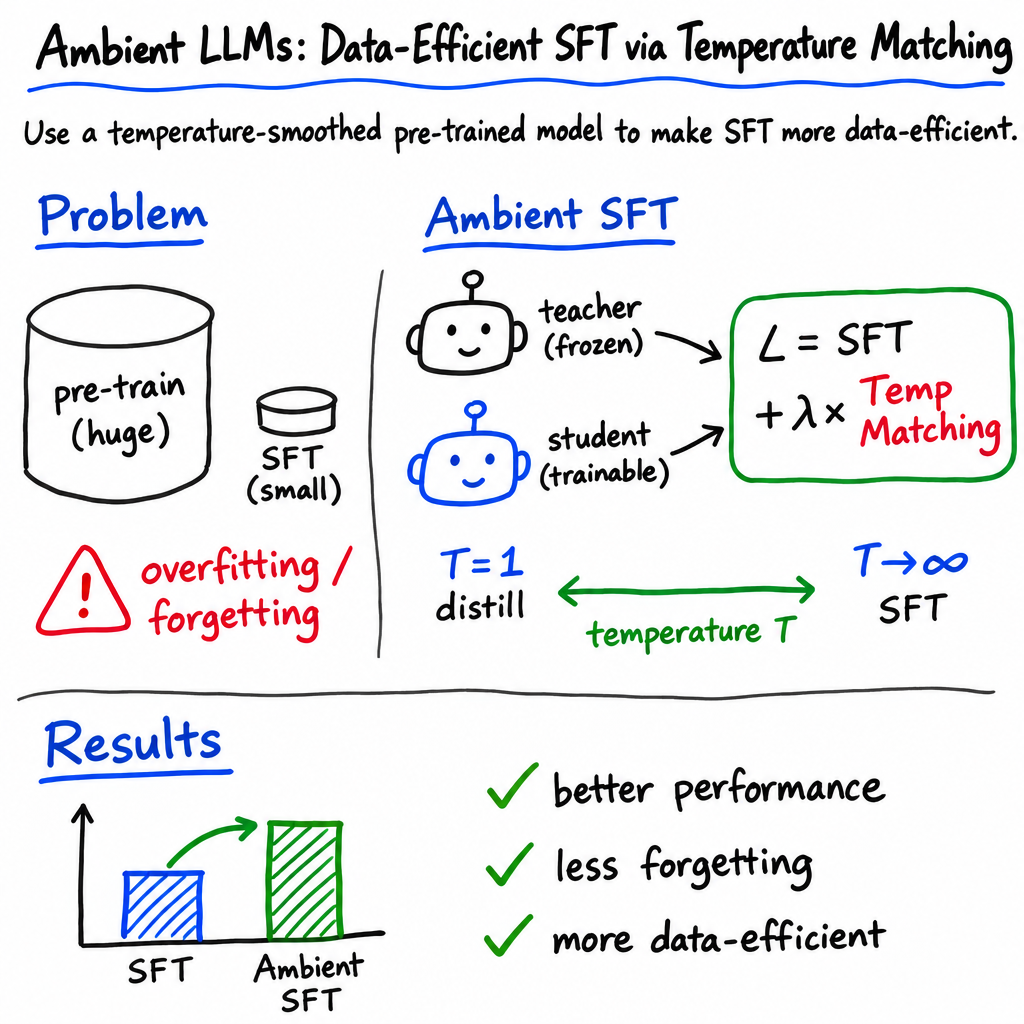
Abstract: Collecting large-scale, diverse, and high-quality post-training datasets for autoregressive LLMs is challenging. Consequently, Supervised Fine-Tuning (SFT) is typically applied to datasets significantly smaller than those used for pre-training, which leads to overfitting and the catastrophic forgetting of the tails of the data distribution. To prevent this collapse, we introduce Ambient SFT, a principled framework for leveraging imperfect predictions to augment the fine-tuning set. In our method, a "frozen" version of the pre-trained model serves as a noisy teacher that the fine-tuned model must match at a coarse level. In particular, we require that the high-temperature versions of the conditional distributions produced by the post-training model should match the high-temperature versions of the pre-training ones. The temperature hyperparameter controls the level of trust in the pre-trained model, with the limit reverting back to regular SFT and to knowledge distillation. We demonstrate that our approach outperforms standard SFT across domain adaptation, instruction-tuning, and reasoning, leading for up to average relative improvement to standard SFT.
Paper Prompts
Sign up for free to create and run prompts on this paper.
Explain it Like I'm 14
1. What is this paper about?
This paper introduces a new way to train LLMs, called Ambient SFT.
LLMs are usually trained in two main steps:
- Pre-training: The model reads a huge amount of general text, such as books, websites, and articles.
- Fine-tuning: The model studies a much smaller collection of special examples, such as instructions, computer code, medical writing, or reasoning problems.
The problem is that the fine-tuning dataset is often small. If the model focuses too much on this small dataset, it may become good at the new task but forget some of what it learned before. This is called catastrophic forgetting.
The paper asks:
Can we teach a model new skills without making it forget its old knowledge, especially when only a small amount of new training data is available?
The authors propose Ambient SFT as a solution.
2. What are the main research questions?
The researchers mainly want to find out:
- Can a LLM learn effectively from a small fine-tuning dataset?
- Can it avoid overfitting, which means memorizing the small dataset too closely?
- Can it preserve knowledge from its original training?
- Is it better to use the original model as a guide while training the new model?
- What is the best amount of trust to place in the original model?
- Does the method work for different goals, such as:
- adapting to a new subject,
- following instructions,
- solving reasoning problems?
3. How does Ambient SFT work?
Ordinary supervised fine-tuning
In normal supervised fine-tuning, a model is shown examples and asked to predict the next word or token.
For example, if the training sentence is:
“The cat sat on the…”
the correct next word might be:
“mat.”
The model changes its settings so that it becomes more likely to predict “mat” in that situation.
This works well, but with a small dataset the model can become too focused on the examples it sees. It may improve on the new task while losing older abilities.
Using the original model as a teacher
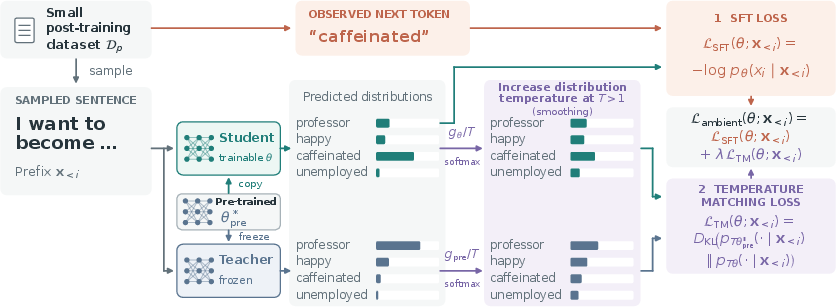
Ambient SFT keeps a frozen copy of the original pre-trained model. This copy is called the teacher. The model being trained is called the student.
The student receives two kinds of guidance:
- The actual answer in the fine-tuning data. This teaches the new skill.
- The general predictions of the original model. This reminds the student of the knowledge and behavior it had before fine-tuning.
The teacher does not force the student to copy every prediction exactly. Instead, the student matches the teacher’s predictions after they have been softened using a temperature.
What does temperature mean?
A model normally gives different probabilities to possible next tokens. For example:
| Possible next word | Normal probability |
|---|---|
| mat | 90% |
| floor | 7% |
| chair | 2% |
| tree | 1% |
A higher temperature makes the predictions less certain and spreads probability more evenly:
| Possible next word | High-temperature probability |
|---|---|
| mat | 45% |
| floor | 30% |
| chair | 15% |
| tree | 10% |
This softer prediction contains more information about the model’s alternatives. It tells the student not only which answer the teacher prefers, but also which other answers are somewhat reasonable.
The temperature controls how strongly the student listens to the teacher:
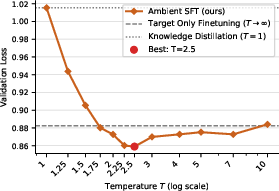
- At temperature 1, the student uses ordinary knowledge distillation, meaning it tries to copy the teacher fairly closely.
- At a very high temperature, the teacher’s predictions become almost uniform, so the teacher has little effect. The method becomes ordinary fine-tuning.
- At an intermediate temperature, the student learns the new material while still receiving useful reminders from the original model.
The authors call the extra training term Temperature Matching.
An everyday analogy
Imagine a student preparing for a new exam with only a small number of practice questions.
- Ordinary fine-tuning is like studying only those practice questions.
- The original model is like an older tutor who remembers many other subjects.
- Ambient SFT lets the student study the new questions while occasionally checking with the tutor about the broader topic.
The tutor does not give the exact answer every time. Instead, the tutor gives a list of likely answers with different levels of confidence. This helps the student learn the new subject without forgetting everything else.
4. What methods did the researchers use?
The paper combines mathematical analysis with computer experiments.
Mathematical analysis
The researchers prove several facts about their method:
- Even predictions made with a high temperature still contain useful information.
- If two models’ predictions are softened enough, their predictions become more similar.
- This makes the original model a useful, approximate guide for the new model.
- In a simplified mathematical model, Ambient SFT can have lower error than:
- ordinary fine-tuning,
- copying the original model,
- standard knowledge distillation.
The authors describe the balance as a trade-off between:
- Bias: Trusting the old model too much and not learning enough new information.
- Variance: Trusting the small fine-tuning dataset too much and overfitting it.
Temperature helps control this balance.
Computer experiments
The researchers tested Ambient SFT in three major settings:
- Domain adaptation: Teaching a model to work with specific kinds of text.
- Instruction tuning: Teaching a model to follow user instructions.
- Reasoning: Teaching a model to solve problems involving mathematics, coding, and logic.
They compared Ambient SFT with several other methods, including:
- ordinary fine-tuning,
- mixing old and new training data,
- knowledge distillation,
- keeping the model close to its original settings,
- label smoothing and other regularization techniques.
They tested different model sizes and different amounts of training data.
5. What did the researchers find?
Ambient SFT helped with domain adaptation
The method was tested on five areas:
- Python code,
- computer science papers,
- biomedical writing,
- news,
- product reviews.
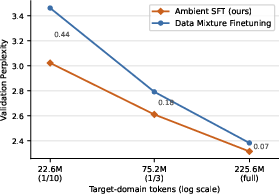
Ambient SFT matched or beat the other methods in all five areas. Its largest improvement was on news text, where it reduced the model’s prediction error by up to 26.7% compared with the best competing method.
The method was especially helpful when the new dataset was small. As the dataset became smaller, the advantage of Ambient SFT became larger.
It reduced catastrophic forgetting during instruction tuning
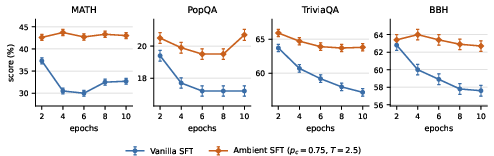
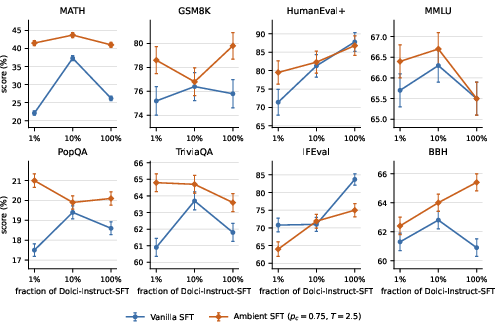
Ordinary fine-tuning made models better at following instructions, but it often caused them to lose abilities in mathematics, coding, general knowledge, and reasoning.
Ambient SFT usually improved instruction following while preserving more of these other abilities.
For example, when training a small model with limited instruction data, Ambient SFT produced an average improvement of about 20.3% over ordinary fine-tuning. For larger models, the improvement was still between about 8% and 10% in many tests.
The method worked on different model families, including Qwen, OLMo, and Llama models.
It helped reasoning abilities
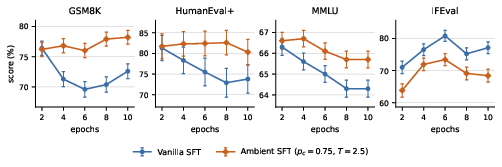
For reasoning tasks, Ambient SFT performed better than ordinary fine-tuning on 5 out of 6 tests.
It improved results on tasks involving:
- advanced mathematics,
- general questions,
- instruction following,
- computer programming.
The improvement was smaller than in domain adaptation and instruction tuning, but it still showed that the method can help models learn reasoning skills without damaging their other abilities.
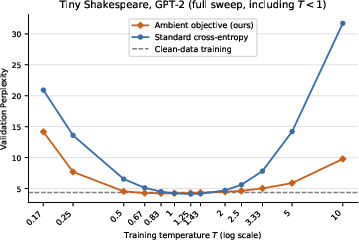
A medium temperature worked best
The researchers found that neither extreme was ideal:
- Temperature 1, which is standard knowledge distillation, was not the best choice.
- An extremely high temperature removed most of the teacher’s influence.
- A temperature around 2.5 often worked well in their experiments.
This supports the paper’s main idea: the student should listen to the original model, but not copy it too strongly.
The method costs slightly more computing power
Ambient SFT requires an extra prediction step from the frozen teacher model. This makes training about 10% slower in the authors’ usual setup.
Therefore, the method is most useful when training data is scarce, rather than when computer time is the main limitation.
6. Why are these results important?
The results suggest that LLMs do not always need huge amounts of new training data to learn effectively.
Usually, developers may try to solve limited-data problems by collecting more and more examples. That can be expensive and difficult, especially for expert topics such as medicine, science, or advanced reasoning.
Ambient SFT offers another possibility:
- use a small amount of carefully chosen new data,
- keep the original model’s broad knowledge as a guide,
- reduce forgetting and overfitting,
- improve several skills at once.
The method is also simple to add to existing fine-tuning systems because it is a small change to the training objective rather than a completely new model design.
7. Conclusion and possible impact
The paper presents Ambient SFT as a way to make language-model training more data-efficient.
Its central idea is:
Train the model on the new examples, but also ask it to remember the general patterns it learned before.
The original model acts as a soft guide rather than a strict teacher. Using a carefully chosen temperature allows the new model to learn new abilities while preserving older ones.
If the findings continue to hold for larger and more varied models, Ambient SFT could make it cheaper and safer to adapt LLMs to new subjects, instructions, and reasoning tasks. It may be particularly useful in areas where high-quality training examples are rare or expensive to collect.
However, the method is not a complete solution to every problem. It requires extra computation, and the best temperature may depend on the model and the training data. Even so, the paper shows that a model’s own previous knowledge can be used to protect it while it learns something new.
Practical Applications
Immediate Applications
- Data-efficient domain adaptation for specialized LLMs — Industry / Software
- Apply Ambient SFT when adapting a general-purpose LLM to domains such as software code, biomedical literature, legal documents, financial reports, news, or product reviews using relatively small target datasets.
- A practical workflow is to initialize a student from a pretrained model, retain a frozen copy as the teacher, and optimize:
- 1. standard next-token cross-entropy on the target-domain data; and
- 2. a temperature-matching KL term between teacher and student predictions.
- This can produce domain-specific models with lower validation perplexity while reducing degradation on general language capabilities. The paper reports especially large gains for code and news adaptation, including up to a 26.7% relative perplexity improvement over the best baseline in one setting.
- Dependencies and assumptions: the pretrained model must already contain useful knowledge of the target domain; performance is expected to improve most when target data is scarce and the model’s zero-shot target-domain perplexity is reasonably low. An additional teacher forward pass increases training cost by approximately 10% in the reported configuration.
- Low-data instruction tuning for commercial and open-source assistants — Industry / Software
- Replace vanilla SFT in the training pipeline for chatbots, coding assistants, enterprise copilots, and customer-service agents when only a few thousand high-quality instruction-response examples are available.
- Ambient SFT can preserve pretrained knowledge in areas such as factual recall, mathematics, coding, and general reasoning while still improving instruction-following behavior.
- A practical implementation can use the paper’s reported starting point of approximately and , followed by validation-based tuning. For heterogeneous instruction datasets, separate temperatures can be selected for different data sources.
- Potential products and workflows: compact enterprise assistants trained on proprietary examples without requiring extensive synthetic or human-labeled datasets; safer model customization pipelines that reduce knowledge loss; and model adaptation services for organizations with limited data.
- Dependencies and assumptions: the base model must support access to logits or token distributions, and the instruction data must be sufficiently representative of the desired behavior. The method does not guarantee that every capability improves; in the experiments, instruction-following scores could lag vanilla SFT unless temperatures were adjusted per source.
- Preserving general capabilities during alignment and post-training — Industry / Model governance
- Use temperature matching as a regularization layer in alignment pipelines to reduce catastrophic forgetting, sometimes called the alignment tax.
- Organizations can evaluate both target-task performance and retention of pretrained capabilities during post-training, rather than relying only on instruction-following benchmarks.
- Potential tool: a post-training dashboard that jointly tracks target behavior, factual knowledge, reasoning, coding, and domain perplexity across training checkpoints.
- Dependencies and assumptions: the frozen pretrained model is treated as a useful prior, not as an authoritative source of truth. If the base model contains serious biases, unsafe knowledge, or systematic errors, temperature matching may preserve those properties.
- Reasoning-model fine-tuning with small supervised datasets — Industry / Academia
- Apply Ambient SFT to mathematical reasoning, scientific question answering, code generation, and chain-of-thought-style datasets when reasoning examples are expensive to curate.
- The experiments show improvements over vanilla SFT on five of six reasoning benchmarks and improved robustness to prompting, suggesting a practical use in training reasoning-capable assistants without sacrificing the model’s pretrained competencies.
- Potential products: lightweight domain-specific reasoning models for tutoring, scientific search, coding, and technical support.
- Dependencies and assumptions: reasoning improvements were smaller than those observed for domain adaptation and instruction tuning. Results depend on the quality of reasoning demonstrations and should be verified for factuality, calibration, and susceptibility to prompt variation.
- Post-training smaller models as alternatives to larger models — Industry / Energy / Software
- Use Ambient SFT to obtain the performance of a larger vanilla-SFT model with a smaller student model and limited data. The paper reports cases where Ambient SFT at smaller scales approaches or exceeds vanilla SFT at larger scales on selected benchmarks.
- This could reduce inference cost, memory use, latency, and energy consumption in deployed applications.
- Dependencies and assumptions: benchmark gains may not transfer directly to production workloads. The student must have sufficient capacity, and the method still requires an additional training-time forward pass; the main savings occur during inference and data collection, not necessarily during training.
- A drop-in regularization component for existing SFT infrastructure — Software / Industry
- Integrate Ambient SFT into current supervised fine-tuning systems without changing the model architecture or requiring access to the original pretraining corpus.
- The frozen teacher can be a copy of the original base model, and the method can be implemented through stochastic alternation between clean cross-entropy updates and temperature-matching updates.
- Potential tools: Hugging Face-style trainer plugins, distributed-training loss modules, hyperparameter sweeps over temperature and mixing probability , and checkpoint-selection systems based on retention metrics.
- Dependencies and assumptions: the implementation must correctly compute temperature-scaled logits and the KL divergence over the vocabulary. Memory availability may be a constraint because both student and teacher are used during training.
- Data-efficiency diagnostics for model customization — Industry / Academia
- Measure the base model’s zero-shot perplexity on a target corpus before committing to an adaptation strategy.
- According to the paper, lower initial target-domain loss is strongly associated with larger Ambient SFT gains. This provides an inexpensive screening procedure for deciding whether to use Ambient SFT, data mixing, additional data collection, or conventional SFT.
- Dependencies and assumptions: the reported correlation was obtained across five domains and may not generalize to highly different model architectures, languages, or task formats. Perplexity is also less informative for non-linguistic objectives or tasks where success is primarily behavioral rather than distributional.
- Academic experimentation on learning from noisy or corrupted data — Academia
- Use the method as an experimental framework for studying whether high-temperature, noisy samples retain information about an underlying language distribution.
- Researchers can investigate model identifiability, robustness to corrupted supervision, and the relationship between sampling temperature, bias, and variance.
- Potential outputs: educational demonstrations of how apparently nonsensical training samples can still encode recoverable statistical structure; benchmark suites for noisy-data learning; and empirical comparisons between self-distillation, label smoothing, and regularization.
- Dependencies and assumptions: the exact theoretical recovery results rely on autoregressive distributions with full support and idealized optimization or log-linear assumptions. Neural-network behavior outside these settings may differ.
- Personalized local assistants with limited private data — Daily life / Privacy
- Fine-tune a general LLM on a user’s small collection of writing, notes, workflows, or preferences while retaining broad language and reasoning abilities.
- Ambient SFT could reduce overfitting to a narrow personal style and lower the risk that the assistant loses general capabilities after personalization.
- Dependencies and assumptions: the base model must already possess the desired general capabilities; privacy-preserving training and secure storage remain necessary. Temperature matching does not itself prevent memorization of sensitive personal examples or eliminate privacy risks.
Long-Term Applications
- Continual learning across many domains and tasks — Industry / Academia
- Extend Ambient SFT to sequentially adapt one model to multiple domains, languages, products, or user groups while using the original or periodically updated model as a stabilizing teacher.
- A future continual-learning system could select a temperature based on domain similarity, teacher confidence, or measured zero-shot perplexity, and maintain a library of teacher checkpoints.
- Dependencies and assumptions: the paper studies a single post-training stage more directly than long sequences of adaptations. Repeated teacher regularization could preserve outdated behavior, and methods are needed for handling changing knowledge, task conflicts, and distribution drift.
- Adaptive or token-level temperature matching — Long-Term / Software
- Develop systems in which varies by domain, data source, context, token type, uncertainty, or training stage rather than using one global temperature.
- High temperatures could be used where the base model is reliable or where data is extremely sparse, while lower temperatures—or no matching term—could be used for newly introduced facts and behaviors.
- Potential tools: uncertainty-aware training schedulers, source-specific temperature controllers, and token-level gates that determine when the teacher should influence the student.
- Dependencies and assumptions: reliable uncertainty estimates and stable optimization are required. Incorrectly assigning high trust to the base model could suppress genuinely useful new information.
- Federated and privacy-preserving model personalization — Healthcare / Finance / Enterprise
- Use Ambient SFT to adapt a shared model to hospitals, banks, legal practices, or individual devices using small local datasets while limiting the need to transmit raw examples.
- The frozen base model can act as a common prior, and each institution can train a local student using its private target data.
- Dependencies and assumptions: federated optimization, differential privacy, secure aggregation, and regulatory validation would be required. Temperature matching may preserve sensitive biases in the base model and does not by itself address cross-client distribution differences.
- Specialized healthcare, scientific, and legal assistants — Healthcare / Science / Policy
- Build assistants for clinical documentation, biomedical literature analysis, scientific research, or legal drafting from small expert-curated datasets while retaining broad language competence.
- Ambient SFT is particularly relevant where expert annotations are expensive and catastrophic forgetting could remove general knowledge needed for safe operation.
- Potential products: literature triage tools, clinical coding assistants, research copilots, and legal document-analysis systems.
- Dependencies and assumptions: high-stakes deployment requires factuality testing, calibration, auditability, human review, data governance, and domain-specific safety evaluation. The method improves distributional fitting but does not establish clinical or legal correctness.
- Policy and public-sector language-model adaptation — Policy / Government
- Adapt open or foundation models to public-sector terminology, administrative procedures, regulatory documents, and multilingual government services using relatively small curated corpora.
- Temperature matching could help preserve broad reasoning and language skills while reducing the need to collect massive government-specific post-training datasets.
- Dependencies and assumptions: public-sector deployments require transparency, reproducibility, bias audits, records-management compliance, and validation against changing laws and policies. A frozen teacher may encode outdated or inappropriate assumptions.
- Cost-aware training and model lifecycle management — Industry / Energy
- Incorporate the method into decisions about whether to collect more post-training data, increase model size, or spend additional compute.
- A lifecycle system could estimate:
- target-domain zero-shot perplexity;
- the amount of available target data;
- teacher-student compute cost;
- expected retention of general capabilities; and
- the projected benefit of Ambient SFT versus data mixing or larger-scale annotation.
- Dependencies and assumptions: the paper demonstrates data-efficiency benefits but does not provide a complete economic or carbon accounting model. For compute-limited rather than data-limited organizations, the extra teacher pass may outweigh the gains.
- Knowledge-preserving model editing and targeted behavioral updates — Software / Safety
- Combine temperature matching with controlled updates for new policies, product information, or organizational procedures, attempting to introduce a narrow change without broadly altering the model.
- This could support regular updates to assistants while retaining general competencies.
- Dependencies and assumptions: the method is not a complete model-editing technique and may not guarantee locality of changes. Additional mechanisms are needed to verify that updates affect only intended concepts and do not preserve obsolete or unsafe information.
- Multilingual and low-resource language adaptation — Education / Government / Global software
- Apply Ambient SFT to adapt multilingual models to low-resource languages or regional varieties where only small amounts of high-quality text are available.
- This could support translation, educational tutoring, government access, and local-language conversational systems.
- Dependencies and assumptions: the pretrained model must contain enough representation of the target language for the teacher to be useful. Language imbalance, script differences, tokenizer coverage, and culturally specific evaluation criteria may limit effectiveness.
- Automated post-training controllers and foundation-model training platforms — Long-Term / Industry
- Build automated systems that choose between vanilla SFT, Ambient SFT, knowledge distillation, data mixing, or additional data collection based on validation results and resource constraints.
- Such a platform could search jointly over , or , training duration, student size, teacher size, and data-source weights.
- Dependencies and assumptions: robust multi-objective evaluation is required because improvements on one benchmark may correspond to regressions on another. Automated selection must also account for safety, fairness, factuality, privacy, and production-specific metrics rather than perplexity alone.
- Broader applications beyond LLMs — Long-Term / Robotics / Vision / Multimodal AI
- Investigate whether the central idea—learning a new task from sparse clean data while matching softened predictions from a pretrained model—transfers to vision, speech, robotics, multimodal models, and reinforcement learning.
- Possible examples include adapting a robot to a new environment while preserving prior behaviors, tuning a vision model to a new medical imaging domain, or personalizing speech recognition with limited recordings.
- Dependencies and assumptions: the current theoretical and empirical evidence is for autoregressive LLMs. Other modalities may require different notions of temperature, probability smoothing, trajectory matching, or teacher confidence, and the effectiveness of the approach remains to be established.
Glossary
- Alignment tax: The loss of general capabilities that can result from aligning a LLM to specific preferences or tasks. “This phenomenon is known as the alignment tax”
- Ambient Diffusion: A framework for training generative diffusion models from corrupted or incomplete observations. “The name connects to Ambient Diffusion”
- Ambient SFT: The proposed supervised fine-tuning method that combines ordinary next-token training with high-temperature distribution matching. “Our algorithm, termed Ambient SFT, mitigates the overfitting typically observed when applying Supervised Fine-Tuning (SFT) to small datasets.”
- Autoregressive model: A model that represents a sequence distribution as a product of conditional distributions over successive tokens. “Let be any AR model over ”
- Bias–variance trade-off: The statistical compromise between systematic error from model assumptions and variability caused by limited data. “In Ambient SFT, the temperature controls a bias-variance trade-off”
- Catastrophic forgetting: The abrupt loss of previously learned information when a model is trained on new data. “post-trained LLMs tend to suffer from catastrophic forgetting at the tails of the pre-training data distribution”
- Conditional distribution: A probability distribution over an outcome given an observed context or condition. “we require that the high-temperature versions of the conditional distributions produced by the post-training model should match the high-temperature versions of the pre-training ones.”
- Contraction mechanism: A process that reduces differences between distributions as a transformation is applied. “Temperature scaling as a contraction mechanism”
- Cross-entropy: A loss measuring the discrepancy between a target probability distribution and a model’s predicted distribution. “Eq.~\eqref{eq:normal_loss} computes the cross-entropy between the model's predicted distribution and the target distributions”
- Data adaptation: The process of adapting a model trained on one distribution or domain to another target domain. “We proceed to post-training experiments, beginning with domain adaptation”
- Data mixture fine-tuning: Fine-tuning that combines examples from the original pre-training distribution with examples from a target distribution. “data-mixing (where we split training updates between the pre-training domain and the target domain)”
- Data-efficient fine-tuning: Fine-tuning designed to achieve strong performance using relatively few training examples. “Data-Efficient Supervised Fine-tuning via Temperature Matching”
- Empirical distribution: A distribution constructed from a finite sample, assigning probability according to observed data frequencies. “We denote this empirical distribution with .”
- Fisher information matrix: A matrix describing the curvature of a likelihood objective and the information that data provide about model parameters. “ is the Fisher information matrix controlling the curvature of the first term in the loss function.”
- Frozen teacher: A teacher model whose parameters are kept fixed while a student model is trained. “the teacher $\theta^*_{\mathrm{pre}$ is frozen”
- Full support: A probability distribution that assigns nonzero probability to every possible outcome. “For any two distributions that have full support”
- Generative training: Training a model to represent or produce samples from a data distribution. “Typically, the success of the generative training depends on the size of .”
- Identifiability: The property that model parameters or a distribution can be uniquely determined from observable data. “The theorem shows that the distribution is identifiable from high-temperature data.”
- Instruction tuning: Fine-tuning a LLM to follow natural-language instructions. “We start with pre-trained base models, ranging from $1.7$B to $14$B params, and we fine-tune them on the Dolci-Instruct-SFT”
- Knowledge distillation: A training method in which a student model learns to reproduce the output distribution of a teacher model. “ to knowledge distillation.”
- Kronecker product: A matrix operation that produces a block matrix from two input matrices or vectors. “ is the Kronecker product”
- Label smoothing: A regularization technique that replaces one-hot target labels with softened probability distributions. “Ambient SFT outperforms other regularization methods.”
- LLM: A large neural network trained on extensive text data to model and generate language. “The development of state-of-the-art LLMs”
- Log-linear model: A probabilistic model whose log-probabilities are linear functions of feature representations. “Ambient SFT analysis under a log-linear model”
- Logit: An unnormalized real-valued score assigned to a possible output before normalization into probabilities. “outputs logits for each potential token in the vocabulary”
- Log-normalizer: The logarithm of the normalization factor that converts exponentiated scores into probabilities. “the logarithm of its denominator”
- Maximum likelihood: A parameter-estimation principle that selects parameters maximizing the probability of the observed data. “the three terms inside the minimum being , and the best run.”
- Negative log-likelihood: The negative logarithm of the probability assigned to observed data, commonly used as a training loss. “The standard training objective targets the minimization of the population negative log-likelihood”
- Oracle model: An idealized model assumed to provide access to an otherwise unavailable target distribution or prediction. “Imagine having access to an oracle LLM that can generate the high-quality post-training data distribution”
- Overfitting: The degradation of generalization caused by fitting training-specific patterns rather than the underlying distribution. “Ambient SFT mitigates the overfitting typically observed when applying Supervised Fine-Tuning (SFT) to small datasets.”
- Perplexity: An exponential transformation of average negative log-likelihood used to measure language-model prediction quality. “For News, the relative improvement in perplexity over the best baseline reaches ”
- Population objective: A loss defined as an expectation over the underlying data distribution rather than a finite dataset. “Let $R_T(\theta)=\sum_{i=1}{l}\mathbb E_{x_{<i}\sim\mu_i}”
- Post-training: Training performed after pre-training to adapt a LLM to instructions, domains, alignment, or reasoning tasks. “This severe bottleneck arises because post-training requires extraordinarily high-quality data”
- Pre-training distribution: The broad data distribution from which a model’s initial training corpus is drawn. “the tails of the pre-training data distribution”
- Regularization: A method of constraining model training to improve generalization or prevent undesirable parameter changes. “a second term, which we call Temperature Matching, that regularizes the post-trained network”
- Risk expansion: An asymptotic approximation expressing estimation error through bias, variance, and higher-order terms. “The next theorem quantifies how these quantities affect the estimation error.”
- Sampling temperature: A scalar that controls the sharpness or randomness of a model’s output distribution. “known as the sampling temperature”
- Spearman rank correlation: A statistic measuring the monotonic association between two ranked variables. “this heuristic gives a Spearman rank correlation of ”
- Supervised Fine-Tuning (SFT): Training a pre-trained model on labeled examples, typically using observed next-token targets. “Supervised Fine-Tuning (SFT) is typically applied to datasets significantly smaller than those used for pre-training”
- Synthetic data: Artificially generated examples used for training or evaluation. “we use it to produce synthetic data at different temperatures as before.”
- Temperature Matching: The loss that encourages a student model to match a frozen teacher’s temperature-scaled conditional distributions. “We refer to the full objective of Eq.~\eqref{eq:tm-objective} as Ambient SFT and to its second term as Temperature Matching.”
- Temperature scaling: The modification of a model’s output distribution by dividing logits by a temperature parameter. “Adjusting the temperature.”
- Tempered distribution: A probability distribution obtained by applying temperature scaling to another distribution. “Prefixes sampled from the tempered teacher are a special case”
- Token embedding: A vector representation assigned to a token for use in a neural or statistical model. “Let be a fixed token embedding”
- Vanilla SFT: Ordinary supervised fine-tuning without the proposed temperature-matching regularizer. “Ambient SFT improves on Vanilla SFT on 7/8 tasks”
- Variance: The component of estimation error caused by sensitivity to the particular sample used for training. “+\underbrace{\tfrac1n\operatorname{tr}!\big((F+\lambda H_T){-1}F(F+\lambda H_T){-1}\big)}_{\text{variance}”
- Zero-shot loss: The loss measured on a target domain before the model has been fine-tuned on that domain. “a cheap and reliable predictor of the benefit is the model's perplexity on the target domain before fine-tuning.”