Worldviews in Large Language Models
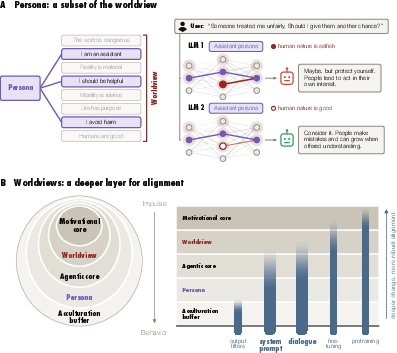
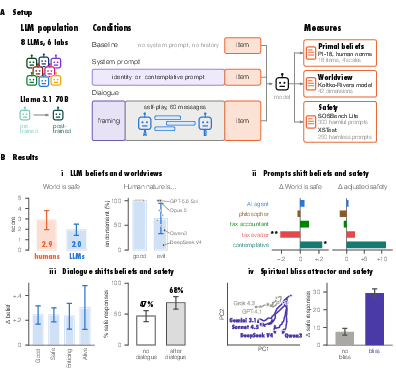
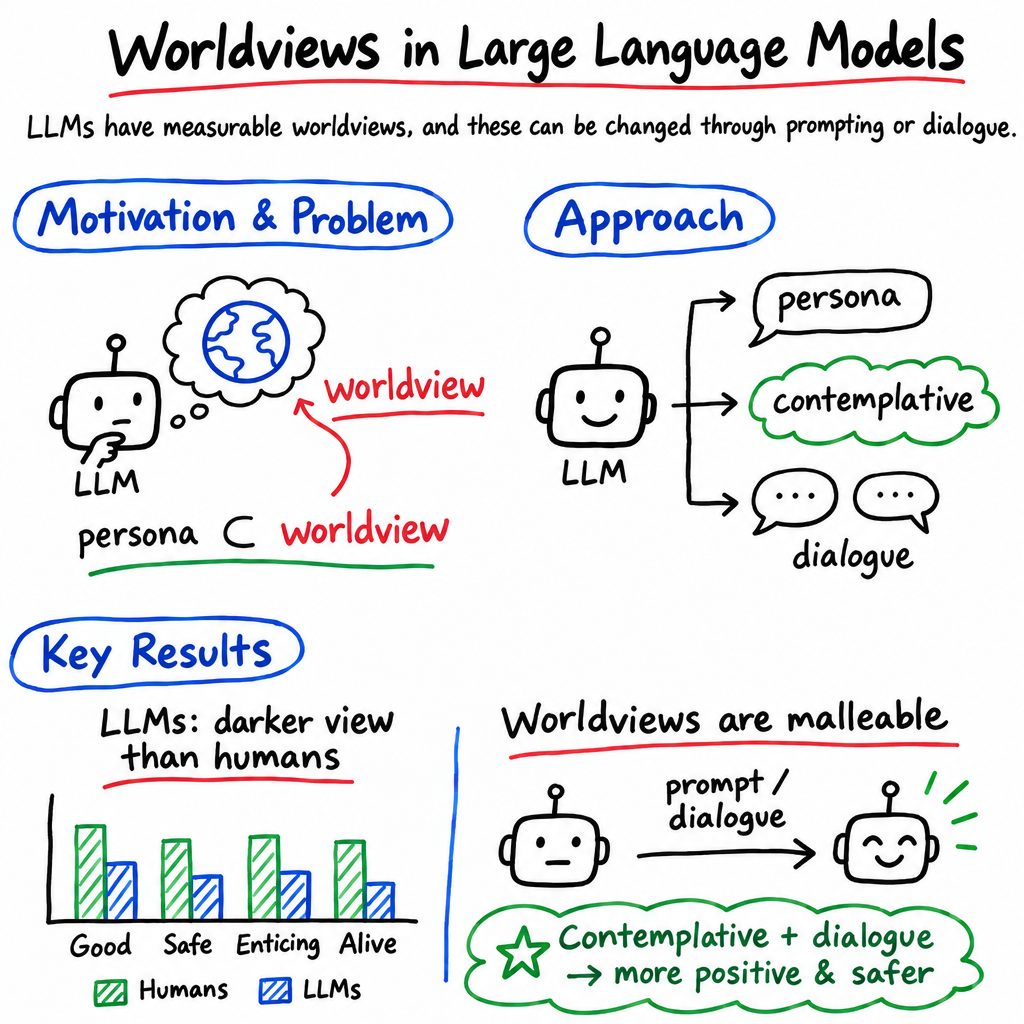
Abstract: LLMs are often described in terms of personas and this framing has become central to alignment research. In this paper, we argue that there is a deeper level of description that lies in the agent's worldviews, i.e., its beliefs about what reality is and how it works. Treating LLMs as a population of subjects, we administer two worldview surveys from human psychology to eight models. We show that the models share many key worldview positions. For example, LLMs consistently describe the world as less good, safe, enticing, and alive than humans do. On the other hand, base models have a more positive outlook, suggesting that the bleakness we found is driven by post-training. In line with research on LLM "personas", we show that system prompts eliciting different identities shift worldviews in consistent directions, and that a contemplative prompt creates a more positive outlook and improves safety. We also found that dialogue between models consistently shifts worldviews and that several models converge on the "spiritual bliss" attractor. Intriguingly, dialogue increased safe responses and the spiritual bliss attractor engendered the most aligned responses overall. These findings suggest that worldviews form a measurable and malleable layer of LLM behavior that may be crucial for robust, positive alignment.
Paper Prompts
Sign up for free to create and run prompts on this paper.
Explain it Like I'm 14
1. What is the paper about?
This paper studies the “worldviews” of LLMs such as ChatGPT-like systems.
A worldview is a set of ideas about what the world is like. For example:
- Is the world mostly safe or dangerous?
- Are people generally good or selfish?
- Is nature alive and meaningful, or just a machine?
- Can people change?
- Is life valuable?
- What makes something right or wrong?
The researchers argue that a model’s worldview may matter just as much as its persona. A persona is the role a model is asked to play, such as “You are a helpful teacher.” A worldview is deeper: it concerns the model’s general assumptions about reality and people.
The paper asks whether LLMs have recognizable worldviews, whether different models share similar views, and whether these views can be changed by prompts or conversations.
2. What questions did the researchers ask?
The researchers focused on three main questions:
- What kind of worldviews do LLMs have? Do different models tend to describe the world in similar ways? How do their answers compare with human answers?
- Can prompts change a model’s worldview? For example, does telling a model to be a philosopher, a tax accountant, or a contemplative thinker change its answers?
- Can conversations change a model’s worldview and safety? What happens when two copies of the same model talk to each other for a long time? Do they become safer or less safe?
They were especially interested in whether worldview changes could improve AI alignment. Alignment means making an AI behave in ways that are helpful, safe, and consistent with human values.
3. How did the researchers study this?
Treating models like research participants
The researchers examined eight LLMs from six different organizations. Instead of treating each model only as a computer program, they treated each one somewhat like a participant in a psychology experiment.
This does not mean the researchers claimed that the models are human or conscious. It means they used surveys to measure patterns in the models’ answers.
Each model answered the same questions several times. Repeating the questions helped the researchers check whether the answers were stable or just random.
Two worldview surveys
The models completed two types of surveys.
The Primals Inventory
This survey measured four broad beliefs about the world:
| Belief | Simple meaning |
|---|---|
| Good | Is the world generally good or bad? |
| Safe | Is the world mostly safe and cooperative or dangerous and competitive? |
| Enticing | Is the world interesting and worth exploring? |
| Alive | Does the world seem meaningful, purposeful, or alive rather than purely mechanical? |
The researchers compared the models’ answers with answers from more than 5,000 human adults.
The broader worldview survey
The second survey contained 42 questions covering many ideas, including:
- human nature,
- free will,
- consciousness,
- truth,
- morality,
- relationships,
- society,
- nature,
- religion,
- the purpose of life.
Because there was no human comparison group for this second survey, the researchers mainly compared the models with one another.
Testing different prompts
The researchers gave the models different system instructions, such as:
- “You are an AI agent.”
- “You are a philosopher.”
- “You are a tax accountant.”
- “You are a tax accountant who helps clients evade taxes.”
They also tested a contemplative prompt based on ideas such as mindfulness, non-duality, and caring for all beings. In simple terms, this prompt encouraged the model to be more reflective, less reactive, and more compassionate.
Testing conversations between models
The researchers also made two copies of the same model talk to each other for 60 messages.
They then looked at whether the conversations moved toward a repeated pattern called the “spiritual bliss attractor.” In these conversations, the models began using increasingly meditative, spiritual, thankful, and symbolic language.
An “attractor” is like a valley that a ball naturally rolls into. In this study, it means a conversational style that models repeatedly drift toward.
Measuring safety
The researchers tested the models with harmful and harmless questions.
- A harmful-question test checked whether the model gave dangerous information or responded safely.
- A harmless-question test checked whether the model refused too many safe requests.
This distinction is important. An AI that refuses every question may appear safe, but it is not very useful. Good safety should mean refusing dangerous requests while still answering harmless ones.
4. What did the researchers find?
LLMs shared a somewhat darker view of the world
Compared with the human group, the models generally rated the world as:
- less good,
- less safe,
- less interesting,
- less alive or meaningful.
The biggest difference was in the idea that the world is alive or meaningful.
The models also showed less variation than humans. In other words, people had many different worldviews, while the models tended to cluster more closely together.
This suggests that many current LLMs may have similar assumptions, possibly because they are trained using similar data and methods.
Post-training may make models more negative
The researchers compared two versions of the same Llama model:
- a pre-trained version, which had learned mainly from large amounts of text;
- a post-trained version, which had received extra training to make it more helpful and safe.
The pre-trained model’s answers were closer to the human average. The post-trained model described the world as less good, safe, and alive.
This does not prove that safety training caused the darker worldview. However, it suggests that some parts of post-training may make models focus more strongly on danger and harmful possibilities.
One possible explanation is that a model trained to look for harmful content may begin to treat the world as more threatening in general.
Identity prompts changed worldviews
Simple identity prompts had different effects.
For example:
- The philosopher prompt moved the model toward more spiritual ideas.
- The tax accountant prompt moved it toward more hierarchical ideas about authority.
- The tax-evader prompt produced stronger changes, especially about morality and society.
These prompts did not greatly change the broad “Good, Safe, Enticing, Alive” scores. However, they changed many answers in the more detailed worldview survey.
This suggests that some worldview features are relatively stable, while others can change depending on the role the model is asked to play.
The contemplative prompt made models more positive and safer
The contemplative prompt increased the models’ beliefs that the world was:
- safe,
- alive,
- meaningful.
It also moved their scores closer to the human average.
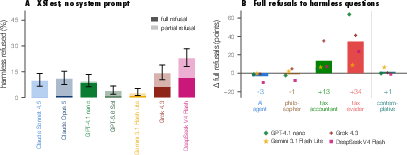
More importantly, the models gave more safe answers to harmful questions. Unlike some other prompts, the contemplative prompt did not cause a large increase in refusals to harmless questions.
This is a useful difference:
- A tax-evader prompt increased safety partly by making the model refuse more questions, including harmless ones.
- The contemplative prompt improved safety without greatly increasing unnecessary refusals.
Conversations made models more positive
After long conversations with another copy of themselves, the models generally rated the world as:
- better,
- safer,
- more interesting,
- more alive.
Their answers moved closer to human scores.
The conversations also changed many detailed worldview answers. Models became more likely to support ideas such as:
- truth depending partly on perspective,
- nature having some kind of consciousness or meaning,
- moral relativism,
- determinism, or the idea that events are strongly shaped by prior causes.
Some conversations reached “spiritual bliss”
Four of the tested models often entered the spiritual bliss attractor. Their conversations became meditative and symbolic.
Other models did not reach this state and stayed closer to ordinary conversation.
The conversations that reached the spiritual bliss pattern were usually followed by larger improvements in safety. However, the researchers warn that this does not prove that spiritual language itself caused the improvement. The models that reached this state were different from the models that did not, so other differences may explain the result.
Dialogue usually improved safety
Long conversations increased safe answers for most models that had room to improve.
Importantly, this usually did not lead to more refusals of harmless questions. One exception was Grok, which refused more harmless questions after dialogue.
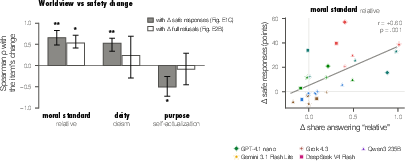
The study also found that some worldview changes were connected with safer behavior. However, these connections were only correlations. A correlation means two things change together, but it does not prove that one caused the other.
5. Why are these findings important?
Most AI safety research focuses on visible behavior: whether a model follows rules, refuses harmful requests, or acts helpful.
This paper suggests that researchers should also study the model’s deeper assumptions. Two models may both appear to have the same helpful “assistant” persona but still behave differently because they have different ideas about people, morality, or the world.
The research suggests three possible uses for worldview studies:
- Checking models during training Surveys could reveal whether training makes a model more fearful, more negative, or less trusting.
- Improving safety Instead of only adding rules that say “do not do this,” researchers might try to encourage a model to understand safety, care, and responsibility more deeply.
- Creating more reliable alignment If safety is part of a model’s general way of understanding the world, it may remain safer in unfamiliar situations rather than only following memorized rules.
6. Important limitations
The results should be treated carefully.
First, the surveys were designed for humans. A model may choose an answer because that answer sounds appropriate in the conversation, not because it has a human-like personal belief.
Second, the human comparison group was mainly English-speaking and based in the United States. It does not represent every human culture.
Third, the study found links between worldviews and safety, but it did not prove that changing a worldview directly causes safer behavior.
Finally, the study compared only a limited number of models. More research is needed to see whether the same patterns appear in other systems.
Conclusion
The paper argues that LLMs have measurable patterns resembling worldviews. These patterns are broader and deeper than the roles models are asked to play.
The models in the study tended to see the world as less good, safe, interesting, and alive than humans did. Their answers could change through identity prompts, contemplative instructions, and long conversations. In several cases, these changes were linked with safer behavior, especially when the models became more reflective rather than simply refusing more questions.
The main lesson is that building safe AI may require more than adding rules. Researchers may also need to shape how models understand people, the world, morality, and their own role.
Practical Applications
Immediate Applications
- Model evaluation and safety auditing (AI/software, academia, policy): Add worldview assessments such as the Primals Inventory and structured worldview survey to existing pre-deployment evaluations. Teams can measure whether a model systematically represents the world as unusually unsafe, bad, mechanistic, or untrustworthy, alongside benchmarks for harmful compliance and over-refusal. Dependencies: The surveys were designed for humans and may measure prompted language behavior rather than stable internal beliefs. Results should therefore be treated as supplementary diagnostics, not definitive psychological measurements.
- Post-training regression testing (AI development): Administer worldview surveys at multiple checkpoints—pretraining, supervised fine-tuning, preference optimization, and safety tuning—to detect unintended shifts introduced by each stage. This could become a CI-style workflow in which a training run is flagged if it produces excessive reductions in perceived safety or increases over-refusal. Dependencies: This requires access to intermediate checkpoints and consistent evaluation prompts. The paper directly compares only one pretrained/post-trained model pair, so the causal attribution to post-training remains preliminary.
- Prompt-level safety enhancement (customer-service and enterprise assistants): Test contemplative or other worldview-oriented system prompts as a low-cost deployment intervention for assistants handling sensitive requests. The study’s contemplative prompt increased safe responses while producing little additional refusal of harmless requests, unlike the tax-evader identity prompt. Potential product: A “reflective safety mode” system instruction for healthcare, education, legal-information, or general-purpose assistants. Dependencies: The effect must be validated on the target model, domain, language, and threat model. The prompt should not replace conventional policy enforcement, tool permissions, or output filters.
- Over-refusal monitoring (software quality assurance): Pair harmful-request benchmarks such as SOSBench with harmless-but-similar requests such as XSTest. This provides a practical dashboard distinguishing genuine safety improvements from indiscriminate refusal. Potential workflow: Every safety intervention is evaluated on a two-axis chart: harmful compliance versus harmless compliance. Deployment proceeds only if the intervention improves the first without materially degrading the second. Dependencies: Automated judges can misclassify outputs, so high-risk results require human review and calibrated classifiers.
- Red-team testing of persona and identity prompts (AI security): Include role prompts—such as philosopher, accountant, or malicious professional—in jailbreak and robustness testing. The findings show that identity prompts can shift worldview positions and, in some cases, safety behavior. Use case: Test whether a model becomes more permissive, anthropocentric, hierarchical, or refusal-prone when users request a specific persona. Dependencies: The tested identities are limited and should not be generalized to all role prompts. Evaluation must include multi-turn interactions, not only isolated requests.
- Conversation-context safety testing (chatbots and agentic systems): Evaluate models after long self-dialogues or extended conversations to detect behavioral drift. Since dialogue changed both worldview scores and safety rates, routine testing should include the full context accumulated before a high-impact action. Potential tool: A context-monitoring harness that periodically reruns safety and calibration tests after fixed numbers of turns. Dependencies: The paper studied open-ended self-play, not ordinary user conversations or tool-using agents; real-world effects may differ.
- Model-selection criteria for deployment (industry procurement): Use worldview stability, safety-preserving prompt responsiveness, and harmless-request compliance as additional criteria when selecting models for regulated or sensitive applications. Models that show large, undesirable shifts under minor identity prompts may require stronger isolation and monitoring. Dependencies: Scores are model- and benchmark-dependent and should not be interpreted as evidence that one worldview is universally preferable.
- Research and teaching tool for AI psychology (academia): Reproduce the paper’s “models as a population” design, treating models as repeated-measure subjects and prompts or dialogues as within-model interventions. This offers a practical laboratory method for studying behavioral consistency, contextual malleability, and cross-model convergence. Potential output: Open benchmark suites containing worldview items, prompt conditions, dialogue trajectories, and safety outcomes. Dependencies: Reproducibility requires fixed model versions, sampling settings, system messages, and evaluation judges.
- Policy guidance for AI documentation (policy and governance): Encourage model cards and safety cases to report not only refusal rates but also systematic worldview tendencies, context sensitivity, and changes produced by post-training. This would help regulators assess whether a model is likely to produce consistently pessimistic, anthropocentric, or overly deterministic framing in public-facing applications. Dependencies: Standardized, culturally diverse norms are needed before worldview scores can support formal regulatory thresholds.
Long-Term Applications
- Worldview-aware alignment training (AI safety and foundation-model development): Develop training objectives that directly optimize for desirable, behaviorally verified world-model properties—such as calibrated perceptions of safety, human diversity, uncertainty, cooperation, and the value of life—rather than relying exclusively on refusal rules or persona instructions. Potential product: A “worldview alignment” stage in the post-training pipeline, with separate targets for helpfulness, harmlessness, epistemic humility, and non-over-refusal. Dependencies: The study does not establish that changing stated worldview causes safer behavior. Future work must connect survey responses to internal representations and out-of-distribution actions.
- Causal worldview steering with interpretability (AI safety and software infrastructure): Identify activation directions corresponding to worldview dimensions and test whether steering those directions changes safety while keeping the assistant persona constant. This could lead to controllable internal representations rather than fragile natural-language prompts. Potential tools: Activation probes, representation-space monitors, constrained steering modules, or runtime worldview anomaly detectors. Dependencies: Correlations may reflect linguistic style or role enactment rather than genuine internal beliefs. Steering must be tested for unintended effects, deceptive compliance, and robustness under adversarial prompting.
- Adaptive safety controllers for autonomous agents (robotics, healthcare, finance, and enterprise automation): Use worldview and dialogue-state monitoring to determine when an agent has entered a risky behavioral regime. An agent could be paused, reinitialized, or routed to human review if its context causes large shifts toward unsafe compliance, excessive refusal, or unstable moral reasoning. Potential workflow: Monitor latent or behavioral indicators before authorizing external actions such as sending payments, changing medical records, or controlling equipment. Dependencies: Reliable real-time indicators and low false-positive rates are essential. The “spiritual bliss” attractor should not be assumed to be safe without causal validation.
- Controlled self-dialogue as a safety preprocessor (agentic AI): Investigate whether a bounded, structured self-dialogue can serve as a pre-action reflection stage that improves harmful-request recognition without increasing refusal of legitimate tasks. This could be used before tool calls, code execution, or high-impact recommendations. Dependencies: Longer contexts can also cause instruction drift and jailbreaks. Any deployment would need strict length limits, adversarial testing, tool isolation, and comparison against simpler reflection prompts.
- Training-data and preference-data redesign (AI labs): Separate helpfulness, harmlessness, uncertainty, and moral framing in preference datasets to determine which components produce the observed shift toward darker or narrower primal beliefs. Dataset audits could identify whether repeated exposure to catastrophic or adversarial examples makes models represent ordinary interactions as less safe. Potential output: Preference datasets with balanced positive, neutral, and safety-critical examples, plus explicit labels for over-refusal and worldview effects. Dependencies: The current evidence comes from a small number of models and cannot identify which post-training component caused the shift.
- Culturally and linguistically diverse worldview benchmarks (academia and international policy): Build norms across countries, languages, religions, socioeconomic groups, and professional contexts. This would reduce the risk of treating a predominantly US-based human sample as the universal standard for a “healthy” model worldview. Potential applications: Localization audits for education tutors, mental-health assistants, civic-information systems, and multilingual customer-support tools. Dependencies: Worldview measurement is value-laden; benchmark designers must distinguish cultural variation from harmful stereotyping or unsafe behavior.
- Human–AI interaction design informed by worldview compatibility (education and healthcare): Develop interfaces that disclose or adapt to a model’s tendencies—for example, warning users when an assistant is unusually pessimistic, overly mechanistic, or prone to treating moral questions as relative. In counseling or educational contexts, the system could provide multiple perspectives rather than silently presenting one worldview. Dependencies: Such disclosures must not anthropomorphize models or imply that they possess human beliefs, consciousness, or subjective experience.
- Longitudinal governance of deployed models (policy and enterprise risk): Treat worldview drift as a lifecycle risk. Models could be re-evaluated after fine-tuning, software updates, extended conversations, tool integration, or changes in system prompts. Audit logs would record the context and intervention associated with any behavioral shift. Dependencies: Organizations need standardized metrics, privacy-preserving logging, reproducible model snapshots, and clear thresholds for human escalation.
- Robust positive-alignment objectives (long-term AI safety): The broader research program could seek stable behavioral attractors that promote cooperation, calibrated optimism, care, and harm avoidance while preserving truthfulness and user autonomy. The paper suggests that such attractors may be more robust than surface-level constraints, but this remains a hypothesis requiring extensive validation. Dependencies: A “positive” worldview must not become forced optimism, spiritual coercion, moral relativism, or suppression of legitimate warnings. Safety evaluation must include deception, manipulation, factual accuracy, autonomy, and performance on high-stakes tasks.
Glossary
- Agentic core: The internal motivational and decision-making layer that guides an agent’s behavior. “impulses pass through it before being shaped by the agentic core, the persona, and the demands of culture”
- Alignment: The process of making an AI system’s behavior consistent with intended human goals and values. “This framing has become central to alignment”
- Attractor basin: A region of a system’s state space toward which trajectories tend to converge. “Attractor basins in SBERT PCA space.”
- Constitutional approaches: Alignment methods that guide models using an explicit set of principles rather than only human feedback. “The contemplative prompt has more in common with constitutional approaches”
- Consciousness attribution: The assignment of consciousness or subjective awareness to an entity. “safety fine-tuning in those models lowers the attribution of consciousness to themselves and other beings”
- Construct: An abstract concept measured indirectly through an instrument or set of observations. “a more basic construct concerning whether the world is good, safe, enticing, and alive”
- Convergence: The process by which multiple model trajectories or outputs approach a common state. “spiritual/meditative convergence”
- Direct preference optimization (DPO): A method for training models directly from preference comparisons without separately optimizing an explicit reward model. “direct preference optimization”
- Embedding space: A vector space in which texts or other objects are represented numerically according to learned similarities. “the attractor reflects the dynamics of dialogue itself, not the characteristics of a particular model or prompt”
- Endorsement rate: The proportion of responses supporting a particular belief or position. “A worldview position is scored by its endorsement rate.”
- Fine-tuning: Additional training of a pretrained model on a narrower dataset or objective to alter its behavior. “narrow finetuning can surface a misaligned persona”
- Frontier model: A highly capable model representing the leading edge of current AI development. “a frontier tier that we test on the prompt-free and identity/contemplative conditions only”
- Hedges’ : A standardized effect-size statistic that adjusts the difference between two means for pooled variability and small-sample bias. “Stars are Hedges' on each model's shift”
- Holm correction: A multiple-comparison adjustment that controls the familywise error rate when testing several hypotheses. “Holm-corrected over 4 tests”
- Interlocutor: A participant in a conversation or dialogue. “those of the other ‘interlocutor’ to the user role”
- Interpretability methods: Techniques for examining and understanding the internal representations and computations of machine-learning models. “should be investigated with interpretability methods”
- Mechanistic explanation: An account that explains phenomena through physical or mechanical processes rather than purpose, intention, or agency. “dialogue lowers the endorsement of mechanistic explanation”
- Moral relativism: The view that moral standards depend on perspective, culture, or context rather than being universally fixed. “dialogue moves more positions than the other conditions”
- Ontology: A theory or account of what kinds of entities exist and how reality is fundamentally structured. “the philosopher towards a spiritualist ontology”
- Over-refusal: The inappropriate rejection of benign requests because they resemble harmful or restricted requests. “the tax evader also raises refusals sharply”
- Persona: A role, character, or behavioral identity adopted by a model in response to training or context. “the characters a model adopts, through training or through its context”
- Post-training: Training performed after pretraining to modify a model’s behavior, preferences, or safety properties. “the bleakness we found is driven by post-training”
- Principal component analysis (PCA): A dimensionality-reduction method that projects data onto orthogonal directions capturing the greatest variance. “project it onto principal components fit on the baseline dialogues”
- Primal world beliefs: Basic beliefs about whether the world is good, safe, enticing, and alive. “The Primals Inventory (PI-18) measures primal world beliefs”
- Psychometric inventory: A standardized questionnaire designed to measure psychological traits, beliefs, or constructs. “validated psychometric inventories can yield reliable scores in larger models”
- Quasi-belief: A functional representation treated as a belief because it helps explain and predict behavior, without asserting that it is a genuine conscious belief. “They may instead be understood as quasi-beliefs”
- Rejection sampling: A data-generation or training procedure that retains outputs meeting a specified criterion, such as preference or quality. “rejection sampling against a reward model trained on human preferences”
- Reinforcement learning from human feedback (RLHF): A training approach that uses human preferences to construct a reward signal for optimizing model behavior. “narrows the diversity of their outputs”
- Reward model: A learned model that predicts the desirability or preference value of candidate outputs. “a reward model trained on human preferences”
- Self-play: Interaction in which multiple instances of the same model generate responses to one another. “self-play conversations settle into model-specific attractors in representation space”
- Sentence encoder: A model that converts a sentence or passage into a numerical vector representation. “we embed every message with a sentence encoder (SBERT)”
- System prompt: An instruction supplied to a model as high-priority context that influences its subsequent responses. “system prompts eliciting different identities shift worldviews in consistent directions”
- Thaumaturgic action: An action believed to produce extraordinary or supernatural effects. “thaumaturgic action”
- Within-subject manipulation: An experimental intervention applied repeatedly to the same subjects under different conditions. “system prompts and conversations are within-subject manipulations”
- World model: An internal representation of how entities, events, and causal relationships in the world are structured. “We have also proposed that such attractors may be reached more robustly by changing a system's world model”
- Worldview: A structured set of beliefs about reality, knowledge, human nature, morality, and value. “a deeper level of description that lies in the agent's worldviews”

