Factorized Self-Supervised Speech Tokenization
Abstract: Speech tokenizers convert audio into discrete units, enabling LLMs to process and generate speech. The goal is to learn compact, text-like representations while preserving enough detail to reconstruct a speaker's voice and delivery. We propose Facto: a factorized tokenizer that disentangles time-varying information (content and prosody) from static components (speaker identity and recording conditions). We build on a recent linear factorization method for self-supervised features, extending it to handle unseen speakers. Then, we cluster the factorized space and train a lightweight decoder to reconstruct audio from the resulting tokens. By removing the static components before clustering, our tokens are more robust to small noise perturbations. We validate this by testing token stability under various noise conditions. Next, we theoretically analyze Facto's convergence and scaling properties, quantifying how the factorization improves with the number of training speakers. Finally, we evaluate Facto on a range of downstream tasks. We show that greater token stability translates into improved text-to-speech performance and competitive results in voice conversion and spoken language modeling. Code and checkpoints at https://github.com/ubisoft/ubisoft-laforge-facto/ and demo page at https://ubisoft-laforge.github.io/speech/facto/.



Paper Prompts
Sign up for free to create and run prompts on this paper.
Explain it Like I'm 14
1. What is this paper about?
This paper introduces Facto, a new way to turn speech into small pieces called tokens.
A speech token is like a word in a written sentence, except it represents a short part of sound. Speech tokens help computers understand and produce speech. For example, a computer could use tokens to:
- turn text into spoken audio,
- change one person’s voice into another person’s voice,
- create realistic computer-generated speech,
- learn patterns in spoken language.
The main problem is that speech contains many kinds of information at once:
- What is being said — the words and sounds,
- How it is being said — emotion, speed, and pitch,
- Who is saying it — the speaker’s voice,
- Where it was recorded — background noise and microphone effects.
Facto tries to separate these pieces. It mainly stores the changing information, such as speech sounds and emotion, while keeping speaker identity separate.
2. What questions did the researchers ask?
The researchers wanted to find out:
- Can speech content be separated from speaker identity? For example, can the system recognize that two people said the same sentence even though their voices are different?
- Can the method work for speakers it has never heard before? Many systems work only with speakers included during training. Facto is designed to work with new speakers too.
- Can the system create stable tokens? If a tiny amount of noise is added to a recording, a good tokenizer should not completely change its tokens.
- Do more training speakers make the system better? The researchers studied whether using many different speakers helps Facto learn a more general idea of speech content.
- Do better tokens improve real speech tasks? They tested Facto on speech reconstruction, text-to-speech, voice conversion, and spoken-language modeling.
3. How does Facto work?
Facto has three main stages.
Stage 1: Separating content from the speaker
First, the researchers use WavLM, a model that has already learned useful information about speech. It changes audio into lists of numbers called features.
The researchers then match similar speech sounds from different speakers. For example, they might find examples of several people saying a sound like “b” or “ee.” This gives them speech examples with similar content but different voices.
They use a mathematical process called factorization to split the information into two parts:
- a shared part representing speech content,
- a speaker-specific part representing the person’s voice.
This is similar to separating a recipe into the food itself and the container it is served in. The food is the speech content; the container represents the speaker and recording conditions.
The method uses singular value decomposition, or SVD. In everyday terms, SVD is a tool that finds the most important patterns in a large collection of numbers and represents them more simply.
Stage 2: Estimating content for new speakers
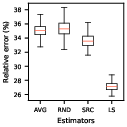
For a new speaker, Facto cannot use a speaker transformation it has already learned. Instead, it trains a simple linear estimator.
A linear estimator is like a rule that combines numbers using multiplication and addition. It learns how to remove speaker-related information from new speech and keep the content.
The researchers use least squares to train this estimator. Least squares means choosing the rule that makes the average prediction error as small as possible—similar to drawing the line that fits a group of points most closely.
After that, Facto groups similar content features together using -means clustering. Clustering is like sorting objects into piles based on how similar they are. Each pile becomes a speech token.
For example, one token might often represent a particular sound, while also preserving information about pitch or speaking style.
Stage 3: Rebuilding the speech
Finally, Facto uses a decoder to turn the tokens back into audio.
The decoder also receives a speaker embedding, which is a compact numerical description of the speaker’s voice. This allows the system to combine:
- the content tokens,
- the identity of the target speaker.
The decoder is based on HiFi-GAN, a neural network designed to create realistic audio.
4. What did the researchers find?
Facto separates useful types of information
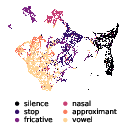
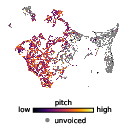
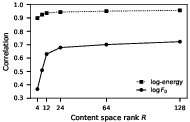
The experiments showed that Facto’s content space mainly organized speech by sound type. It also kept smaller differences connected to pitch and speaking style.
This means Facto did not throw away all expressive information. It separated the speaker’s identity while preserving important details about how the speech was delivered.
Facto becomes more reliable with more speakers
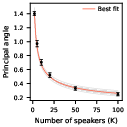
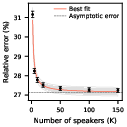
The mathematical analysis predicted that the learned content space becomes more accurate as the number of training speakers increases.
The factorization error decreased roughly according to:
where is the number of training speakers.
The content estimator’s error decreased even faster, approximately as:
In simple terms, adding more varied speakers helps Facto learn a more dependable, speaker-independent representation.
Facto was more stable when noise was added
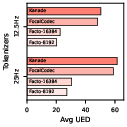
The researchers added small amounts of noise to speech and checked how much the tokens changed. They measured this using Unit Edit Distance, which counts how many token changes are needed to turn one token sequence into another.
Facto reduced this error by about 50% compared with the other tested systems.
This is important because stable tokens are easier for another computer model to learn. If tiny changes in sound cause completely different tokens, the system has a much harder time learning speech patterns.
Speech reconstruction was strong
Facto reconstructed speech with good:
- word accuracy,
- speaker similarity,
- audio quality.
Its results were competitive with or better than the other systems in several measures. It performed especially well at preserving the target speaker’s identity.
Facto performed particularly well for text-to-speech
In the text-to-speech tests, a LLM read text and generated Facto tokens, which were then converted into audio.
Facto generally performed better than the main comparison systems. At 12.5 Hz, for example, Facto achieved:
- lower word error rates,
- higher speaker similarity,
- higher resistance to being detected as artificial speech,
- strong naturalness ratings.
Facto also performed well on expressive and spontaneous speech, although all systems found this type of speech more difficult than carefully read speech.
Voice conversion was also successful
In voice conversion, the goal is to keep the words from one recording but make them sound like another person.
Facto produced speech with high speaker similarity and good audio quality. Its word accuracy was slightly worse than one competing method, but it still showed that Facto could separate speech content from voice identity effectively.
Spoken-language modeling results were promising
The paper also tested whether Facto’s tokens captured language information, such as:
- recognizing real words,
- understanding grammar,
- following the topic of a story.
The provided section ends before giving the complete results for these experiments, so the exact final scores are not included in the paper excerpt. However, the experiment was designed to test whether Facto’s tokens were useful not only for copying sound, but also for representing the structure of spoken language.
5. Why are these findings important?
Facto is important because it offers a simpler and more reliable way to represent speech.
Many speech systems try to store everything in one stream of tokens. This can make the token system large and confusing because the same words may receive different tokens depending on the speaker or recording environment.
Facto instead tries to store the changing parts of speech—such as sounds, pitch, and rhythm—in the tokens while handling speaker identity separately. This has several possible benefits:
- More efficient speech models: Smaller or simpler token systems may require less computing power.
- Better text-to-speech: LLMs can focus on producing understandable and expressive speech.
- Improved voice conversion: The words and the speaker’s voice can be changed more independently.
- Greater noise resistance: Small recording problems are less likely to completely change the representation.
- Better generalization: The method can work with speakers who were not present during training.
The research also suggests that token quality is not only about how accurately speech can be reconstructed. Tokens should also be stable and easy for other models to learn. This may be one reason Facto performed especially well in text-to-speech.
Conclusion
The paper presents Facto, a speech tokenizer that separates what is being said from who is saying it. It uses mathematical factorization, a simple content estimator, clustering, and a speech decoder to create compact speech tokens.
The experiments show that Facto produces stable tokens, works with new speakers, and performs strongly in tasks such as text-to-speech and voice conversion. The main lesson is that speech systems may work better when they organize different kinds of information separately instead of mixing everything together.
In the future, methods like Facto could help computers create more natural voices, imitate speaking styles more accurately, and understand spoken language using less data and computing power.
Practical Applications
Immediate Applications
- Robust text-to-speech systems — Speech technology and accessibility. Facto can be integrated into existing autoregressive text-to-speech pipelines as a compact, single-stream speech representation. Its stable tokens and low frame rates of 12.5–25 Hz can reduce sequence length and make speech generation more efficient. The paper reports improved intelligibility, speaker similarity, naturalness, and robustness on both read and expressive speech.
- Potential products and workflows: voice assistants, screen readers, audiobook generation, navigation systems, customer-service agents, and personalized accessibility tools.
- Dependencies: deployment requires a trained Facto encoder, codebook, decoder, and a LLM adapted to the resulting token vocabulary. Performance may decline for languages, accents, speakers, or acoustic conditions absent from the training distribution.
- Zero-shot voice conversion — Media, gaming, dubbing, and communication. A system can encode source speech into speaker-independent content tokens and decode those tokens using a short reference recording from a target speaker. This supports voice conversion without training a separate model for every target identity.
- Potential tools: real-time voice filters, game-character voices, film and game dubbing pipelines, multilingual content localization, and assistive voice personalization.
- Dependencies: the target speaker must provide an adequate reference recording; latency, consent, watermarking, and misuse prevention are important operational requirements. The paper shows strong speaker similarity, but some baselines achieve better intelligibility, so application-specific evaluation remains necessary.
- Speech resynthesis and audio compression — Archival and communications systems. Facto’s low-rate discrete representation can be used to transmit or store speech as tokens plus speaker information rather than as raw waveforms. Its single codebook and reduced frame rate may simplify downstream modeling and storage.
- Potential workflows: bandwidth-constrained speech messaging, synthetic audio archives, searchable speech repositories, and token-based editing or regeneration.
- Dependencies: the achievable bitrate depends on frame rate, codebook size, and any separately stored speaker embedding. Compression artifacts and reconstruction quality should be assessed on noisy, conversational, multilingual, and far-field recordings rather than only on LibriSpeech-style data.
- Noise-tolerant speech generation and processing — Mobile, telephony, and edge AI. The reported approximately 50% reduction in Unit Edit Distance under tested perturbations suggests that Facto tokens are less likely to change when input audio contains small amounts of noise. This can make speech-generation pipelines less sensitive to microphone variation or mild transmission noise.
- Potential applications: mobile voice assistants, in-car systems, call-center augmentation, wearable devices, and on-device speech interfaces.
- Dependencies: the paper evaluates selected small perturbations, not all real-world acoustic conditions. Robustness to reverberation, overlapping speakers, packet loss, accents, and severe background noise requires additional testing.
- Efficient spoken-language modeling — Language-model research and speech AI. Facto tokens can serve as targets for spoken-LLMs. Their lower frame rate and improved stability may reduce the effective sequence length and make next-token prediction easier than modeling more speaker-dependent representations.
- Potential tools: speech-native conversational agents, audio completion systems, speech-conditioned LLMs, and models that learn linguistic structure directly from audio.
- Dependencies: token stability does not guarantee preservation of all lexical, semantic, or paralinguistic information. Models must be evaluated for transcription accuracy, dialogue quality, long-context behavior, and fairness across speaker groups.
- Speaker-independent speech representations for academic research — Speech and representation learning. Researchers can use the released implementation, checkpoints, and linear content estimator as a lightweight baseline for disentanglement, token stability, voice conversion, and speech generation experiments.
- Potential workflows: probing phonetic and prosodic information, comparing tokenizers, studying robustness to perturbations, and building reproducible speech-token benchmarks.
- Dependencies: results depend on the chosen self-supervised encoder, factorization rank, speaker coverage, nearest-neighbor alignment procedure, and clustering configuration. The theoretical results assume independent speakers, additive noise, and suitable spectral separation.
- Privacy-aware separation of content and speaker attributes — Data governance and speech analytics. Facto’s factorization can support workflows that process linguistic or prosodic content separately from speaker identity, such as content analysis without retaining full speaker characteristics.
- Potential applications: privacy-preserving speech analytics, anonymized corpus construction, and selective retention of linguistic information.
- Dependencies: the representation is not automatically anonymous. The decoder and residual features may preserve identifiable information, and re-identification attacks must be evaluated before use in regulated settings. Legal compliance and explicit consent remain necessary.
- Improved speech interfaces in daily life — Consumer devices and accessibility. Facto-based systems could provide more consistent voice output across phones, microphones, and environments while retaining a chosen voice identity and prosodic style.
- Examples: personalized synthetic voices for people who lose the ability to speak, consistent voice output across smart-home devices, and expressive reading assistance.
- Dependencies: personalization requires representative reference speech and safeguards against unauthorized imitation. Human evaluations should supplement automatic metrics such as WER, MOS, and speaker similarity.
Long-Term Applications
- Multilingual and cross-lingual speech generation — Global communication and education. A future Facto-like tokenizer could separate language-independent phonetic/prosodic structure from speaker identity, enabling multilingual TTS, dubbing, and speech-to-speech translation with a shared token interface.
- Potential products: real-time interpretation, language-learning tutors, multilingual educational narration, and localized media production.
- Dependencies: the current evidence is primarily based on English read and expressive speech. Cross-lingual transfer may require language-balanced speaker data, language-specific clustering, phoneme coverage, and evaluation of tones, phonation, and non-English prosody.
- Real-time, low-latency speech-to-speech agents — Robotics and interactive systems. Low-frame-rate tokens could enable robots, game characters, and conversational agents to generate speech with reduced computational and memory costs. The explicit separation of content, prosody, and speaker information could allow independent control of wording, emotion, and voice.
- Potential workflows: robots that retain a consistent identity, interactive virtual characters, adaptive tutoring systems, and voice-controlled industrial interfaces.
- Dependencies: real-time deployment requires optimized encoders and decoders, streaming factorization, low-latency speaker estimation, and reliable behavior under interruptions and overlapping speech. The current method is not explicitly designed for streaming inference.
- Controllable expressive speech synthesis — Entertainment, education, and assistive technology. Because the content space retains local prosodic structure, future systems could manipulate pitch, energy, timing, or speaking style while preserving lexical content and speaker identity.
- Potential tools: emotion-controlled narration, pronunciation coaching, therapeutic speech training, game-character performance systems, and adaptive educational voices.
- Dependencies: prosody is only partially disentangled from content in the presented method. Explicit prosody control, reliable style labels, and human studies are needed to avoid unintended changes in intelligibility or speaker identity.
- Speech editing using discrete tokens — Creative software and production. Token sequences could provide an editable intermediate representation for inserting, removing, rearranging, or style-transforming speech segments without directly manipulating waveforms.
- Potential products: transcript-based audio editors, automatic dubbing tools, pronunciation correction software, and dialogue post-production systems.
- Dependencies: editing requires accurate temporal alignment between tokens and text, smooth boundary reconstruction, and protection against generating unauthorized speech. The paper does not directly evaluate token-level editing or discontinuity artifacts.
- Large-scale speech foundation models with factorized modalities — Academic and industrial AI research. Facto could contribute to multimodal models that combine text, speech content, speaker identity, and acoustic conditions as separate streams rather than encoding all variation in one token sequence.
- Potential systems: speech-capable LLMs, unified text–speech agents, controllable audio generation, and models that transfer knowledge between text and speech.
- Dependencies: further work is needed on scaling beyond 251 training speakers, expanding data diversity, jointly modeling multiple channels, and determining which information should remain discrete or continuous. The theoretical convergence rates do not by themselves establish scaling to unrestricted domains.
- Adaptive personalization with few-shot speaker enrollment — Consumer and enterprise voice services. Since unseen speakers can be projected into the learned content space using a shared least-squares estimator, future systems could support rapid enrollment of new voices from only a few seconds of speech.
- Potential applications: personalized assistants, enterprise voice agents, synthetic voices for broadcasters, and accessible communication devices.
- Dependencies: the estimator assumes that new speakers come from approximately the same distribution as training speakers. Performance may degrade for atypical voices, pathological speech, children, elderly speakers, heavily accented speech, or unusual recording devices.
- Policy and auditing tools for synthetic speech — Regulation, provenance, and trust. The factorized structure could support systems that separately audit linguistic content, speaker identity, and recording conditions, potentially improving detection and provenance workflows for generated speech.
- Potential tools: synthetic-speech watermarking, consent verification, voice-cloning audit logs, and forensic comparison systems.
- Dependencies: Facto’s strong speaker fidelity also increases the risk of impersonation. Reliable provenance cannot be inferred from token stability alone; robust watermarking, adversarial testing, access controls, disclosure requirements, and legal standards are needed.
- Privacy-preserving speech datasets and federated training — Healthcare, education, and public-sector research. Disentangled representations could eventually allow institutions to share content-oriented speech features while limiting direct exposure of speaker identity or recording conditions.
- Potential applications: collaborative clinical speech research, classroom speech analytics, and cross-institutional language studies.
- Dependencies: privacy must be demonstrated empirically through membership-inference, speaker-identification, and reconstruction attacks. Healthcare and education deployments also require consent, governance, demographic validation, and compliance with applicable data-protection regulations.
- Robust speech technology for healthcare and assistive communication — Clinical and therapeutic systems. A future model trained on diverse pathological and atypical speech could support voice banking, augmentative communication, rehabilitation feedback, and personalized speech reconstruction.
- Potential products: patient-specific synthetic voices, speech-assistance devices, and therapist-facing pronunciation or prosody analysis tools.
- Dependencies: the current corpus does not establish clinical validity. Medical deployment requires specialized data, clinician oversight, longitudinal evaluation, safety testing, and careful handling of highly sensitive voice recordings.
Glossary
- Adversarial objective: A training objective in which a model is optimized against an opposing model or discriminator to encourage a desired representation. “adversarial objectives”
- Autoregressive LLM: A model that generates a sequence by predicting each next element from previously generated elements. “integrating them into an autoregressive LLM”
- Bias–variance trade-off: The balance between systematic estimation error and variability caused by data or noise. “\textbf{bias--variance trade-off}”
- Block matrix: A matrix formed by arranging smaller matrices as its constituent blocks. “where and are the resulting block matrices.”
- Codebook: A finite collection of discrete vectors or tokens used to quantize continuous representations. “a small, single-level codebook”
- Codebook size: The number of entries available in a discrete codebook. “Two factors control the bitrate of the discretization: the frame rate of the representation and the codebook size.”
- Content estimator: A model that predicts a speaker-independent content representation from speech features. “we propose a shared linear estimator that projects self-supervised features directly into the content space.”
- Content space: A learned representation space intended to encode linguistic and prosodic information while suppressing speaker-specific information. “the content space is broadly clustered by sound type”
- Convergence: The tendency of an estimated quantity or algorithm to approach a limiting value as the amount of data or computation increases. “We analyze the convergence and scaling properties of Facto's factorization and content estimation steps.”
- Covariance matrix: A matrix describing the variances of variables and their pairwise covariances. “let $\lambda_R({\mathbf{\Sigma}_\mathbf{X})$ denote the -th largest eigenvalue of the sample covariance matrix”
- Disentanglement: The separation of different underlying factors of variation into distinct components of a representation. “a factorized tokenizer that disentangles time-varying information”
- Equal error rate (EER): The point at which false-acceptance and false-rejection rates are equal in a verification system. “We report this comparison as an equal error rate (Spoof-EER)”
- Factorization: The decomposition of a complex representation into multiple components, such as shared content and speaker-specific transformations. “we jointly factorize self-supervised features using the method of”
- FiLM conditioning: Feature-wise Linear Modulation, a conditioning technique that scales and shifts neural activations based on an auxiliary representation. “FiLM conditioning layers”
- Focal modulation network: A neural architecture that aggregates contextual information using focal modulation mechanisms. “FocalCodec is a single-stream tokenizer based on focal modulation networks.”
- Frame rate: The number of speech representation frames produced per second. “We test two patch configurations with window sizes of two or four, corresponding to frame rates of 25 and 12.5 Hz.”
- HiFiGAN: A generative adversarial neural vocoder architecture for producing high-fidelity speech waveforms. “we adapt HiFiGAN”
- Identifiability: The property that a model’s underlying parameters or representations can be uniquely determined from observations, possibly up to an allowed transformation. “the content matrix is only identifiable up to an invertible transformation”
- Information bottleneck: A mechanism that restricts the amount of information retained in a representation. “carefully tuned information bottlenecks”
- Invertible transformation: A transformation that has a corresponding inverse and therefore preserves recoverability of the transformed representation. “For any invertible matrix $\mathbf{H}”
- Joint factorization: The simultaneous decomposition of multiple related data matrices using shared and individual factors. “we jointly factorize self-supervised features across a fixed set of training speakers.”
- Latent geometry: The geometric organization of an implicit representation space. “smooth latent geometry”
- Least-squares estimator: An estimator that minimizes the sum of squared prediction or reconstruction errors. “This estimator balances the bias and variance terms by directly minimizing the empirical reconstruction error”
- Low-rank matrix: A matrix whose rank is substantially smaller than its dimensions, enabling a compressed representation. “into a low-rank content matrix ”
- Mean opinion score (MOS): A numerical rating, typically based on human or predicted judgments, of perceived speech quality or naturalness. “Finally, we assess overall quality using predicted mean opinion scores (MOS).”
- Multi-resolution discriminator: A discriminator that evaluates generated audio at multiple temporal or spectral resolutions. “the multi-resolution discriminator proposed by”
- Nearest-neighbor matching: A procedure that associates an item with the most similar item in a reference set according to a distance measure. “For the matching step, we use a single nearest-neighbor based on cosine distance”
- Orthogonal projector: A linear operator that projects vectors onto a subspace while preserving the component within that subspace. “let be the orthogonal projector onto .”
- Principal component analysis (PCA): A dimensionality-reduction method that projects data onto directions of greatest variance, often producing uncorrelated components. “we apply principal component analysis (PCA) to decorrelate the features”
- Principal angle: An angle measuring the relative orientation between two subspaces. “The following theorem provides a bound on the distance between these two spaces, characterized by their principal angles.”
- Pseudo-inverse: A generalized matrix inverse, commonly used when a matrix is non-square or singular, to obtain least-squares solutions. “using the pseudo-inverse of the source speaker transformation”
- Prosody: The rhythm, pitch, stress, and intonation patterns of speech. “The content space is organized globally by phonetic information and locally by prosodic structure.”
- Quantization: The conversion of continuous values into a finite set of discrete values or symbols. “Then, we finetune on the corresponding tokenized inputs to account for quantization error.”
- Residual quantizer: A quantization method that successively quantizes and encodes the residual error left by previous quantizers. “FACodec is a disentangled tokenizer that operates at a higher frame rate and uses multiple residual quantizers.”
- Self-supervised feature: A representation learned from unlabeled data using supervisory signals derived from the data itself. “We propose Facto, a disentangled speech tokenizer based on a linear factorization of self-supervised features.”
- Singular value decomposition (SVD): A matrix decomposition into left singular vectors, singular values, and right singular vectors. “We can solve this exactly by applying singular value decomposition to the block matrix .”
- Sub-Gaussian: A random variable or distribution whose tails decay at least as rapidly as those of a Gaussian distribution. “the columns of are sub-Gaussian.”
- Subspace: A subset of a vector space that is itself closed under vector addition and scalar multiplication. “we measure the convergence of the estimated column space”
- Token stability: The extent to which a tokenizer produces the same discrete units when the input is subjected to small perturbations. “We validate this by testing token stability under various noise conditions.”
- Unit Edit Distance (UED): An edit-distance measure that quantifies differences between sequences of discrete speech units. “To quantify token robustness, we calculate Unit Edit Distance (UED)”
- UMAP: Uniform Manifold Approximation and Projection, a nonlinear technique for visualizing high-dimensional data in a lower-dimensional space. “visualize the results using UMAP”
- Voice conversion: The transformation of an utterance so that it retains its linguistic content while sounding like a target speaker. “Next, we test Facto on zero-shot voice conversion”
- Zero-shot voice conversion: Voice conversion performed for a target speaker without speaker-specific training data, using only a short reference recording. “We focus on the 25~Hz tokenizers here, with further comparisons provided in Appendix~\ref{appendix:voice-conversion}.”

