The Chabauty--Kim dimension inequality via noncommutative Iwasawa theory
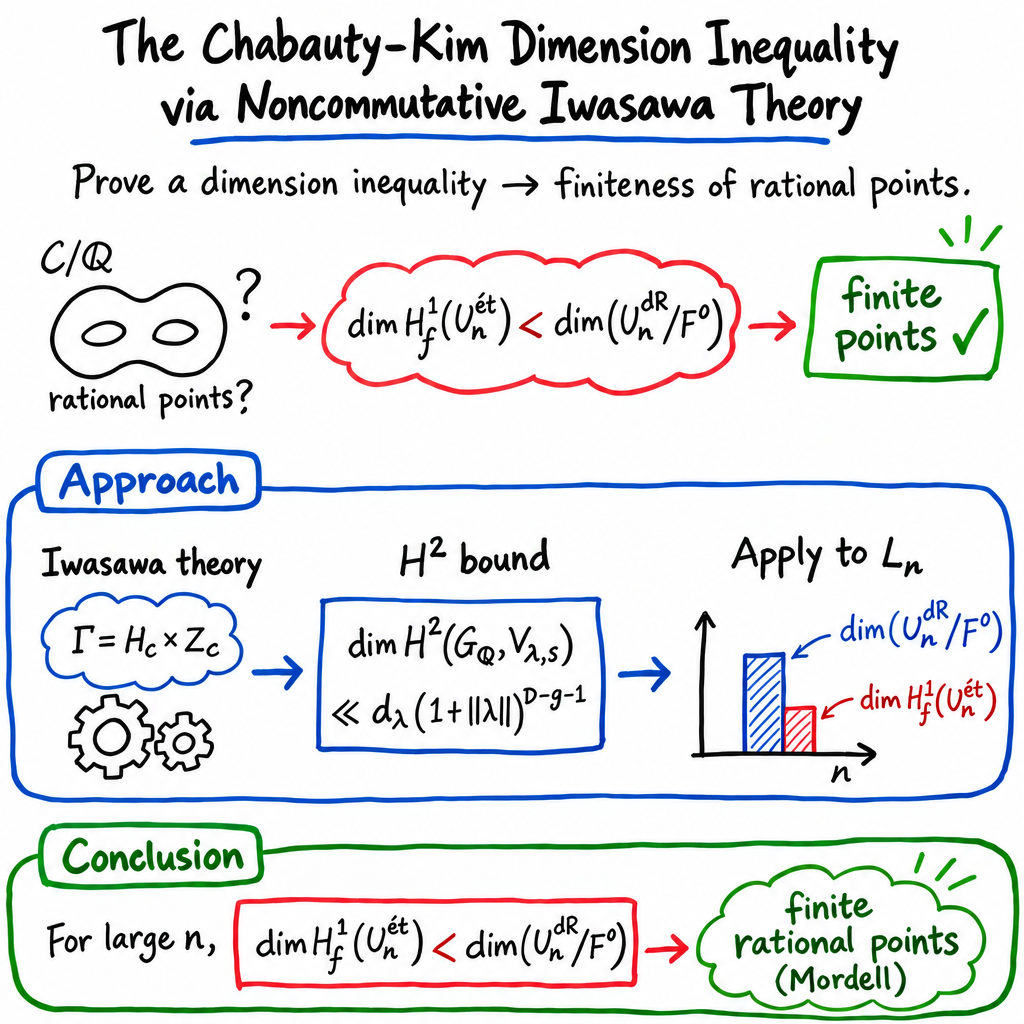
Abstract: We establish Kim's conjectural dimension inequality for smooth projective geometrically connected curves of genus at least two with a rational basepoint. For every odd prime of good reduction, we prove that for all sufficiently large , where and are the 'th lower central series truncations of the -pro-unipotent geometric étale, and de Rham fundamental groups of , and is any finite set of places containing , , and the primes of bad reduction. Inspired by Coates and Kim's work on curves with CM Jacobians, we use noncommutative Iwasawa theory to bound second Galois cohomology through dimensions of kernels of certain Iwasawa operators, acting on finite dimensional representations of the ambient generalized symplectic group. We establish bounds for these kernels in terms of the highest weight and dimension of the ambient symplectic representation. No restriction is imposed on the Jacobian's geometric endomorphism ring or its Tate-module Galois image. Consequently, the Chabauty--Kim loci are finite at all sufficiently large levels, recovering the Mordell theorem over through the Chabauty--Kim method.
Paper Prompts
Sign up for free to create and run prompts on this paper.
Explain it Like I'm 14
1. What is this paper about?
This paper studies a difficult problem in number theory: understanding the rational and integral points on curves.
A curve is a mathematical object that looks locally like a line or a loop. Some curves have many rational points, while others have only a few. For curves with enough complexity—specifically, curves of genus at least 2—the famous Mordell theorem says that there are only finitely many rational points.
The paper proves that a method called Chabauty–Kim theory can be used for every smooth projective curve of genus at least 2 over the rational numbers. In other words, the paper shows that this method always eventually gives enough information to prove that the curve has only finitely many rational points.
The author does this by combining:
- Galois cohomology, a way of studying how numbers change under symmetries;
- Iwasawa theory, which studies patterns in towers of number fields;
- representation theory, which studies symmetries of mathematical objects; and
- Chabauty–Kim theory, a method for restricting the possible rational points on a curve.
2. What questions does the paper ask?
The main question is:
Can Chabauty–Kim theory always prove that a genus-at-least-2 curve over has only finitely many rational points?
Kim’s method works when one important space has smaller dimension than another. In simplified form, the required inequality is
Here, “global information” comes from studying the curve over all rational numbers, while “local information” comes from studying it near one prime number .
The paper aims to prove that this inequality is true when the curve is examined at a sufficiently high level. The “level” measures how much information from the curve’s fundamental group is being used.
The paper also asks a related technical question:
How large can certain second Galois cohomology groups be?
Controlling these groups is important because their size affects the size of the global information in Kim’s method.
3. How was the research carried out?
The proof uses several advanced ideas. Here is the basic strategy in everyday language.
Studying symmetries of the curve
The paper studies the curve’s fundamental group. In ordinary geometry, a fundamental group records loops in a space. Here, the author uses more sophisticated versions that also remember arithmetic information.
These groups are approximated in stages:
Each higher stage remembers more complicated combinations of loops. This is similar to examining a complicated machine first by its simplest parts, then by increasingly detailed parts.
Passing to a tower of number fields
The author studies the fields obtained by adding the coordinates of the curve’s related abelian variety, especially its powers of -torsion points:
These fields form a growing tower. Iwasawa theory studies how mathematical information behaves as one moves higher and higher in such a tower.
An Iwasawa algebra is used to keep track of the symmetries of this tower. One can think of it as a large algebraic machine that records how all these field extensions fit together.
Replacing cohomology by kernels
The paper shows that the difficult cohomology groups can be related to the kernels of certain operators acting on representations.
A kernel is the collection of inputs that an operation sends to zero. For example, the kernel of “multiply by 3” on ordinary numbers contains only zero. In this paper, the relevant operators are much more complicated, but the idea is similar.
This change is useful because it turns a difficult global arithmetic problem into a problem about how operators act on finite-dimensional spaces.
Using symplectic representations
The arithmetic symmetries act through a group called a general symplectic group. This group describes transformations that preserve a special kind of pairing, similar to how rotations preserve distances.
The paper breaks complicated representations into simpler building blocks, called irreducible representations. This is like breaking a complicated shape into basic pieces that cannot be split any further.
Each piece is described by a list of numbers called a highest weight. The author proves bounds depending on the size of these weights.
Using characters and compact groups
The paper also studies characters. A character is a function that summarizes how a representation behaves under each symmetry.
The author uses facts about the compact group and the orthogonality of characters. Roughly, different basic symmetry patterns behave independently when averaged over the whole group. This helps estimate how often each irreducible representation appears.
The proof also divides the representations into two groups:
- representations with relatively small weights;
- representations with large weights.
The small-weight terms are controlled using a sharper bound. The large-weight terms are controlled using a simpler bound and an averaging argument. Balancing these two estimates gives the final result.
4. What are the main results?
A bound on Galois cohomology
The central technical theorem says that, except for finitely many exceptional weights,
The notation is complicated, but the meaning is straightforward:
The size of the relevant cohomology group cannot grow too quickly compared with the size and complexity of the representation being studied.
Here:
- is the dimension of the representation;
- measures the size of its highest weight;
- is a number depending on the genus .
This estimate is important because it gives the author control over the global arithmetic information used by Chabauty–Kim theory.
A stronger estimate for the curve’s fundamental group
For the th layer of the curve’s fundamental group, the paper proves
where is the dimension of and is a constant.
The factor
gets smaller as grows. This means that, compared with the total amount of information in , the unwanted cohomological information becomes relatively less important at higher levels.
Kim’s dimension inequality
Using this estimate, the author proves that for all sufficiently large ,
In simpler language:
At high enough levels, the global set of possibilities is smaller than the local space in which those possibilities must lie.
This is exactly the condition needed for the Chabauty–Kim method to work.
5. Why are these results important?
When the dimension inequality holds, the global rational points must lie inside the zeros of a nontrivial analytic function. An analytic function is a function that changes smoothly and predictably, like a polynomial or a power series.
On each small -adic neighborhood of the curve, such a function has only finitely many zeros unless it is identically zero. Therefore, there can be only finitely many rational points.
The paper’s main consequence is:
Chabauty–Kim theory proves the finiteness of rational points on every smooth projective curve of genus at least 2 over .
This recovers the conclusion of the Mordell theorem, also known as Faltings’ theorem, through a new method.
6. Possible impact of the research
The results have both theoretical and practical importance.
Theoretically, the paper shows that Chabauty–Kim theory is not limited to special types of curves, such as curves whose Jacobians have extra symmetries. No special condition is required on the curve’s Jacobian or on its Galois image.
Practically, the method can sometimes help find the rational points, not merely prove that there are finitely many. The theory produces equations or functions whose common zeros contain the possible rational points. Solving those equations can reveal the points explicitly.
In short, the paper shows that a powerful method based on arithmetic, symmetry, and analysis works broadly for complicated curves. It provides a general framework for proving that such curves cannot have infinitely many rational points.
Practical Applications
Immediate Applications
- Effective finiteness framework for integral points on curves
- Sector: Number theory, computational arithmetic geometry.
- The paper proves that for every smooth, projective, geometrically connected curve of genus , the Chabauty–Kim dimension inequality holds at all sufficiently large unipotent levels , for every odd prime of good reduction.
- This gives a general-purpose workflow for proving finiteness of -integral points:
- 1. Compute or approximate the Jacobian and its -adic Galois representation.
- 2. Construct the truncated étale and de Rham unipotent fundamental groups.
- 3. Compute the global Selmer image and the Bloch–Kato logarithm.
- 4. Find an algebraic function on vanishing on the global Selmer image.
- 5. Pull this function back through the -adic period map and solve its zeros on residue disks.
- The result provides a theoretical foundation for software implementing higher-depth nonabelian Chabauty–Kim computations.
- Dependencies: Explicit computation remains difficult. One must determine a sufficiently large usable level , construct Selmer conditions, perform -adic integration, and control possible extraneous zeros in the Chabauty–Kim locus.
- A uniform replacement for Jacobian-specific hypotheses
- Sector: Arithmetic geometry.
- The result applies without assumptions on the geometric endomorphism ring of the Jacobian and without requiring the -adic Tate-module image to be particularly large or generic.
- This allows existing Chabauty–Kim workflows to be applied to curves whose Jacobians are not of CM type, are not products of CM abelian varieties, or have otherwise complicated Galois representations.
- Dependencies: The curve must satisfy the stated geometric hypotheses, must be odd and of good reduction, and the relevant Iwasawa-theoretic assumptions used in the proof must be valid.
- Bounds for second Galois cohomology in representation-theoretic computations
- Sector: Galois cohomology, automorphic and arithmetic representation theory.
- For irreducible $\GSp_{2g}$-representations , the paper gives the estimate
outside a finite set of central weights. - This can be incorporated into computational pipelines that estimate Selmer-group dimensions, obstruction spaces, or deformation-theoretic tangent and obstruction groups. - The trivial estimate is available for all weights, while the sharper estimate is available away from finitely many exceptional weights. - Dependencies: The constants are generally ineffective or dependent on the abelian variety, the set of ramified primes, and the chosen prime . The finite exceptional set of weights must also be identified or bounded for concrete calculations.
Algorithmic reduction of cohomology to kernel computations
- Sector: Computational algebra, noncommutative Iwasawa theory.
- The identity
reduces a Galois-cohomology calculation to the computation of kernels of Iwasawa operators acting on finite-dimensional representations. - This suggests practical software tools for: - constructing finite-level approximations to noncommutative Iwasawa algebras; - specializing central variables at representation weights; - computing kernels of specialized operators; - estimating cohomology dimensions using PBW filtrations and central reductions. - Dependencies: Exact computation in noncommutative Iwasawa algebras is technically demanding. Truncation, integral-lattice choices, and control of denominators must be handled carefully.
Representation-theoretic estimation through compact-group character calculations
- Sector: Symbolic computation, harmonic analysis, representation theory.
- The proof uses character theory, orthogonality, Weyl’s unitary trick, Chebyshev-type formulas, and Casimir operators to estimate multiplicities in graded pieces .
- These methods can be used to build computational routines that:
- decompose graded Lie-algebra pieces into $\Sp_{2g}$-irreducibles;
- estimate multiplicities without explicitly constructing every representation;
- calculate second moments of highest weights;
- prioritize the representations most relevant to cohomological obstructions.
- Dependencies: The character formulas are tailored to symplectic groups and to the graded Lie algebra arising from a curve. Generalization to other groups or varieties requires new character estimates.
- Guidance for selecting auxiliary primes
- Sector: Arithmetic computation and experimental number theory.
- Since the theorem works for every odd prime of good reduction, practitioners can select based on computational convenience rather than on CM, rank, or large-image assumptions.
- In practice, one may choose a prime that minimizes:
- the complexity of the reduction of ;
- the cost of -adic integration;
- the size of residue-field computations;
- numerical instability in period-map calculations.
- Dependencies: Although the theorem guarantees eventual applicability, the required level and computational complexity may vary substantially with .
- Research and teaching infrastructure for noncommutative Iwasawa theory
- Sector: Academia and graduate education.
- The paper provides a concrete example connecting:
- -adic Galois representations;
- uniform pro- groups;
- noncommutative Iwasawa algebras;
- universal enveloping algebras;
- Harish–Chandra central characters;
- Hilbert-series estimates;
- nonabelian Chabauty–Kim theory.
- These connections can support graduate courses, research seminars, and computational projects in modern arithmetic geometry.
- Dependencies: The material requires substantial background in algebraic number theory, -adic Hodge theory, representation theory, and derived or nonabelian cohomology.
Long-Term Applications
- A practical algorithm for determining rational and integral points on arbitrary higher-genus curves
- Sector: Number theory and mathematical software.
- The theorem removes the main conjectural dimension obstruction for projective curves over . A mature implementation could turn this into an algorithmic pipeline for enumerating or -integral points:
- automate the construction of ;
- compute global Selmer constraints;
- produce Coleman functions;
- solve their common zero loci on all residue disks;
- certify completeness of the resulting point set.
- Why long-term: The theorem establishes eventual finiteness but does not provide an explicit or efficiently computable bound for the required level , nor does it guarantee that the first practically accessible level is sufficient.
- Dependencies: Effective control of the exceptional weights, explicit Selmer computations, algorithms for nonabelian -adic integration, and certified zero-counting methods are needed.
- Effective recovery of Mordell-type finiteness results
- Sector: Diophantine equations.
- The method could eventually be applied systematically to equations defining high-genus curves, including families of superelliptic, modular, and explicitly presented plane curves.
- A resulting tool could take an equation as input and return:
- a provable finite set containing all rational points;
- a finite set of -integral points;
- -adic certificates showing why no additional points exist.
- Why long-term: The current result is primarily structural and asymptotic. Turning it into a uniformly effective method requires quantitative estimates on , periods, Selmer varieties, and global algebraic functions.
- Extension to number fields
- Sector: Arithmetic geometry and algebraic number theory.
- Analogous dimension inequalities could support nonabelian Chabauty–Kim methods for curves over number fields , potentially yielding finiteness and computational approaches to and -integral points.
- The relevant adaptations would involve:
- in place of ;
- several archimedean and -adic places;
- more complicated local conditions;
- modified Iwasawa modules and Euler characteristics.
- Why long-term: The proof uses arithmetic properties specific to , and the required cohomological and Iwasawa-theoretic bounds over general number fields are not established here.
- Dependencies: Control of Leopoldt-type phenomena, local-global Selmer conditions, ramification, and the structure of the relevant -adic Lie extensions.
- Generalization to other reductive ambient groups
- Sector: Representation theory, arithmetic geometry, automorphic forms.
- The strategy may extend from $\GSp_{2g}$ to other reductive groups by replacing:
- symplectic highest-weight theory with the representation theory of another group;
- the symplectic universal enveloping algebra with the corresponding enveloping algebra;
- the symplectic central reduction with a suitable Harish–Chandra reduction;
- character estimates with compact-form harmonic analysis.
- Possible targets include orthogonal, unitary, or exceptional groups arising from motives and compatible systems.
- Why long-term: The required faithfulness results, filtration estimates, domain properties, and uniform Hilbert-polynomial bounds may not hold in the same form for other groups.
- Applications to broader motivic and nonabelian Selmer problems
- Sector: Motives, -adic Hodge theory, arithmetic geometry.
- The Iwasawa-module method could provide bounds for groups attached to more general geometric or motivic representations, not only those arising from the Tate module of an abelian variety.
- Such bounds could help establish dimension inequalities for nonabelian Selmer varieties associated with:
- higher-dimensional varieties;
- relative fundamental groups;
- mixed Tate or mixed-motive constructions;
- families of curves and degenerating varieties.
- Dependencies: One needs an appropriate ambient -adic Lie group, a torsion Iwasawa module, compatible local conditions, and an analogue of the representation-theoretic kernel estimate.
- Quantitative estimates for the complexity of Chabauty–Kim computations
- Sector: Computational complexity in arithmetic geometry.
- The power-saving estimate
suggests that the relative obstruction contribution decreases with the level . - With further quantitative work, this could lead to complexity models predicting: - how large must be for a given curve; - how many representation types need to be considered; - how large the relevant Selmer varieties are; - when increasing is computationally advantageous. - Why long-term: The current asymptotic bound is not yet an implementation-level complexity theorem and does not directly provide sharp constants or optimal algorithms. - Dependencies: Effective constants, explicit multiplicity estimates, efficient representation decomposition, and numerical control of -adic analytic functions.
Automated discovery of Chabauty–Kim equations
- Sector: Symbolic mathematics and AI-assisted mathematical software.
- The proof identifies a structured route from torsion Iwasawa modules to annihilating operators and then to algebraic functions vanishing on global Selmer images.
- A future system could search for suitable annihilators, central reductions, and PBW-filtered operators automatically, producing candidate Coleman functions for point determination.
- Why long-term: Such automation would require reliable symbolic manipulation of noncommutative power series, certified specialization, and rigorous verification that the resulting functions are nonzero on each residue disk.
- Dependencies: Formal verification, effective annihilator construction, control of exceptional weights, and rigorous -adic analytic zero testing.
- Policy and funding implications for arithmetic-computation infrastructure
- Sector: Research policy and scientific computing.
- The result supports investment in open-source arithmetic-geometry infrastructure, including:
- databases of curves, Jacobians, and good-reduction primes;
- -adic integration libraries;
- nonabelian Selmer and Iwasawa-algebra computation;
- certified arithmetic software;
- reproducible computational notebooks for Diophantine problems.
- Why long-term: The mathematical theorem does not itself produce such infrastructure, but it identifies a broad class of curves for which these tools could eventually have universal relevance.
- Dependencies: Sustained development of specialized software, standardized data formats, independent verification, and collaboration between arithmetic geometers, computational mathematicians, and formal-methods researchers.
Glossary
- Affinoid Verma faithfulness theorem: A faithfulness result asserting that certain affinoid completions of universal enveloping algebras act faithfully on Verma-type modules. “The affinoid Verma faithfulness theorem of Ardakov and Wadsley”
- Bloch–Kato logarithm: A map relating Selmer cohomology classes to de Rham periods in -adic Hodge theory. “the local Bloch--Kato logarithm”
- Chevalley -lattice: An integral lattice in a representation compatible with the action of a Lie algebra or algebraic group. “Fix a Chevalley $\Zp$-lattice ”
- Chabauty–Kim locus: The subset of local points cut out by the global Selmer conditions in Chabauty–Kim theory. “the Chabauty--Kim loci are finite at all sufficiently large levels”
- Coleman function: A -adic analytic function defined using Coleman integration, often on residue disks of curves. “The pullback is a Coleman function”
- Congruence subgroup: A subgroup defined as the kernel of reduction modulo a power of a prime. “define the level congruence subgroup of ”
- Corestriction: A transfer map in Galois cohomology from a subgroup or finite extension to a larger group or base field. “where the transition maps are given by corestriction”
- Descending central series: A filtration of a group obtained by repeatedly taking commutators with the whole group. “For a (pro-)unipotent group scheme , write ... for its (closed) descending central series”
- Geometric generic fibre: The fibre of a scheme over the algebraic closure of the generic point of its base. “the geometric generic fibre of ”
- GSp (general symplectic similitude group): The group of linear transformations preserving a symplectic form up to a scalar factor. “the Galois representation ... factors through $\GSp(V,\omega)$”
- Harish–Chandra character: The character describing how the center of a universal enveloping algebra acts on an irreducible representation. “The center of acts on through the Harish--Chandra character”
- Hochschild–Serre spectral sequence: A spectral sequence relating the cohomology of a group to that of a normal subgroup and its quotient. “It is an immediate consequence of the Hochschild--Serre spectral sequence”
- Iwasawa algebra: A completed group algebra used to study Galois representations over infinite -adic extensions. “We shall refer to the group rings, $\Omega := \Zp[[\Gamma]]$ and as the integral, and rational Iwasawa algebras.”
- Iwasawa cohomology: An inverse limit of cohomology groups over a tower of number fields, with transition maps given by corestriction. “we define the Iwasawa cohomology group”
- Iwasawa module: A module over an Iwasawa algebra arising from arithmetic or Galois cohomology. “We then prove that is finitely generated and torsion”
- Jacobson density theorem: A theorem stating that an irreducible representation of an algebra is dense in the endomorphism algebra of its representation space. “It follows, as a corollary of Jacobson's density theorem”
- Kummer map: A map sending rational or integral points to cohomology classes represented by torsors. “The vertical arrows are the (global and local) Kummer maps”
- Lazard comparison map: A map comparing a completed group algebra of a -adic analytic group with a completed universal enveloping algebra of its Lie algebra. “we introduce the Lazard comparison map”
- Mordell conjecture: The assertion that a curve of genus at least two over a number field has only finitely many rational points. “In particular, Kim's method successfully recovers the Mordell conjecture.”
- Noncommutative Iwasawa theory: Iwasawa theory for nonabelian -adic Lie extensions and their completed group algebras. “we use noncommutative Iwasawa theory to bound second Galois cohomology”
- PBW filtration: The filtration on a universal enveloping algebra by the maximum number of Lie algebra factors in a product, arising from the Poincaré–Birkhoff–Witt theorem. “The universal enveloping algebra is equipped with its ascending PBW filtration”
- Period map: A map associating local points with de Rham or -adic period data. “The diagonal arrow, $\Phi_p: \mathcal{C}(\Zp)\to U_n^\dR/F^0(\mathbb{Q}_p)$ is Kim's period map”
- Pro-unipotent fundamental group: An inverse-limit unipotent algebraic group encoding iterated extensions of the fundamental group. “the pro-unipotent etale and de Rham fundamental groups”
- Rankin trick: An inequality that bounds the contribution of large parameters by inserting a positive power of those parameters. “which we may further bound above, by the well-known Rankin trick”
- Residue disk: A rigid-analytic neighborhood of a point in the special fibre of a curve over a -adic field. “denote by the tube of , also called the residue disk above ”
- Selmer scheme: An affine moduli scheme parametrizing cohomology classes satisfying specified local conditions. “Kim's global and local Selmer schemes”
- Similitude character: A character recording the scalar by which an element of a symplectic similitude group scales the symplectic form. “Write $\nu: \GSp_{2g}(\Qp)\to \Qp^\times$ for the similitude character”
- Tannakian category: A category whose tensor structure and fibre functor allow it to be reconstructed from an affine group scheme. “the (neutral) Tannakian categories of iterated extensions”
- Tate dual: A dual representation twisted by the cyclotomic character, commonly written . “Theorem~\ref{thm:h2-bound} reduces to bounding $\dim_\Qp \Hom_\Gamma(X, V_{\lambda,2-s})$”
- Uniform pro- group: A particularly well-behaved finitely generated pro- group with a uniform -adic analytic structure. “for which $\Gamma := \Gal(K_\infty/K_c)$ is a uniform pro- group”
- Universal enveloping algebra: An associative algebra encoding representations of a Lie algebra. “let denote its (integral) universal enveloping algebra”
- Weierstrass preparation: A factorization principle for power series that separates distinguished polynomial factors from invertible factors. “via a noncommutative Weierstrass preperation-type of an argument”
- Weyl’s unitary trick: A method transferring representation-theoretic questions from a complex reductive group to a compact real form. “Weyl's unitary trick provides the bound”
- Zariski closure: The smallest algebraic subgroup containing a given subset in the Zariski topology. “denote the Zariski closure of $\Gamma_{\mathcal A,p}\subseteq \GSp_{2g,\mathbb{Q}_p}$”
- Zariski dense: Not contained in any proper closed algebraic subset. “these restrictions are all Zariski dense”

