Rebrightening in the Radio: Secondary Flares from Tidal Disruption Events AT2019ehz and AT2019eve
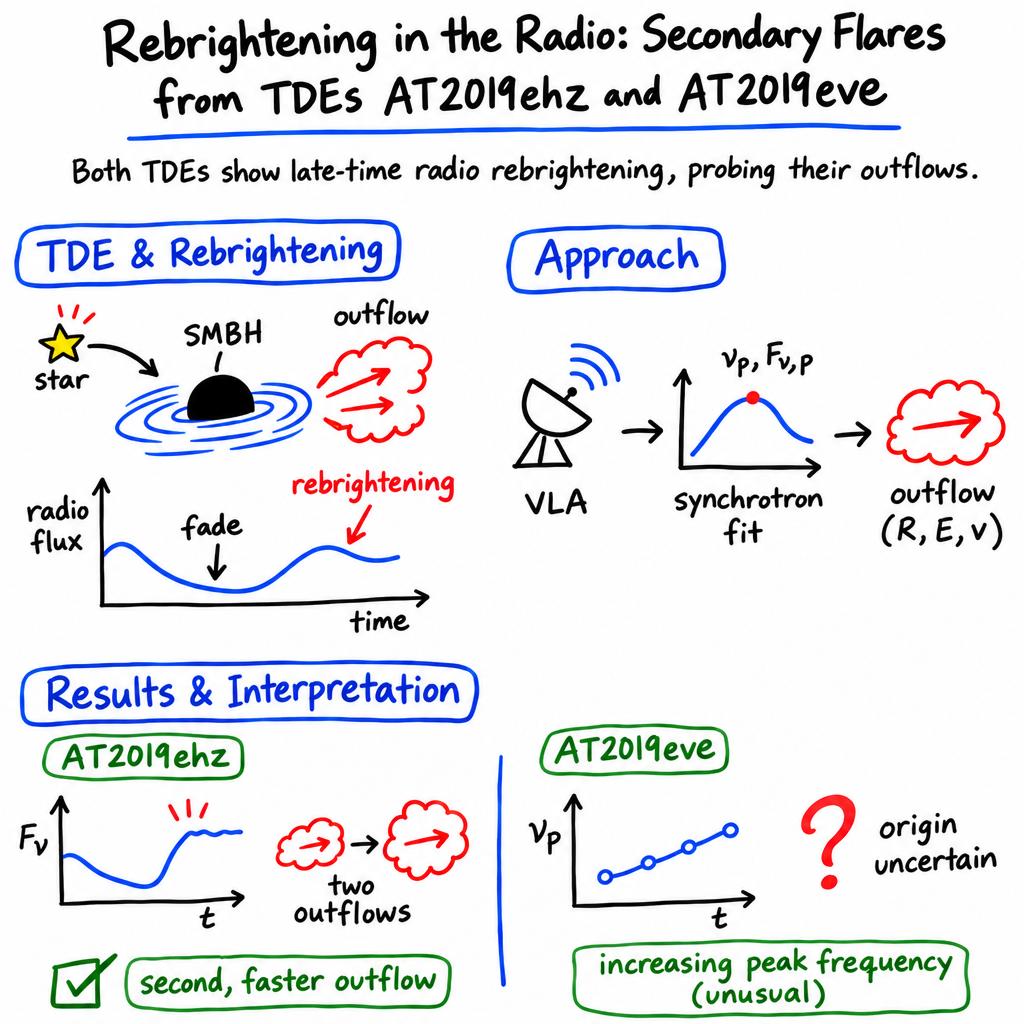
Abstract: We present the discovery of new secondary delayed radio flares from two tidal disruption events (TDEs), AT2019ehz and AT2019eve from observations ranging 1-18 GHz using the Karl G. Jansky Very Large Array. For AT2019ehz, we find a secondary flare in radio emission began at 1545 days post-disruption, 770 days after the first radio flare detected at 775 days post-disruption, and for AT2019eve the secondary flare was detected at 1594 days post-disruption, 825 days after its initial radio detection at 769 days post-disruption. Through spectral modeling of the multi-frequency observations, we extract physical parameters of the new flares to constrain the origin of the rebrightening. We find the secondary flare of AT2019ehz is likely produced by a second outflow launched at roughly 1000 days. For AT2019eve, the secondary flare reveals unexpected spectral evolution with a self-absorbed peak increasing from 1325 to 2173 days post-disruption, which is not well explained with most models of expanding outflows and instead suggests a more complex physical geometry. This inconclusive origin of AT2019eve highlights the need for more complex models to explain observed TDE radio evolution.
Paper Prompts
Sign up for free to create and run prompts on this paper.
Explain it Like I'm 14
1. What is this paper about?
This paper studies two powerful space events called tidal disruption events, or TDEs. A TDE happens when a star gets too close to a supermassive black hole. The black hole’s gravity stretches and tears the star apart, rather like pulling apart soft dough.
When this happens, some of the star’s material can fall toward the black hole, while some material is thrown away in an outflow. These outflows can produce radio waves.
The researchers studied two TDEs:
- AT2019ehz
- AT2019eve
Both events produced radio signals, became fainter, and then suddenly became brighter again years later. This second increase in radio brightness is called rebrightening.
The main purpose of the paper was to find out what caused these delayed radio flares.
2. What questions did the researchers ask?
The researchers wanted to answer several main questions:
- Are the new radio flares real? In other words, were the objects truly getting brighter again, or could the changes be caused by measurement problems?
- Did a second outflow or jet come from the black hole? The first outflow may have happened earlier, so the researchers asked whether another one was launched later.
- Could the outflows be crashing into denser clouds of gas? A blast wave can become brighter if it runs into extra material around the black hole.
- Do the two TDEs behave in the same way? Similar-looking radio flares might have completely different causes.
- What can these events teach us about black holes and how they produce outflows?
3. How did the researchers investigate this?
Observing radio waves
The team used the Karl G. Jansky Very Large Array, or VLA, in New Mexico. The VLA is a group of radio telescopes that work together like one very large telescope.
They observed both TDEs at several radio frequencies between about 1 and 18 gigahertz. Observations were taken over several years, from 2023 to 2025, and were combined with older observations.
This allowed the researchers to make light curves. A light curve is a graph showing how bright an object is over time.
Studying the radio spectrum
The researchers also compared the brightness at different radio frequencies during each observation. This creates a spectrum, which is similar to comparing how loud different musical notes are.
The radio emission was assumed to come mainly from synchrotron radiation. This happens when fast-moving electrons spiral around magnetic fields and release energy as radio waves.
The researchers fitted mathematical models to the spectra. The models helped estimate:
- The size of the radio-emitting region
- Its energy
- The strength of its magnetic field
- The number of energetic electrons
- The density of the surrounding gas
- How fast the outflow was expanding
They used a method called Markov chain Monte Carlo, or MCMC. In simple terms, this is like trying many possible answers and gradually finding which answers best match the observations.
They also used an equipartition model. This assumes that the energy is shared in a fairly balanced way between the magnetic field and the energetic particles. It is similar to estimating the size of a campfire by studying how much heat and light it produces.
4. What did they discover?
Both TDEs became bright again
Both objects showed a second radio flare about four years after the original disruption.
| Object | First radio detection | Second radio flare | Main behavior |
|---|---|---|---|
| AT2019ehz | About 775 days after disruption | About 1545 days | Brightened by about a factor of 2, then mostly leveled off |
| AT2019eve | About 769 days after disruption | About 1594 days | Brightness continued increasing for much longer |
The radio brightness of each object increased by roughly a factor of two when the second flare appeared.
AT2019ehz probably had a second outflow
The evidence suggests that AT2019ehz experienced two separate outflows.
The first outflow was probably launched around 400 days after the disruption. The second appears to have been launched around 1,070 days after the disruption.
The researchers reached this conclusion because:
- The outflow began expanding much faster after the rebrightening.
- The estimated energy increased after the second flare.
- The radio spectrum changed in a way that may indicate two sources of radio emission being mixed together.
The second outflow may have been faster and more energetic than the first. The researchers think it could have been caused by a later change in the material falling toward the black hole.
AT2019eve behaved in an unusual way
AT2019eve was more difficult to explain.
Normally, as an outflow expands, the peak of its radio spectrum is expected to move toward lower frequencies. This is similar to a balloon becoming larger and thinner: the signal changes in a predictable direction.
However, in AT2019eve, the peak frequency moved from about 1.3 gigahertz to 2.8 gigahertz over several hundred days. This is the opposite of what the usual model predicts.
The model even suggested that the emitting region might be shrinking. That is probably not physically real. Instead, it likely means that the simple model does not describe what is happening.
Possible explanations include:
- Several radio-emitting regions overlapping
- A second outflow with a complicated shape
- The outflow hitting dense clouds of gas
- A delayed change in the black hole’s feeding activity
- A more complex jet or outflow geometry
At present, the researchers cannot choose one explanation with confidence.
5. Why are these findings important?
These results show that radio emission from TDEs can remain active and change dramatically for many years. A TDE is not necessarily a single flash that quickly fades away. It may produce several different outflows at different times.
The findings are especially important because they suggest that:
- Black holes may launch outflows more than once.
- The timing of outflows may be connected to changes in how matter falls into the black hole.
- The space around a black hole may contain uneven clouds of gas that affect the radio signal.
- One simple model may not explain every TDE.
The study also shows why repeated observations matter. If scientists had stopped observing these objects after the first radio flare, they would have missed the second flares entirely.
6. What could this mean for future research?
The researchers conclude that AT2019ehz is most likely explained by a second outflow launched later, while AT2019eve needs a more complicated explanation.
Future radio observations could reveal whether AT2019eve’s unusual peak-frequency behavior eventually returns to the normal pattern. Scientists also need better models that can include:
- Multiple outflows
- Different outflow shapes
- Clumpy gas around the black hole
- Delayed changes in black-hole feeding
- Several radio-emitting regions at once
In simple terms, this research shows that black holes can produce changing and repeated cosmic fireworks. By watching these events for many years, scientists can learn more about how black holes eat stars, launch powerful outflows, and affect the space around them.
Practical Applications
Immediate Applications
- Late-time radio monitoring workflow for TDEs — astronomy and observatories. The paper demonstrates that TDE radio emission can rebrighten roughly 4–5 years after optical discovery, with rapid rises exceeding . Observatories can therefore add scheduled radio observations at approximately 1–5 years after a TDE, rather than ending follow-up after the initial flare. A practical workflow would combine optical discovery alerts with automated VLA or comparable-array monitoring at multiple frequencies, especially 1–10 GHz. Dependencies: telescope time, reliable optical/TDE classifications, sufficient radio sensitivity, and cadence dense enough to distinguish a new flare from ordinary variability.
- Multi-frequency flare-alert pipelines — software and data science.
- flux increases by factors of approximately two or more;
- rise slopes ;
- shifts in the synchrotron peak frequency ; and
- changes in the inferred electron index .
- Such a system could automatically trigger higher-cadence observations when a delayed radio flare is detected. The paper’s use of CASA,
tclean,imfit,imstat, self-calibration, MCMC fitting, and equipartition modeling provides a directly reusable computational template. - Dependencies: calibrated measurement sets, consistent uncertainty estimates, weather and gain-compression corrections, and validation against interstellar scintillation.
- Standardized spectral-energy-distribution fitting — academic radio astronomy. Researchers can apply the Granot–Sari synchrotron model and MCMC inference to construct a uniform catalog of TDE parameters, including , , , equipartition radius, energy, magnetic-field strength, and external density. A shared fitting package could improve comparisons among the growing population of radio-rebrightening TDEs. Dependencies: the assumptions of synchrotron-dominated, nonrelativistic emission; adequate frequency coverage; and careful treatment of correlated and systematic errors.
- Discriminating between physical flare mechanisms — astrophysical observing strategy.
- accelerated inferred expansion and rising kinetic energy favor a second outflow, as in AT2019ehz;
- stable energy with unusual spectral evolution may indicate structured circumnuclear gas or multiple emitting regions, as possibly seen in AT2019eve;
- a rising rather than declining warns that a simple expanding-outflow model may be inadequate;
- low apparent velocities and energies disfavor an off-axis relativistic jet interpretation.
- These diagnostics can guide follow-up allocation across radio, optical, ultraviolet, and X-ray facilities.
- Dependencies: sufficiently sampled spectra, reliable launch-date estimates, and avoidance of overinterpreting equipartition quantities when the model is visibly inconsistent with the data.
- Improved scheduling of long-baseline TDE campaigns — observatory planning and policy. The results support treating TDEs as multi-year transient targets rather than short-duration events. Telescope programs can reserve monitoring epochs around 1,000–2,500 days after disruption and obtain simultaneous or near-simultaneous measurements across L-, C-, X-, and Ku-bands. Dependencies: long-term archive continuity, stable instrument calibration, and coordination among facilities whose observing cycles are usually optimized for shorter transients.
- Training and benchmarking datasets for transient-analysis tools — academia and software development. The two events, together with the broader sample of nine radio-rebrightening TDEs, can serve as benchmark cases for testing flare-detection algorithms, spectral decomposition, uncertainty propagation, and physical-model selection. The data are particularly useful for evaluating whether an algorithm can identify multiple overlapping synchrotron components. Dependencies: publication of calibrated data products, homogeneous metadata, and inclusion of nondetections and upper limits rather than detections alone.
- Public communication and scientific outreach about delayed black-hole activity — education. The findings provide a concrete example of how a stellar-disruption event can continue producing observable activity years later. They can support university teaching modules on synchrotron radiation, black-hole accretion, Bayesian inference, and time-domain astronomy. Dependencies: simplified presentation of model assumptions and clear distinction between established results and unresolved interpretations.
Long-Term Applications
- A population-level diagnostic for black-hole accretion-state transitions — healthcare-independent astrophysics and policy-relevant fundamental research. If delayed radio flares are statistically associated with transitions near a critical accretion rate of approximately $0.02$–, radio monitoring could become a probe of accretion-disk state changes in previously quiescent supermassive black holes. This would connect TDE observations with state transitions known from X-ray binaries and potentially establish a scale-invariant jet-launching threshold. Dependencies: larger samples, late-time optical/UV/X-ray measurements, viscous-timescale accretion models, and improved black-hole-mass estimates.
- Automated physical-model selection for transient events — artificial intelligence and scientific computing. A future tool could compare competing models in real time: a second outflow, density enhancement, delayed accretion-driven wind, off-axis jet, or repeating partial TDE. Bayesian model comparison could use the joint evolution of flux, , , inferred radius, and energy rather than relying on a single light curve. Dependencies: physically complete model libraries, synthetic training data, uncertainty-aware inference, and safeguards against selecting a model solely because it fits an inadequately sampled light curve.
- Three-dimensional and multi-component models of circumnuclear environments — theoretical astrophysics. AT2019eve’s increasing and apparently decreasing equipartition radius demonstrate that one-zone spherical expansion models can produce physically misleading results. Future models could represent clumpy molecular clouds, anisotropic outflows, multiple shock fronts, and overlapping synchrotron-emitting regions. These models may yield new tools for inferring the geometry and density structure of gas near supermassive black holes. Dependencies: computationally expensive radiation-hydrodynamic simulations, broadband observations, and independent constraints on circumnuclear gas from spectroscopy or infrared data.
- A multi-messenger and multi-wavelength TDE early-warning network — astronomy infrastructure. An integrated system could combine optical surveys, radio arrays, X-ray observatories, ultraviolet telescopes, and possibly neutrino or gravitational-wave alerts. A radio rebrightening would trigger targeted searches for delayed optical/X-ray activity, helping test whether the flare is linked to a repeated partial disruption or an accretion-state change. Dependencies: interoperable alert standards, low-latency data exchange, long-term source association, and sufficient sensitivity for faint late-time emission.
- Identification of repeating partial tidal-disruption events — black-hole and stellar-population studies. Continued monitoring could establish whether some radio rebrightenings correspond to repeated stellar passages. Confirming this would create a new observational method for identifying surviving stellar remnants and constraining their orbital dynamics around supermassive black holes. Dependencies: detection of correlated optical, ultraviolet, or X-ray re-flares; dense temporal coverage; and reliable separation of repeated disruptions from environmental radio shocks.
- Improved estimates of energy injection and feedback from low-luminosity black holes — galaxy evolution. The inferred energies of roughly – erg and changing external densities can eventually be incorporated into models of how episodic TDE outflows deposit energy and magnetic fields into the circumnuclear medium. A population study could quantify whether apparently modest TDE outflows contribute meaningfully to the feedback environment of galactic nuclei. Dependencies: better geometric corrections, relaxation of the equipartition assumption , measurements of outflow anisotropy, and a representative TDE population.
- Design of next-generation radio surveys optimized for delayed transients — instrumentation and public research policy. The results motivate survey strategies that retain source histories for many years and revisit archival optical transients at multiple radio frequencies. Future facilities could incorporate automated scheduling for late-time reobservations, enabling discovery of flares that would be missed by surveys focused only on prompt emission. Dependencies: survey sensitivity and field of view, sustainable observing allocations, archival data preservation, and algorithms capable of associating late radio sources with years-old optical events.
- A general framework for separating intrinsic variability from propagation effects — radio astronomy. The paper’s rejection of interstellar scintillation as the explanation for the observed changes can inform broader transient-analysis systems. Combining multi-frequency behavior, angular-size estimates, cadence information, and propagation models could provide a general-purpose classifier for distinguishing intrinsic radio flares from scintillation and calibration artifacts. Dependencies: accurate line-of-sight electron-density models, high-quality calibration, and observations at enough frequencies and epochs to identify propagation signatures.
- Long-term monitoring programs for individual TDE remnants — practical observing protocols. AT2019eve may be entering a transition in which its peak flux and peak frequency begin evolving in a more conventional way, but the available observations are insufficient to decide whether this is physical or an artifact of combining observations taken nearly 50 days apart. A dedicated program obtaining quasi-simultaneous broadband spectra could resolve this ambiguity and establish whether its behavior represents a new class of TDE radio evolution. Dependencies: repeated observations with consistent calibration, simultaneous frequency coverage, and continued monitoring beyond the current time baseline.
Glossary
- Accretion disk: A rotating disk of gas spiraling inward toward a compact object while releasing energy. “the rest of the debris settles into bound orbits that circularize around the SMBH and ultimately form an accretion disk”
- Accretion rate: The rate at which matter falls onto a compact object. “The accretion rate is predicted to continue in a steady decline”
- Bondi radius: The distance from a gravitating object within which its gravity strongly influences the surrounding gas. “at the Bondi radius, the CNM density profile”
- Circumnuclear medium (CNM): Gas and matter surrounding a galaxy’s central supermassive black hole. “Shock interactions with varying density profiles in the circumnuclear medium (CNM) can induce fluctuations in radio luminosity”
- Circularize: To settle into approximately circular orbits, usually through dissipation of orbital energy. “the rest of the debris settles into bound orbits that circularize around the SMBH”
- Equipartition analysis: An analysis that assumes comparable energy shares among different components, such as particles and magnetic fields. “The equipartition radius and kinetic energy are calculated”
- Equipartition radius: The characteristic radius of an emitting region inferred under an energy-equipartition assumption. “The equipartition radius and kinetic energy are calculated”
- Fallback rate: The rate at which stellar debris returns toward the black hole after disruption. “they are modeled with the fallback rate rather than the viscous timescale”
- Gain compression: A nonlinear reduction in the response of a receiver or amplifier at high input levels. “to account for potential gain compression due to a thunderstorm over the array”
- Interstellar scintillation: Apparent variability in a source’s observed intensity caused by scattering through turbulent interstellar plasma. “We have concluded the observed variations could not be explained by interstellar scintillation”
- Kinetic energy: Energy associated with the bulk motion of an outflow. “The equipartition energy follows a similar trend of decreasing energy”
- Luminosity distance: The distance defined so that an object’s observed flux and intrinsic luminosity obey the inverse-square relation. “Here, is the luminosity distance”
- MCMC (Markov chain Monte Carlo): A sampling method that uses correlated random sequences to estimate probability distributions of model parameters. “we estimate the best fit for the parameters , , and using MCMC methods”
- Nonrelativistic: Involving speeds sufficiently below the speed of light that relativistic corrections are not dominant. “In this work, we assume non-relativistic emission”
- Off-axis jet: A relativistic jet whose direction does not point directly toward the observer. “a relativistic off-axis jet are both valid solutions to observed delayed radio flares”
- Optically thin: Describing a medium through which radiation can pass with little absorption or scattering. “the optically thin portion of the spectrum”
- Partial tidal disruption event (pTDE): A tidal disruption in which a stellar core survives and may later return for additional encounters. “where the stellar core survives the initial disruption”
- Power-law index: An exponent describing how a physical quantity scales as a power of another quantity. “where is the power law index of the electron energy distribution”
- Redshift: The fractional shift of spectral features toward longer wavelengths caused primarily by cosmic expansion. “AT2019ehz was optically discovered on 2019. April 29 at ”
- Relativistic electron: An electron whose speed is close enough to the speed of light that relativistic physics is required. “the fraction in the relativistic electrons, ”
- Rebrightening: A renewed increase in emission after an earlier flare has faded. “This new flare of emission, or ‘rebrightening,’ occurs on varying timescales”
- Self-absorption: Absorption of radiation by the same population of particles that produced it. “where is the synchrotron self-absorption frequency”
- Self-calibration: A radio-interferometric calibration technique that uses the observed source data to refine instrumental phase and amplitude corrections. “When needed, further self-calibration was performed”
- Self-absorbed peak: The maximum in a spectrum produced when synchrotron self-absorption transitions to optically thin emission. “the secondary flare reveals unexpected spectral evolution with a self-absorbed peak increasing”
- Spectral energy distribution (SED): The distribution of an astronomical source’s emitted energy as a function of frequency or wavelength. “spectral energy distributions (SEDs) can be constructed to characterize the radio emission”
- Spectral slope: The exponent describing how flux changes with frequency in a portion of a spectrum. “ and are the asymptotic spectral slopes above and below the peak”
- Super-Eddington accretion: Accretion occurring above the Eddington limit, where radiation pressure is expected to oppose gravitational infall. “The light curves were compared to predictions of when a jet may be launched at super-Eddington and sub-Eddington accretion phases”
- Synchrotron radiation: Electromagnetic radiation emitted by relativistic charged particles spiraling in magnetic fields. “radio emission from TDEs is commonly assumed to be dominated by synchrotron processes”
- Tidal disruption event (TDE): An astronomical event in which a star is torn apart by the tidal gravity of a massive black hole. “TDEs occur when a star passes inside the tidal radius of a SMBH”
- Tidal radius: The distance from a black hole within which its tidal forces overcome a star’s self-gravity. “where the tidal forces then exceed the star’s own self-gravity”
- Viscous timescale: The characteristic time for matter in an accretion disk to move inward through viscous transport. “the viscous timescale that the accretion disk evolves on”
- Volume filling factor: The fraction of a modeled volume occupied by emitting material. “ and are the area and volume filling factors”
- X-ray binary: A binary system in which matter transferred from one star accretes onto a compact object and emits X-rays. “This latter behavior mirrors a phenomenon seen in X-ray binaries when accretion disks transition from a soft to hard state”

