Thermodynamics of words
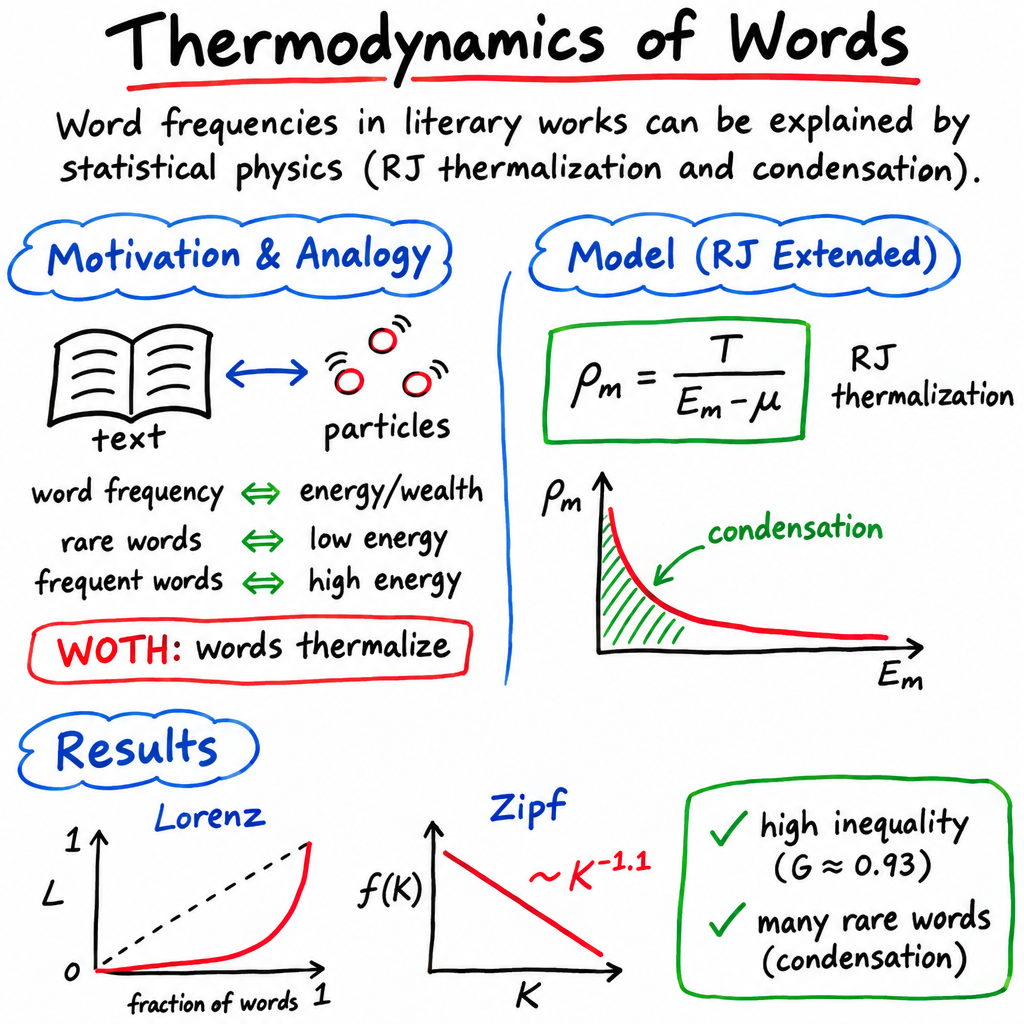
Abstract: We introduce the word thermalization hypothesis according to which in a literary work there are effective interactions between words that drive them to thermalization where their word frequency distribution is the same as for the phenomenon of Rayleigh-Jeans (RJ) thermalization and condensation. In this concept, the different words play a role of classical oscillators (particles) and their word frequencies, or related tokens, are analogous to certain filling factors over energy state levels. The thermalization process is characterized by the conservation of total system energy, or total number of words/tokens, and total probability norm, or total number of different words. We apply this approach to analyze 16 literary works, including Bible, complete works of Shakespeare, and data from American National Corpus. We show that for these cases the effective system energy is very low and thus there is the RJ condensation phenomenon with a big fraction of total probability concentrated at the lowest energy states corresponding to a big fraction of rare words appearing only once or twice in the whole text. Such a RJ condensation is observed for light propagation in multimode optical fibers and other physical systems. We relate the thermalization of words to the recently proposed wealth thermalization for households in world countries. The economy concepts of Lorenz and Pareto curves, and also Zipf curves, are applied to the word frequency distributions of the selected 16 cases and it is shown that the thermalization theory gives a strikingly good description of real data.
Paper Prompts
Sign up for free to create and run prompts on this paper.
Explain it Like I'm 14
1. What is the paper about?
This paper studies how often different words appear in books.
For example, words such as “the,” “and,” or “of” may appear thousands of times, while unusual words may appear only once. The authors compare this pattern with ideas from physics, especially the way energy spreads among particles.
They call their idea the Word Thermalization Hypothesis. In simple terms, they suggest that the meanings and connections between words in a book may act like invisible “forces.” These forces could help create a stable pattern in which a small number of words are used very often and many words are used very rarely.
The paper compares this word pattern with:
- Thermalization, a physics idea describing how systems settle into an overall pattern.
- Condensation, where a large amount becomes concentrated in a small number of places.
- Zipf’s law, the familiar observation that a few words are extremely common while most words are uncommon.
- Wealth inequality, where a small group of people or companies owns a large share of total wealth.
2. What questions are the researchers asking?
The researchers mainly want to know:
- Can the frequency of words in books be described using ideas from physics?
- Do different books and languages show similar patterns of word use?
- Are rare words like “poor households” and common words like “rich households”?
- Can a physics model accurately reproduce real word-frequency data?
- Does this model explain Zipf’s law better than using a simple mathematical curve?
Their central idea is that words can be treated somewhat like objects in a physical system:
- Each different word is like a particle or household.
- How often the word appears is like its amount of “wealth” or energy.
- Very rare words have little “wealth.”
- Very common words have a great deal of “wealth.”
This is an analogy. Words are not literally particles, and books are not literal physical machines.
3. How did the researchers study the problem?
Collecting books and word counts
The researchers examined 16 sets of text:
- 15 literary works or collections of works
- 1 large collection from the American National Corpus
The texts included works in English, Spanish, Italian, German, French, and Russian. They included texts such as the Bible, works by Shakespeare, novels by Jane Austen and Charles Dickens, The Lord of the Rings, Les Misérables, and War and Peace.
For every text, they counted:
- The total number of words
- The number of different words
- How many times each word appeared
For example, imagine a short text:
“Cats like cats. Cats sleep.”
The word “cats” appears three times, while “like” and “sleep” appear once each.
Treating word frequency like wealth
The authors gave each word a value based on its frequency:
Here, is the number of times a word appears. Subtracting 1 means that a word appearing only once receives a value of zero.
The authors then ordered the words from least frequent to most frequent. This is similar to ordering people from poorest to richest.
Using the Lorenz curve
The researchers used a tool from economics called a Lorenz curve.
A Lorenz curve shows how unevenly something is distributed. For wealth, it can show how much money belongs to the poorest 50% or richest 10% of people. In this paper, it shows how much of the total word frequency belongs to the least common or most common words.
The paper also calculates the Gini coefficient, a number between 0 and 1:
- A value near 0 means the distribution is fairly equal.
- A value near 1 means the distribution is extremely unequal.
In this study, a high Gini coefficient means that many words are used only a few times, while a small number of words are used repeatedly.
Comparing the data with a physics model
The authors used a mathematical model called Rayleigh–Jeans thermalization, or the RJ model.
A simple way to imagine this model is to picture a box containing many objects with different energy levels. After interacting for a long time, the objects settle into a predictable pattern.
The researchers adapted this idea to words:
- Energy levels represent possible word-frequency levels.
- The number of words at each level represents how common different frequencies are.
- The model predicts that, when the system has low total energy, many words will collect at the lowest levels.
For words, this means many words should appear only once or twice. The authors call this RJ condensation.
They compared the model with real texts using:
- Lorenz curves
- Pareto curves
- Zipf curves
A Pareto curve shows how many words have at least a certain frequency. A Zipf curve shows how word frequency changes with rank. The most common word has rank 1, the next most common has rank 2, and so on.
4. What did they find?
Word use is extremely unequal
The main result is that word frequencies are highly uneven in all 16 data sets.
The average Gini coefficient was approximately:
This is very high. It means that a large number of different words make up only a tiny part of the total text, while a small number of common words make up most of it.
The authors report that, in most cases:
- The least frequent 50% of words account for less than about 0.5% of the total reduced word frequency.
- The most frequent 10% of words account for about 86% to 96%.
- The most frequent 1% account for about 53% to 76%.
For the American National Corpus, the pattern was even more unequal:
- The top 10% accounted for about 95.6%.
- The top 1% accounted for about 75.9%.
This does not mean that the top 10% of words make up 90% of all individual words in a text. Rather, it means that these common words account for most of the repeated uses of words after the authors’ adjustment.
Many words are “one-time visitors”
Between about 32% and 66% of the different words in the data sets appeared only once.
These words are called hapax legomena, although the paper mainly describes them as words with frequency one. They may include:
- Names
- Technical terms
- Unusual descriptions
- Old-fashioned words
- Words used only because of a particular story or topic
This large group of rare words is what the authors compare with a condensed group at the lowest energy levels in physics.
Different books show similar patterns
Although the books were written by different authors and in different languages, their overall curves were surprisingly similar.
This suggests that word-frequency patterns may have a common structure. The authors interpret this as evidence for a kind of universal “thermal” behavior in language.
The American National Corpus was somewhat different. The researchers suggest this may be because it combines writing from many authors and many styles instead of representing one author or one literary work.
The physics model fits the data well
The extended RJ model matched the real word-frequency data quite closely, especially for:
- The main Lorenz curves
- The Pareto curves
- The Zipf curves
For some examples, such as the Bible, Shakespeare’s works, and Les Misérables, the model followed the data over several orders of magnitude.
The model also reproduced the slight bending of the curves. This is important because the paper argues that word frequencies are not perfectly described by one simple power law across the entire range.
Zipf’s law appears over part of the data
The data roughly follow the well-known pattern called Zipf’s law:
This means that the word ranked second may appear roughly half as often as the most common word, the word ranked third about one-third as often, and so on.
However, the authors say that this rule is only an approximation. The real curves bend and change, especially for very rare and very common words. Their RJ model describes these changes more accurately than a single straight power-law line.
5. Why are these findings important?
The study suggests that word usage may have a regular mathematical structure shared by many different texts.
This could be useful for:
- Understanding why Zipf’s law appears in languages
- Comparing writing styles
- Studying how vocabulary is organized
- Improving computer models of language
- Understanding how rare and common words behave in large text collections
- Comparing language patterns with other unequal systems, such as wealth or company size
The results may also be relevant to artificial intelligence and LLMs, because LLMs divide text into words or smaller pieces called tokens. Knowing how frequently these units appear helps researchers understand how language data are distributed.
6. What does the research not prove?
The paper presents a strong mathematical comparison, but it does not prove that words literally behave like particles or that language obeys the exact same physical laws as matter.
The “interactions” between words are an analogy. They might represent:
- Grammar
- Meaning
- Topic
- Writing style
- Repeated phrases
- The author’s choices
- The way readers and writers use language
Also, the study mainly looks at patterns in already-written texts. It does not directly observe words changing over time because of physical interactions. Therefore, the term “thermalization” describes a useful model rather than a directly observed physical process.
7. Simple conclusion
The paper argues that the way words are used in books resembles the way energy or wealth is distributed in some physical and economic systems.
A few words are used again and again, while a very large number of words appear only once or twice. This pattern is found in many books and languages. A physics-inspired model called the RJ model describes these patterns surprisingly well.
The possible impact is that researchers may gain a new way to study language: not only as a system of meanings and grammar, but also as a large statistical system with its own regular patterns. However, the theory should be viewed as an interesting model and analogy, not as proof that language is literally a physical thermal system.
Practical Applications
Immediate Applications
The paper’s central practical contribution is a reproducible framework for analyzing word-frequency inequality using cumulative frequency curves, Pareto-style distributions, Zipf curves, and fitted Rayleigh–Jeans extended (RJE) models. These applications do not require accepting the thermodynamic interpretation as literally causal; the statistical tools can be used independently.
- Literary and corpus analytics — academia, publishing, and digital humanities
- Compute the frequency distribution of words in a book, author’s complete works, or multilingual corpus.
- Generate a Lorenz-style curve, Gini coefficient, bottom-50% and top-10% frequency shares, Pareto curve, and Zipf curve.
- Use these indicators to compare authorial style, vocabulary concentration, genre, historical period, translation choices, or corpus composition.
- A practical workflow could be implemented as a Python or R package that accepts plain text and returns frequency tables, inequality metrics, fitted RJE parameters, and diagnostic plots.
- Dependency: preprocessing decisions—tokenization, capitalization, stemming, punctuation removal, treatment of inflected forms, and named entities—can substantially change the results.
- Corpus-quality and dataset-composition auditing — NLP and machine learning
- Use the unusually high concentration of frequency mass in a small number of common words as a diagnostic for detecting heterogeneous or mixed corpora.
- For example, the paper reports that the American National Corpus has a higher inequality coefficient than the individual literary works, plausibly because it combines texts from many authors and domains.
- Corpus developers could compare the Gini coefficient and fitted RJE parameters across training-data subsets to identify domain imbalance, excessive duplication, or stylistic mixing.
- Dependency: a high inequality value does not uniquely identify poor corpus quality; it may also reflect legitimate genre, language, or author effects.
- Language-model tokenization and cost analysis — software and AI infrastructure
- Measure how vocabulary frequency is distributed before and after a tokenizer is introduced.
- Compare word-level and subword-level representations using normalized frequency, rank, and tail statistics.
- Use the results to estimate how much of a corpus is concentrated in highly frequent tokens and how much consists of rare or singleton tokens, which can inform vocabulary design, caching policies, and token-budget estimation.
- A monitoring dashboard could track changes in token-frequency inequality between model versions or application domains.
- Dependency: the paper’s analogy between word frequency and token “energy” is conceptual; token price, computational cost, and semantic importance are not determined by frequency alone.
- Rare-word and vocabulary-tail analysis — education, lexicography, and information retrieval
- Identify the proportion of words appearing once or twice and use it to build lists of rare vocabulary, spelling anomalies, technical terminology, or potential OCR errors.
- In educational settings, instructors could select vocabulary items from a text’s frequency tail for advanced reading exercises.
- In lexicography, the same workflow could prioritize candidate dictionary entries or domain-specific terms for manual review.
- Dependency: rare words include both valuable terminology and noise; automated filtering should therefore be followed by contextual or human validation.
- Authorship and stylistic comparison — forensic linguistics and humanities research
- Compare normalized frequency curves, Gini coefficients, and RJE fit parameters across authors or documents.
- Use deviations from an author’s typical curve as a screening signal for mixed authorship, edited passages, plagiarism, or changes in genre.
- This could complement established stylometric features such as function-word frequencies, character n-grams, and syntactic patterns.
- Dependency: the reported study contains a small and nonrandom selection of literary works, so the measures should not be treated as standalone authorship evidence.
- Visualization and reporting of distribution inequality — policy and communication
- Adapt the paper’s Lorenz-style presentation to communicate vocabulary concentration in reports about language access, public communication, or government documents.
- For example, agencies could report how much of a document is represented by its most frequent terms and how large the rare-word tail is.
- This can help distinguish simple-language initiatives from documents that remain lexically specialized.
- Dependency: frequency concentration is not equivalent to readability, accessibility, or semantic complexity; readability indices and user testing remain necessary.
- Reproducible teaching modules — academia
- The analysis provides a compact teaching example linking statistical mechanics, probability, economics, linguistics, and data science.
- Students can reproduce the workflow on books, news articles, social-media samples, or translated texts and examine how the curves change under different preprocessing rules.
- Dependency: the manuscript contains notation inconsistencies and several redacted or corrupted expressions, so educational implementations should rely on the clearly defined empirical procedures rather than copying every displayed equation without verification.
Long-Term Applications
The following possibilities require validation on broader datasets, causal modeling, or integration into operational systems.
- A general-purpose “distribution thermodynamics” toolkit — NLP, economics, and complex-systems research
- Develop a shared software framework for fitting RJE or related constrained-condensation models to word frequencies, wealth, firm sizes, traffic states, network degree distributions, and other heavy-tailed data.
- The toolkit could estimate parameters, confidence intervals, goodness-of-fit statistics, uncertainty from finite samples, and comparisons against alternative models such as lognormal, Yule–Simon, preferential-attachment, or shifted power-law distributions.
- Dependencies: the paper demonstrates descriptive agreement, not proof that nonlinear interactions between words cause thermalization. Model selection must establish whether RJE models outperform simpler statistical explanations.
- Improved language-model vocabulary and sampling strategies — AI and software
- Use the fitted distribution to design adaptive vocabularies that allocate capacity differently to common, medium-frequency, and rare tokens.
- A model could dynamically expand or compress vocabulary regions depending on domain-specific concentration, while preserving important rare terms.
- The same approach might inform sampling schedules that oversample underrepresented but semantically important vocabulary.
- Dependencies: frequency alone does not measure utility, fairness, or semantic coverage. Any adaptive vocabulary must be evaluated for perplexity, downstream accuracy, multilingual performance, and bias.
- Training-data balancing and domain-shift detection — machine learning
- Build a corpus-monitoring system that compares the frequency-inequality profile of training, validation, and deployment data.
- Significant changes in the Gini coefficient, rare-word mass, or RJE parameters could signal domain shift, vocabulary loss, or overrepresentation of a particular source.
- Dependencies: thresholds would need to be learned empirically across many tasks and languages. A change in distribution may be benign if task performance and coverage remain stable.
- Multilingual and translation-quality assessment — computational linguistics
- Compare word-frequency concentration across source texts, human translations, machine translations, and back-translations.
- Excessive concentration could indicate simplification, repetitive phrasing, limited vocabulary, or failure to preserve specialized terminology.
- The method could be combined with semantic similarity and adequacy metrics to produce a translation-diversity profile.
- Dependencies: languages differ in morphology, compounding, word segmentation, and inflection. Cross-language comparisons require language-specific tokenization and normalization.
- Early-warning indicators for information ecosystems — policy and social science
- Apply the method to news, legislative documents, online discussions, or emergency communications to track whether vocabulary becomes unusually concentrated during crises or coordinated campaigns.
- Changes in the rare-word tail and top-frequency share might help identify templated messaging, content syndication, or narrowing public discourse.
- Dependencies: this would be correlational unless validated against independently labeled events. Privacy, platform access, bot activity, and changes in user demographics would affect interpretation.
- Reading-level and curriculum personalization — education
- Combine frequency-inequality measures with learner exposure data to select texts whose vocabulary distributions gradually increase in diversity or rarity.
- A recommendation system could distinguish texts dominated by common vocabulary from texts with a substantial technical or literary tail.
- Dependencies: frequency-based difficulty is incomplete. Syntax, prior knowledge, cultural context, morphology, and learner motivation must also be modeled.
- Human–AI writing assistance and style control — publishing and productivity tools
- A writing assistant could compare a draft’s distribution with a target author, genre, or readability profile.
- It might flag excessive repetition, identify an unusually large rare-word tail, or suggest alternatives while preserving the writer’s intended style.
- Dependencies: stylistic imitation raises copyright, consent, and authorship concerns. The statistical curve should be treated as one style feature among many, not as a complete representation of literary voice.
- Causal testing of the word-thermalization hypothesis — fundamental and computational linguistics
- Construct controlled experiments in which semantic associations, repetition incentives, genre constraints, or author interaction networks are varied while holding corpus size constant.
- Agent-based language-production models could test whether local semantic and syntactic interactions naturally produce the observed low-energy, condensed distributions.
- Dependencies: the current paper infers effective interactions from stationary distributions but does not specify or experimentally verify a microscopic mechanism. Longitudinal and generative evidence is required.
- Policy dashboards for public-language inequality — government and public services
- Agencies could monitor vocabulary concentration in health guidance, legal notices, benefit applications, and emergency alerts.
- Documents with high concentration or a large inaccessible technical tail could be routed for plain-language review, translation, or accessibility testing.
- Dependencies: policy decisions must not reduce vocabulary diversity indiscriminately; specialized terms may be necessary for accuracy. Human review and comprehension testing are essential.
- Cross-domain anomaly detection in financial and organizational data — finance and management
- Because the paper connects word distributions to wealth and market-capitalization distributions, the same fitting machinery could be tested for detecting structural changes in firm sizes, transaction volumes, or organizational activity.
- Abrupt changes in fitted condensation parameters might signal market concentration, mergers, platform dependence, or organizational centralization.
- Dependencies: the analogy between words and wealth does not establish that identical mechanisms operate in markets. Financial use requires out-of-sample validation, robust data, and safeguards against interpreting descriptive concentration as a trading signal.
Glossary
- Algebraic decay: A decrease described by a power-law function of the form . “According to this law the word frequencies decay algebraically with an exponent”
- American National Corpus (ANC): A large annotated collection of American English texts used for linguistic analysis. “data from American National Corpus”
- Canonical ensemble: A statistical-mechanical model in which a system exchanges energy with a heat reservoir while temperature is fixed. “such a system can be replaced (for ) by a grand canonical ensemble”
- Chemical potential: A thermodynamic parameter controlling the expected occupation of energy states or particle number. “where the temperature and the chemical potential are determined”
- Constraint-driven condensation: Concentration of a macroscopic fraction of a conserved quantity in a small subset of states due to system constraints. “the constraint-driven condensation”
- Cumulative distribution function (CDF): A function representing the fraction of observations at or above, or below, a specified value. “the cumulative distribution function (CDF) ”
- Density of states: The number of available states per unit interval of energy. “a constant density of energy states”
- Equipartition: Equal distribution of a conserved quantity among agents, states, or population members. “The perfect equipartition of wealth corresponds to the diagonal ”
- Grand canonical ensemble: A statistical-mechanical ensemble that permits exchange of energy and particles with an external reservoir. “such a system can be replaced (for ) by a grand canonical ensemble”
- Ground state: The state with the minimum possible energy. “a high fraction of total probability in the states in a vicinity of the energy ground state”
- Integrals of motion: Quantities that remain constant during the time evolution of a dynamical system. “there are two exact integrals of motion”
- Jamming: A transition in which interacting components become immobilized or constrained, often preventing flow or rearrangement. “such diverse physical systems as jamming in traffic”
- Lorenz curve: A curve showing the cumulative fraction of total wealth or another quantity held by the cumulative fraction of a population. “This curve represents the dependence of cumulated normalized wealth”
- Microcanonical ensemble: A statistical-mechanical ensemble describing systems with fixed total energy and other conserved quantities. “this type of system corresponds to a special type of microcanonical ensemble”
- Multimode optical fiber: An optical fiber that supports the propagation of multiple spatial or modal light patterns. “light propagation in multimode optical fibers”
- Nonlinear interaction: An interaction whose effect is not proportional to the interacting quantities and can produce complex collective behavior. “the thermalization appears due to nonlinear interactions between particles”
- Optical mode: A distinct spatial or field-distribution pattern supported by an optical system. “a significant fraction of probability is concentrated on a small number of modes”
- Pareto distribution: A heavy-tailed distribution commonly used to model unequal allocations such as wealth or word frequencies. “Usually, this distribution is described by the Pareto distribution”
- Pareto curve: A curve representing the complementary cumulative distribution of a quantity, often on logarithmic axes. “Another useful characteristics, often used in economy studies, is the cumulative distribution function (CDF)”
- Phase: A macroscopically distinct regime or component of a system characterized by different statistical behavior. “The emergence of the phase of very poor households”
- Power law: A mathematical relationship in which one variable varies as a fixed power of another. “power law fits of the type ”
- Probability norm: A conserved sum of state probabilities or squared amplitudes, typically normalized to one. “system energy and the probability norm”
- Rayleigh–Jeans (RJ) condensation: Concentration of a large fraction of total probability or occupation in the lowest-energy states under Rayleigh–Jeans thermalization. “there is the RJ condensation phenomenon with a big fraction of total probability concentrated at the lowest energy states”
- Rayleigh–Jeans distribution: A classical equilibrium distribution describing average occupation of energy states in a thermalized system. “the RJ average”
- Reduced frequency: The word frequency shifted by one so that words occurring once have zero reduced frequency. “a wealth value which represents the (reduced) frequency”
- RJE model: The extended Rayleigh–Jeans model using a nonuniform energy spectrum with an additional parameter. “we introduce the RJ extended (RJE) model”
- RJS model: The standard Rayleigh–Jeans model with a constant density of energy states. “We call this model, the RJ standard (RJS) model”
- Stationary distribution: A probability distribution that remains unchanged under the evolution of a system. “a stationary thermal word frequency distribution”
- Statistical mechanics: The branch of physics that explains macroscopic properties using the statistical behavior of microscopic states. “a more generic phenomenon of statistical mechanics known as the constraint-driven condensation”
- Thermal bath: An external reservoir that exchanges energy with a system and establishes thermal equilibrium. “due to nonlinear interactions between particles or due to a system contact with an external thermal bath”
- Thermalization: The process by which a system evolves toward a statistical equilibrium distribution. “drive them to thermalization”
- Thermodynamic ensemble: A statistical representation of many possible microscopic states subject to specified macroscopic constraints. “this type of system corresponds to a special type of microcanonical ensemble”
- Tokenization: The process of representing text as discrete computational units called tokens. “English words are related to tokens”
- Wealth inequality: Unequal distribution of wealth across individuals, households, or other agents. “the wealth inequality in the world”
- Word Thermalization Hypothesis (WOTH): The paper’s hypothesis that semantic interactions drive word frequencies toward a thermal-equilibrium-like distribution. “we introduce the WOrd Thermalization Hypothesis (WOTH)”
- Zipf curve: A plot of word frequency or a related quantity against normalized rank, often used to examine Zipf-like scaling. “We call the curves for the dependence of on Zipf curves”
- Zipf law: The empirical tendency for word frequency to decrease approximately inversely with rank. “A significant part of research is devoted to the analysis of properties and origins of the Zipf frequency law”